
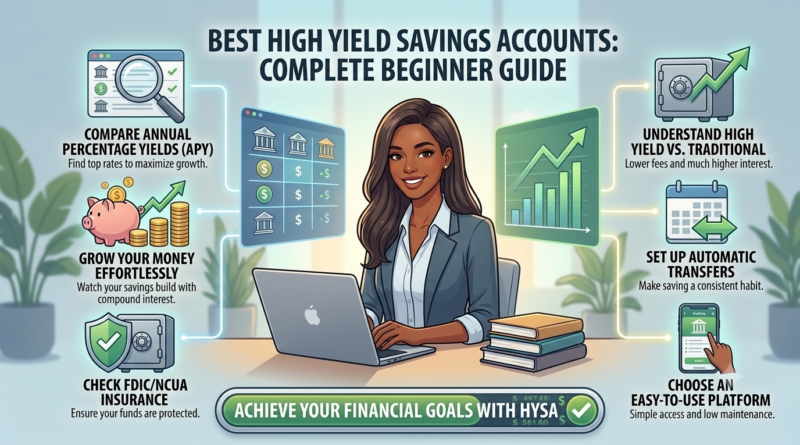
Best High Yield Savings Accounts: Complete Beginner Guide
Imagine finding a safe where you could lock your money away, and every single month, a few extra dollars magically appeared inside it. That is exactly how a high yield savings account works.
If you keep your money in a traditional bank account or under your mattress, it is actually losing value over time due to inflation (the gradual increase in prices that makes your money buy less over time—like how a slice of pizza costs more today than it did ten years ago). To beat inflation, you need your money to grow.
For teenagers and absolute beginners to personal finance, finding the best high yield savings accounts is one of the easiest ways to start building wealth. You do not need thousands of dollars to start, and you do not need to take risky bets on the stock market.
What is a High Yield Savings Account?
A high yield savings account (HYSA) is a type of bank account that pays you a significantly higher interest rate than a standard checking or savings account.
Think of a standard bank account like a bicycle. It gets you from point A to point B, but it moves slowly. A high yield savings account is like a sports car. It uses the exact same road, but it moves your savings forward much faster.
Most traditional neighborhood banks offer interest rates close to 0.01%. That means if you leave $1,000 in the account for an entire year, the bank pays you a grand total of ten cents. Alternatively, the top high yield options offer rates that are often 4% to 5% or higher. With those rates, that same $1,000 earns $40 to $50 a year just for sitting there.
The Magic of APY and Compounding
When shopping around for an account, you will see two common acronyms: APR (Annual Percentage Rate) and APY (Annual Percentage Yield).
- APR: The base interest rate your bank pays you over a year.
- APY: The actual amount of money you earn over a year once you factor in compound interest.
Compound interest is the ultimate financial cheat code. It means you earn interest on your original deposit plus the interest you have already earned. It is a snowball effect:
[ Your Initial Deposit ] ➔ Earns Interest ➔ [ New Total Balance ] ➔ Earns Interest on the New Total ➔ [ Bigger Balance ]
Because of this snowball effect, the APY will always be slightly higher than the APR. When comparing banks, always look at the APY to see how much you will truly earn.
High Yield Savings vs. Regular Accounts vs. CDs
To build a solid financial foundation, you need to understand where to put your cash based on your goals. Let’s break down the three main choices for cash savings.
1. Traditional Savings Accounts
These are the accounts offered by the massive brick-and-mortar banks on your local street corner. They are highly convenient because you can walk inside and talk to a teller, but they pay almost zero interest. They are fine for money you need to spend this week, but terrible for growing your savings.
2. High Yield Savings Accounts (HYSAs)
Usually offered by online-only banks or financial apps, these accounts have minimal overhead costs (no physical branches to pay rent on), so they pass those savings on to you in the form of high interest rates. Your money remains fully accessible whenever you need it.
3. Certificates of Deposit (CDs)
A Certificate of Deposit—often called a “term deposit” outside the US—is an agreement where you leave your money with a bank for a fixed period (like 6 months, 1 year, or 5 years). In exchange, the bank gives you a guaranteed interest rate that is often slightly higher than an HYSA.
The catch? If you touch that money before the time is up, you will pay a harsh financial penalty.
| Feature | Traditional Savings | High Yield Savings Account | Certificate of Deposit (CD) |
| Interest Rate (APY) | Extremely Low (~0.01%) | High (often 4% to 5%+) | High (Fixed rate) |
| Access to Funds | Unlimited or high flexibility | High flexibility (with monthly limits) | Locked until maturity date |
| Penalties | None | None | High fees for early withdrawal |
| Best Used For | Everyday pocket money | Emergency funds & short-term goals | Money you won’t touch for years |
How Digital Apps and Modern Tech Changed the Game
A decade ago, opening a high-yield account meant printing out long physical forms, signing them with a pen, and mailing them to a distant bank. Today, the landscape is completely digital.
The rise of the high yield savings account app means you can open an account on your smartphone in under five minutes. Modern financial technology companies (often called “fintechs”) and neobanks have stripped away the friction of old-school banking.
Features to Look For in a Modern Savings App:
- Automated Round-Ups: Every time you buy a smoothie or a bus ticket with your linked debit card, the app rounds up the purchase to the nearest dollar and sends the spare change directly into your high yield account.
- Savings “Buckets” or “Pockets”: Instead of one giant pool of money, modern apps let you split your savings into specific visual goals inside the app—like “New Laptop,” “Summer Trip,” or “Car Insurance.”
- No Minimum Balances: Old banks used to demand that you keep $1,000 or more in an account just to avoid fees. The best modern apps let you start earning interest with as little as $1.
Is My Money Safe? (A Global Perspective)
When you hear about high interest rates, you might wonder if there is a catch. Is this a gamble?
The answer is no. Unlike investing in stocks or cryptocurrency, money placed in a licensed commercial bank account is protected by government-backed insurance programs. If the bank goes completely out of business, the government steps in and hands your money back to you.
The exact name of this protection changes depending on where you live, but the concept is identical worldwide:
- United States: Protected by the FDIC (Federal Deposit Insurance Corporation). It insures up to $250,000 per depositor, per bank.
- United Kingdom: Protected by the FSCS (Financial Services Compensation Scheme). It protects your savings up to £85,000.
- Canada: Protected by the CDIC (Canada Deposit Insurance Corporation), covering up to $100,000 CAD per category.
- Australia: Protected by the FCS (Financial Claims Scheme), which guarantees deposits up to $250,000 AUD per institution.
Critical Safety Check: Before you open an account with any digital app, read their fine print to verify they are fully covered by your country’s official deposit insurance scheme. If they aren’t insured, walk away.
Step-by-Step Guide: How to Open Your First Account
Ready to start making your money work for you? Follow this step-by-step roadmap to get your account up and running.
Step 1: Research and Compare Rates
Do not just sign up with the first app you see on social media. Use financial comparison websites to find the current highest APY. Look specifically for accounts that advertise “no monthly maintenance fees” and “no minimum deposit requirements.”
Step 2: Gather Your Documents
To verify your identity and protect against fraud, the bank will require a few official details. If you are under 18, you will likely need a parent or guardian to sign up as a joint owner on the account.
- A government-issued photo ID (Passport, Driver’s License, or National Identity Card).
- Your tax identity number (like a Social Security Number in the US, National Insurance Number in the UK, or Social Insurance Number in Canada).
- Proof of your physical address (a utility bill or official letter addressed to you).
Step 3: Fill Out the Digital Application
Download the bank’s official app or visit their secure website. Tap “Open an Account,” select the high yield savings option, and enter your personal details. Use your smartphone camera to snap a clear photo of your ID when prompted.
Step 4: Link an Existing Account and Fund It
To get money into your new account, you will link it to an existing checking account (like the one where your job’s paycheck lands). Input your routing and account numbers, and initiate an electronic transfer.
Step 5: Set Up an Automated Savings Rule
The easiest way to build a massive savings account is to take human willpower out of the equation. Set up a recurring transfer so that $10, $20, or $50 moves automatically from your checking account into your high yield account every single week or month.
Realistic Scenarios: See the Power of High Yield Savings
Let’s look at two hypothetical examples to see exactly how choosing the right account alters your financial path.
Scenario A: Maya’s Traditional School Account
Maya is 16 and gets a part-time job at a local café, earning money to buy her first used car. She opens a standard savings account at the big bank down the street. She manages to save $2,000 and leaves it there for two years while finishing high school.
- The Bank’s Rate: 0.01% APY
- Total Interest Earned After 2 Years: $0.40 (Forty cents)
- The Outcome: Maya’s money sat completely stagnant. Due to inflation, the car she wants actually grew more expensive, meaning her savings lost purchasing power.
Scenario B: Liam’s High Yield Savings Strategy
Liam gets the exact same job and saves the exact same $2,000. However, Liam does his homework and opens an account using a highly rated high yield savings account app. He leaves his money untouched for the same two years.
- The App’s Rate: 4.50% APY (compounded monthly)
- Total Interest Earned After 2 Years: $184.14
- The Outcome: Liam earned nearly $185 absolutely free, just for choosing a smarter place to park his cash. That is extra money he can use for gas, insurance, or car repairs.
Common Pitfalls to Avoid
While high yield savings accounts are exceptionally safe, you can still make mistakes if you don’t read the rules carefully. Watch out for these three traps.
1. Excessive Withdrawal Fees
An HYSA is designed for saving, not daily spending. Many banks restrict you to six withdrawals per month. If you try to transfer money out or pay bills directly from your savings account more than six times in a single statement cycle, the bank may charge you a penalty fee or convert your account into a low-interest checking account.
- The Fix: Keep your daily spending money in a checking account, and only move money out of your savings account when it is truly necessary.
2. Falling for “Teaser” Rates
Some banks use a classic bait-and-switch tactic. They will advertise a massive 5.5% APY to get you to sign up, but if you read the fine print, that incredible rate only lasts for the first three months before dropping down to a mediocre rate.
- The Fix: Look for banks that offer a consistently high, competitive rate for the long haul, rather than a short-term promotional rate.
3. Ignoring Inflation If Saving for Long-Term Goals
While an HYSA is perfect for building an emergency fund or saving for a goal 1 to 3 years away, it is not the right tool for retirement or wealth building twenty years into the future. Over decades, even a high interest rate might struggle to keep pace with inflation.
- The Fix: For long-term goals like retirement, you eventually want to learn how to earn compound interest through investing in diversified stock market indexes. Use an HYSA for your short-term peace of mind, and use investments for your long-term growth.
Pro-Tips for Maximizing Your Growth
- The “Pay Yourself First” Principle: When you receive a paycheck or allowance, do not wait until the end of the month to save whatever is left over. Move money into your high yield account immediately on payday.
- Name Your Accounts: Psychological tricks work. If your app allows you to rename your account buckets, change “Savings Account 1” to something concrete like “My Freedom Fund” or “Concert Tickets.” You will be far less tempted to dip into it for a random fast-food run.
- Keep an Eye on Global Rates: Central banks around the world adjust interest rates based on the state of the economy. This means your high yield account’s APY can go up or down over time. Check in on your bank’s rate a few times a year to ensure they are still offering a competitive deal.
Quick Action Checklist
Print this out or screenshot it to kickstart your savings journey today:
- [ ] Step 1: Look up your country’s official banking protection scheme (FDIC, FSCS, CDIC, or FCS) so you know what safety labels to look for.
- [ ] Step 2: Compare 3 online banks or fintech apps to find the highest current APY with zero monthly fees.
- [ ] Step 3: If you are under 18, sit down with a parent or guardian and explain why a high yield account will earn you more money than a standard account.
- [ ] Step 4: Open the account online and transfer your first deposit (even if it is just $5 or $10 to start).
- [ ] Step 5: Set up an automatic monthly transfer to build your savings effortlessly without having to think about it.