
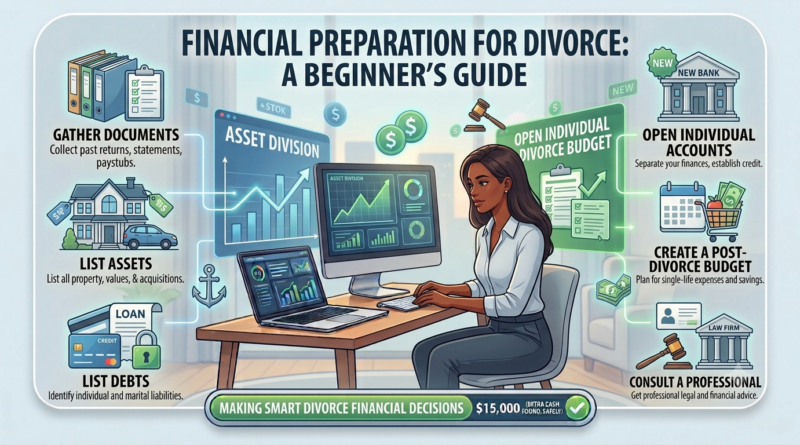
Financial Preparation for Divorce: A Beginner’s Guide
Dealing with the emotional weight of a relationship breakdown is incredibly challenging, but handling the money side of things shouldn’t feel like navigating a maze in the dark. While the emotional fallout of a split is deeply personal, the financial side is strictly business. Taking proactive steps for financial preparation for divorce doesn’t mean you’ve thrown in the towel; it simply means you are protecting your future.
Statistically, separation is one of the most expensive life events you can go through, often forcing a single income to support a household that used to rely on two. Interestingly, taking a clear, structured look at how to prepare for divorce financially can sometimes create a surprising side effect: stability. By removing the constant, toxic arguments about money and getting everything out in the open, some couples actually find the breathing room they need to communicate clearly and achieve reconciliation.
But no matter which path your relationship takes, building a clear financial roadmap ensures you can make calm, informed decisions instead of panicked, emotional reactions. Here is exactly how to take control of your financial reality before you make any final legal moves.
1. Take a Financial Snapshot: The Inventory Shift
The very first phase of your preparation is to establish exactly what you own and what you owe. In the legal world, this is called assessing your marital net worth.
To do this effectively, you need to understand the difference between an asset and a liability.
- Asset: Anything you own that has cash value (e.g., bank accounts, houses, cars, or retirement funds).
- Liability: Any money that you owe to a lender (e.g., mortgages, car loans, student debt, or credit card balances).
Your Marital Assets Checklist
Before speaking with a legal professional, you should gather statements from the last three to six months for every financial account tied to your household. Treat this like an official scavenger hunt:
- [ ] Bank Accounts: Every joint and individual checking or savings account.
- [ ] Retirement and Pension Plans: Workplace retirement funds, personal pension pots, or government-backed retirement accounts.
- [ ] Property & Vehicles: Deeds to your home, land titles, and vehicle registrations.
- [ ] Digital and Liquid Investments: Brokerage accounts, stock portfolios, or digital investment apps.
- [ ] Debts and Obligations: Mortgages, personal loans, lines of credit, and credit cards.
The Golden Rule of Value: Do not guess what things are worth. A vehicle or a boat is a depreciating asset (it drops in value every year), while a house or an investment account is traditionally an appreciating asset (it grows in value over time). Treat them differently during your inventory process.
2. Uncovering the Truth: Credit Reports and “Financial Cheating”
In an ideal world, married couples would share every single financial detail openly. In reality, one of the biggest red flags of a struggling marriage is a breakdown in financial communication.
This often leads to financial infidelity (or financial cheating). This happens when one partner opens secret bank accounts, hides cash, builds up hidden debt, or taps into joint family savings without telling the other person.
   [ Hidden Credit Cards ] ----> Increases Joint Liability
   [ Secret Bank Accounts ] ----> Drains Marital Assets
   [ Unofficial Cash Loans ] ---> Impacts Your Credit Rating
How to Check Your Records
To protect yourself from nasty financial surprises, you need to pull an official copy of your personal credit report. Your credit rating (the score that financial institutions use to see how trustworthy you are with money) tracks every single loan or credit card opened under your name or tied to you jointly.
If your spouse took out a high-interest credit card in both your names and ran up a massive balance without telling you, that debt will show up clearly on your report. Finding this out early allows your legal advisor to argue that you shouldn’t be held responsible for your partner’s solo spending sprees.
3. Gathering Your Paper Trail
If you ever need to apply for a new apartment lease, secure a solo car loan, or file for child or spousal support, you will need concrete proof of your income and financial history.
Do not rely on your partner to hand these documents over down the road once the legal process becomes tense. Start building your secure digital archive right now. Collect and securely store:
- Tax Returns: Your official tax filings from the past three years.
- Proof of Income: Your last three to six consecutive pay stubs or invoices if you are self-employed.
- Household Bills: Utility statements showing what it actually costs to run your household every month (electricity, internet, water, insurance).
4. The Global Reality of Dividing Property
A common myth is that if your name isn’t written on a car title or a house deed, you don’t own it. In most parts of the world, family law operates on the concept of marital property (or relationship property).
Generally, any asset acquired by either partner during the course of the marriage belongs to the marital partnership, regardless of whose name is on the official certificate. However, how this property is split changes depending on your local laws:
- United States: Many states use a system called Equitable Distribution, where a judge divides assets based on what is fair, taking into account how long you were married and who earned what. Other states use Community Property laws, which dictate a strict 50/50 split of everything earned during the marriage.
- United Kingdom: The courts look at the needs of both parties and any children involved. The goal is to divide assets in a way that allows both individuals to transition into independent living, which doesn’t always mean a perfectly even split.
- Canada: Marital property is typically governed by provincial laws, which generally view marriage as an equal economic partnership, leading to an equal division of the value of the property acquired during the marriage.
- Australia & New Zealand: These countries emphasize Binding Financial Agreements and relationship property laws that look closely at both financial contributions and non-financial contributions (like staying home to raise children) to determine an equitable division.
5. Case Studies: Two Approaches to Splitting
Let’s look at how two different approaches to the separation process can lead to completely different financial futures.
Case Study 1: The Reactive Split (Jordan’s Story)
Jordan decided to leave his spouse abruptly during a major argument. He walked out of the house with just a single suitcase, assuming the legal system would sort out the details later.
- The Mistake: Jordan had no copies of their joint bank accounts, tax returns, or mortgage details. His spouse immediately changed the passwords to their online banking portal and drained their joint savings.
- The Outcome: Jordan had to hire an expensive attorney to force his spouse to hand over financial disclosures. It took eight months of costly court battles just to get a clear picture of their assets, leaving Jordan deep in legal debt before the asset division even started.
Case Study 2: The Proactive Preparation (Taylor’s Story)
Taylor realized her marriage was over but spent three months quietly engaging in financial preparation for divorce before making any formal announcements.
- The Process: Taylor securely printed their last three years of tax returns, pulled her credit report, logged every asset on a spreadsheet, and opened a brand-new, individual bank account at a completely different financial institution. She also set aside a small emergency cash fund from her own paychecks.
- The Outcome: When Taylor finally initiated the separation, she handed her legal team a perfectly organized binder. Because there were no hidden assets or missing papers to fight over, the couple was able to settle their asset division quickly via affordable mediation, saving Taylor thousands in court fees.
6. Updating Your Estate Plan and Benefits
When you get married, it is common to name your spouse as the primary beneficiary on all your major accounts. One of the most critical steps in learning how to prepare for divorce financially is updating these legacy designations.
If you don’t change these documents, your ex-spouse could legally inherit your assets if something happens to you, even if you have been separated for years. Make sure to review and update:
- Your Will: Work with an advisor to draft a new will reflecting your current intentions.
- Life Insurance Policies: Change the designated beneficiary to a trusted family member or a trust set up for your children.
- Workplace Benefits: Review your health insurance coverage. If you are currently covered under your spouse’s employer-sponsored healthcare plan, you need to budget for the cost of securing your own independent health insurance once the split is finalized.
Pro-Tips and Common Pitfalls to Avoid
- Pro-Tip: Secure Digital Privacy First. Change the passwords to your personal email accounts, digital banking apps, and cloud storage profiles. If your spouse has access to your tablet or laptop, they can see your communications with advisors or lawyers.
- Pitfall: Hiding Assets or Draining Accounts. Never try to secretly hide cash, transfer property to a friend, or maliciously empty joint accounts out of spite. Modern forensic accountants can track digital footprints easily. If a judge catches you hiding money, you will face severe financial penalties and lose all credibility in court.
- Pro-Tip: Build Solo Credit. If you have never had a credit card or utility bill solely in your name, open a basic, individual credit card right away. Pay it off in full every single month to build an independent credit history, which you will need to buy a home or rent an apartment on your own later.
- Pitfall: Agreeing to a Bad Deal Just to “Get It Over With.” The emotional fatigue of a divorce makes many beginners want to sign the first settlement offer just to find peace. Resist this urge. A hasty agreement can damage your personal finances for decades. Take your time and look at the numbers calmly.
Quick Action Checklist
- [ ] Pull Your Credit Report: Visit an official, free credit tracking portal in your country to check for any hidden debts or joint liabilities.
- [ ] Gather Three Years of Income Proof: Print or download your tax filings and your most recent pay stubs.
- [ ] Open a Solo Bank Account: Set up a brand-new checking and savings account at a completely different bank than the one you use with your spouse.
- [ ] Build an Independent Budget: Create a spreadsheet tracking what it will cost to live completely on your own, including rent, food, utilities, and separate insurance.
- [ ] Prioritize Your Wellbeing: Connect with a licensed therapist or marriage counselor to protect your mental and emotional health throughout this major transition.