
Personal Finance Basics: 5 Simple Steps to Master Your Money
Starting your financial journey can feel like trying to read a map written in a completely different language. Between complex jargon and conflicting advice online, it’s easy to feel overwhelmed. But here is the good news: mastering personal finance basics doesn’t require a math degree.
At its core, managing money is less about complex math and much more about building smart money habits early. Whether you are a teenager earning your first paycheck from a weekend job or an absolute beginner trying to figure out adulting, the rules of the game are exactly the same.
Let’s strip away the corporate fluff and break down how money actually works in the real world, no matter where you live.
1. The Foundation: Tracking and Understanding Your Cash Flow
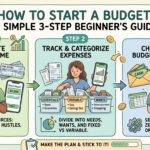
Before you can grow your money, you need to know exactly where it is going. This is where a beginner budgeting guide starts. Think of a budget not as a financial prison sentence, but as a GPS for your cash. It doesn’t tell you that you can’t spend money; it tells you where to direct it so you aren’t left wondering where it went at the end of the month.
Income vs. Expenses
There are two main numbers you need to care about:
- Income: The money coming in (allowance, paychecks, side hustles).
- Expenses: The money going out (streaming subscriptions, food, clothes, transit).
If your expenses are higher than your income, you are bleeding cash. If they are lower, you have a surplus—and that surplus is your ticket to freedom.
The Modern Toolkit for Tracking Money
Gone are the days of keeping crumpled paper receipts in a shoebox. Today, you can automate this entire process using modern digital budgeting tools:
- Budgeting Apps: Apps like YNAB (You Need A Budget), PocketGuard, or local equivalents automatically sync with your bank account to categorize your spending.
- High-Yield Savings Apps: Many modern digital banks (like Revolut, Monzo, Ally, or Tangerine) feature built-in “vaults” or “pockets” that let you split your money the second you get paid.
- The Good Old Spreadsheet: If you love privacy and control, a simple Google Sheet or Excel template works wonders.
Pro-Tip: Try the 50/30/20 Rule. Allocate 50% of your income to Needs (housing, basic groceries), 30% to Wants (eating out, hobbies), and 20% directly to Savings and future goals. If you are a teenager living at home, challenge yourself to flip this: save 70% and spend 30%!
2. The Power of Saving and the “Emergency Fund”
Imagine your car suddenly gets a flat tire, or your laptop screen cracks right before exam week. If you don’t have savings, these minor inconveniences become major financial disasters that might force you to borrow money.
What is an Emergency Fund?
An emergency fund is a stash of cash reserved exclusively for unexpected, urgent expenses. It is your financial safety net.
If you are a beginner or a teen, start small. Aim for a mini-emergency fund of $500 to $1,000. As you get older and take on more bills, expand that to cover 3 to 6 months’ worth of living expenses.
[ Your Income ] ──> [ 50/30/20 Split ] ──> [ 1. Emergency Fund (High-Yield) ]
                                        ──> [ 2. Short-Term Goals (Concerts/Travel) ]
                                        ──> [ 3. Long-Term Wealth (Investing) ]
Where to Keep It: Avoid the Regular Savings Account
Keeping your emergency money in a traditional brick-and-mortar bank account is a mistake. Why? Because they usually pay next to 0% interest. Instead, look for a High-Yield Savings Account (HYSA) or a digital savings app.
Understanding Inflation
You need your money to earn interest to fight against inflation.
What is Inflation? Think of inflation like a slow, invisible thief that makes things more expensive over time. If a slice of pizza costs $3 today, inflation might make it cost $3.50 next year. If your savings account isn’t earning interest, your money is losing buying power. A high-yield account helps your money keep up with these rising prices.
3. Demystifying Credit and Borrowing
Credit is one of the most misunderstood aspects of personal finance basics. Many people will tell you credit cards are evil. Others will tell you to get as many as possible. The truth lies right in the middle: credit is a tool. Used correctly, it’s a power tool; used poorly, it can destroy your financial house.
Credit Ratings Explained
When you borrow money, institutions track your behavior to give you a credit rating (sometimes called a credit score). This is essentially a report card on how trustworthy you are with borrowed money.
| Country | What It’s Called | Excellent Score Range |
| United States | FICO Score | 740 – 850 |
| United Kingdom | Experian / Equifax Score | 800 – 999 (Experian) |
| Canada | Equifax / TransUnion Score | 750 – 900 |
| Australia | Credit Score (Equifax/Illion) | 800 – 1,000 |
How to Build Good Credit Without Trapping Yourself in Debt
If you are of legal age in your country, you can start building your credit rating safely by following a few golden rules:
- Get a Secured Card or Starter Card: These are designed for absolute beginners and often have low limits.
- The “One Subscription” Rule: Put exactly one recurring bill on the card (like your Spotify or Netflix subscription).
- Set Up Auto-Pay: Set your bank account to automatically pay off the full balance of the credit card every single month. Never carry a balance to the next month just to build credit—that is a myth that costs you money in interest.
4. Introduction to Investing: Making Your Money Work For You
Once you have your budget running smoothly and your emergency fund parked safely, it is time to look at the most exciting part of personal finance basics: investing.
Many beginners avoid investing because they think it’s gambling on the stock market. True investing is actually the opposite of gambling—it’s a patient, long-term strategy to build wealth.
The Magic of Compound Interest
The biggest advantage you have right now is time. Time unlocks a financial superpower called compound interest.
What is Compound Interest? Imagine rolling a tiny snowball down a snow-covered hill. As it rolls, it picks up snow. The bigger it gets, the more snow it grabs, until it becomes a massive boulder. Compound interest is when your money earns interest, and then that interest earns interest. Your money starts making its own babies, and those babies have babies.
Let’s look at a realistic scenario to see how compound interest works in action.
Case Study: Maya vs. Liam
- Maya starts investing at age 18. She puts away $100 every month into a diversified index fund yielding an average 8% annual return. She stops contributing entirely at age 28 (investing for just 10 years total, a total of $12,000 out of pocket).
- Liam waits until he is 28 years old to start. He invests the exact same $100 every month for the next 30 years until he turns 58 (investing a total of $36,000 out of pocket).
The Result at Age 58:
Even though Liam invested three times more money out of his own pocket, Maya will still have significantly more money simply because she let her money “snowball” 10 years earlier. That is the power of starting early.
Modern Ways to Start: Micro-Investing
You don’t need thousands of dollars to start investing today. Modern micro-investing platforms allow you to start with as little as $1 or $5 by buying “fractional shares” (tiny pieces of a big stock).
- Look for low-cost Index Funds or ETFs (Exchange-Traded Funds). These are essentially baskets of hundreds of top global companies grouped together. Instead of risking your money on one company, you are betting on the growth of the entire economy.
Look For Tax-Advantaged Accounts
Every country has special, government-approved accounts designed to help citizens save for the future or retirement with major tax breaks.
- United States: 401(k) plans (offered by employers) or IRAs (Individual Retirement Accounts).
- United Kingdom: ISAs (Individual Savings Accounts).
- Canada: RRSPs (Registered Retirement Savings Plans) or TFSAs (Tax-Free Savings Accounts).
- Australia: Superannuation funds.
Always research your local options to avoid paying unnecessary taxes on your investment growth.
5. Common Financial Pitfalls to Avoid
As you build these smart money habits, watch out for these modern traps that are designed to separate you from your cash.
- The “Buy Now, Pay Later” (BNPL) Trap: Services that let you split payments into four easy chunks look innocent. However, they encourage impulsive spending and can quickly pile up into uncontrollable debt if you lose track of them.
- Lifestyle Creep: When you start making more money, it’s natural to want to spend more. If your income goes up by $200 a month, don’t immediately increase your lifestyle costs by $200. Save or invest the difference before you ever have a chance to miss it.
- Chasing “Get Rich Quick” Schemes: Avoid random internet hype, meme coins, or shady financial influencers promising overnight wealth. True wealth creation is boring, consistent, and takes time.
Quick Action Checklist
Ready to take control? Use this step-by-step beginner budgeting guide checklist to kick off your financial journey this week:
- [ ] Step 1: Download a budgeting app or set up a spreadsheet to track everything you spend for the next 30 days.
- [ ] Step 2: Open a High-Yield Savings Account (HYSA) or digital wallet separate from your everyday spending account.
- [ ] Step 3: Automate a small transfer (even if it’s just $10 a week) straight into your new savings account to build your mini-emergency fund.
- [ ] Step 4: Check your local age requirements for credit and investing accounts so you know exactly when you can take the next steps.
- [ ] Step 5: Commit to reading one personal finance article or book chapter a week to keep building your financial confidence.