How to Start a Budget: A Simple 3-Step Beginner’s Guide
Sitting down to map out your money can feel intimidating, but building a personal budget is the absolute baseline of financial freedom. Without a plan, your hard-earned cash tends to evaporate on impulse buys, leaving you wondering where your money went at the end of every month.
If you are a teenager exploring your options, an absolute beginner, or someone ready to build smart investing habits, mastering how to start a budget is the most powerful tool you can own. A budget isn’t a financial prison sentence designed to stop you from having fun; it is a blueprint that puts you in total control of your money instead of letting your money control you.
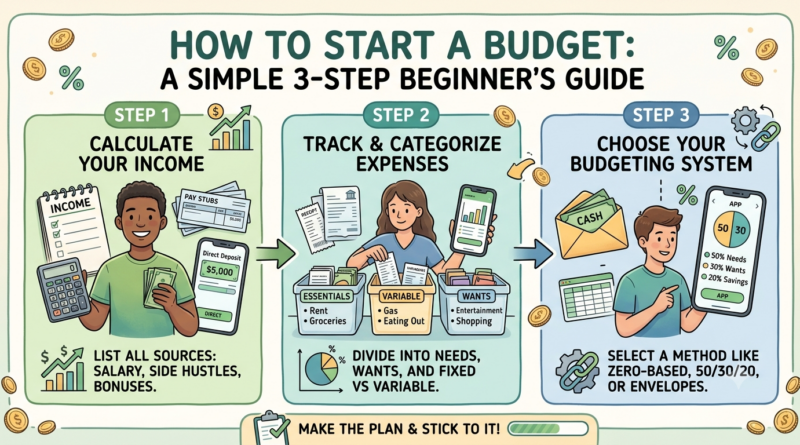
To build a budget that actually works in the real world, you only need to master three fundamental, repeatable phases: Review, Record, and Revise.
Phase 1: Review Your True Expenses
A budget will fail immediately if it is based on wild guesses rather than your actual, real-world spending habits. The first step requires looking backward to see where your money has historically gone.
Leverage Digital Spending Reports
Fortunately, modern technology handles most of the heavy lifting. Log into your online banking app or credit card dashboard and look for an automated “Spending Report” or “Insights” tab. Most modern banks automatically clean up your data, separating your withdrawals into clear visual categories like:
- Groceries
- Restaurants and fast food
- Entertainment and digital subscriptions
- Transportation and fuel
The Cash Blindspot
While digital tools are incredibly fast, they suffer from one major drawback: they cannot track cold, hard cash. If you regularly withdraw cash from an ATM, your bank report will only show the withdrawal itself—not what you bought with it. To fix this blindspot, keep a physical folder for your receipts or make a quick note on your phone whenever you spend physical cash.
Phase 2: Record Your Baseline Cash Flow
Once you have an accurate grasp of your historical spending, it is time to document the math clearly. You can use free online spreadsheet tools like Google Sheets or specialized, secure budgeting apps to simplify this process.
When documenting your cash flow, your goal is to find your Net Disposable Income. This is the exact amount of money left over to allocate toward your personal lifestyle and wealth goals.
[ Your Monthly Take-Home Pay ]
              │
              ▼
    Minus Fixed Bills (Rent, Utilities, Insurance)
              │
              ▼
[ Net Disposable Income (Your Budgeting Canvas) ]
The Golden Rule of Recording
When you document your day-to-day transactions, consistency is everything. Ensure your system captures the date, the vendor, the amount, and the exact reason for the purchase. Many beginner budgets are ruined simply because missing details make it impossible to track accurate weekly trends.
Phase 3: Revise and Choose Your Blueprint
Now that your real-world financial picture is recorded, you can intentionally adjust your future behavior. This is where you transform passive spending into active wealth building. Most people discover they are overspending heavily on retail purchases and dining out.
To bring order to your disposable cash, select a structured budgeting framework that matches your personality.
Option A. The 50/30/20 Framework:
Perfect for beginners who want a simple, big-picture view. You divide your after-tax income into three straightforward buckets: 50% for Needs (rent, groceries, bills), 30% for Wants (dining out, hobbies, shopping), and 20% for Savings and aggressive debt payoff.
Option B. Zero-Based Budgeting:
Ideal for absolute control. With this strategy, every single dollar of your incoming revenue is assigned a specific job before the month starts (e.g., $100 to utilities, $50 to savings, $30 to movies). At the end of your calculation, your income minus your assigned categories must equal exactly zero.
Option C. The Envelope Method (Cash Stuffing):
A highly visual, tactile approach to control variable spending. You allocate strict cash limits into physical envelopes labeled for specific categories like “Gas” or “Groceries.” Once the cash inside a specific envelope is completely empty, your spending in that category stops entirely for the month.
Quick Action Checklist
Ready to build your financial foundation? Complete these five initial steps this week to take control:
- [ ] Step 1: Log into your primary banking portal and download your account statements for the past 60 days.
- [ ] Step 2: Categorize every single transaction into either a “Need” (essential for survival) or a “Want” (discretionary luxury).
- [ ] Step 3: Calculate your total fixed monthly income against your non-negotiable utility and housing bills.
- [ ] Step 4: Pick one framework—whether it’s the 50/30/20 rule, a zero-based app, or physical envelopes—and set a hard spending cap for your highest problem category (like takeout food).
- [ ] Step 5: Set a recurring calendar reminder every Sunday evening to review your weekly spending and verify that you are tracking safely within your targets.