
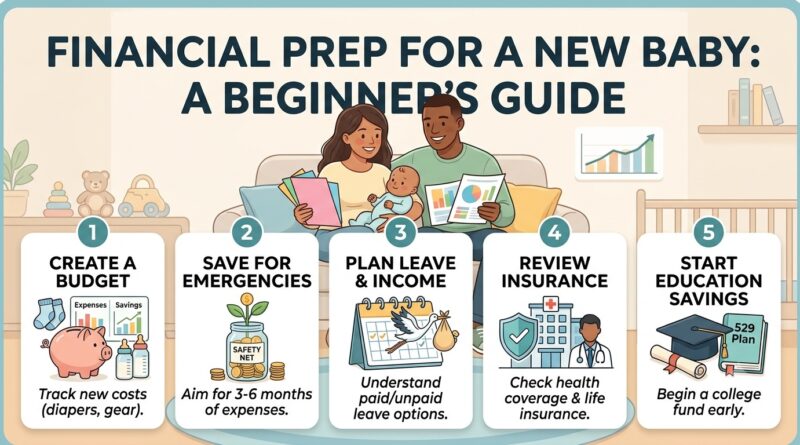
Financial Prep for a New Baby: A Beginner’s Guide
There is nothing that can fully prepare your heart for the overwhelming flood of love you will feel the moment you see your newborn for the first time. However, while the emotional side of parenthood is a beautiful mystery, the financial side doesn’t have to be.
Taking control of your money before your little one arrives ensures that your expanding family hits the ground running on a rock-solid foundation. If you are a young adult looking ahead, an absolute beginner, or expecting a child soon, doing the financial prep for a new baby ahead of time converts a stressful, abstract worry into a clean, actionable game plan.
Let’s cut through the media hype, break down the actual costs, and look at how to set your child up for a wealthy future before they even leave the womb.
1. Grounding Your Reality: The True Cost of Raising a Child
Every year, major economic groups and media outlets publish massive, intimidating statistics about the cost of parenthood. Recent studies show that raising a child from birth through age 17 or 18 in modern times costs a middle-income family roughly $300,000.
Don’t Fall for the Panic Hype: While a $300,000 price tag looks terrifying on paper, remember that you are not writing a lump-sum check for that amount on the day your baby is born. That cost is spread out incrementally over nearly two decades. People have successfully raised happy, thriving children for generations with far less money through smart, tactical planning.
Mapping the Real-World Baseline
To build an effective budget, begin by mapping out your current fixed bills (rent, food, insurance) against your incoming revenue. Then, sketch a simple list of immediate, non-negotiable monthly baby necessities to see how your cash flow will pivot:
| Category | Everyday Essentials | Hidden Upgrades to Watch |
| Daily Consumables | Diapers, wipes, formula | Specialized skin creams, rash treatments |
| Wardrobe | Basic onesies, socks, swaddles | High-end designer outfits (worn twice before outgrown) |
| Nursery & Travel | Car seat (buy new for safety), basic crib | Luxury smart bassinet, motorized strollers |
2. Navigating the “Splurge vs. Save” Dilemma
The baby industry relies heavily on parental anxiety, marketing high-end luxury products by implying they make your child safer or smarter. Steering clear of pricey impulse buys is the fastest way to shield your monthly cash flow from burning out.
1.Sit Down and Communicate
Talk with your partner explicitly about your household financial boundaries. Agree in advance on which 1 or 2 items you will splurge on (like a premium car seat or a top-tier breast pump) and which items you will refuse to buy retail.
2.Source the Second-Hand Market
Connect with friends, family, and local parenting communities online. Babies outgrow clothing sizes and toys in mere weeks, meaning local second-hand shops and online marketplaces are packed with pristine, barely used gear at an 80% discount.
3.Leverage Community Libraries
Before buying an expensive permanent library of children’s picture books or multimedia educational videos, utilize your local public library. Rent them for free first to find out which ones your child actually connects with.
3. Designing Your Child’s Financial Foundation
Once you stabilize your weekly spending patterns, you can begin focusing on long-term wealth building. You do not need to be managing high net worth to use the exact same financial tools the wealthy use to protect their children’s future.
The High-Yield Savings Method
Open a dedicated savings account specifically for your child while you are still expecting. Look for a competitive interest rate through a high-yield savings account (HYSA) or online banking portal.
Set up a modest, automated monthly deposit that fits safely within your long-term household cash flow—even just $25 a month makes a massive dent when compounded over time.
Capitalizing on the Birth
Once your baby is born, the government will issue their official identification (such as a Social Security Number in the US). Use this number to legally transfer the savings account directly into a custodial structure under their name.
When friends and extended family members ask what gifts to buy for baby showers or holidays, direct them to this account. Loved ones are often far more generous when they know their cash gift is bypassing plastic toys and going straight into an interest-earning fund for the child’s future.
Quick Action Checklist
Get your family’s finances organized before the big delivery day with these foundational steps:
- [ ] Step 1: Run a complete audit of your current monthly household income and baseline bills.
- [ ] Step 2: Build a specific “Baby Budget” line item covering diapers, wipes, and pediatric healthcare co-pays.
- [ ] Step 3: Locate the top two second-hand kids’ clothing and gear boutiques in your immediate neighborhood.
- [ ] Step 4: Open a high-yield savings account and automate a comfortable monthly transfer before the due date.
- [ ] Step 5: Review your current life insurance and healthcare policies to ensure your new dependent can be added seamlessly within the standard window after birth.