What Is a Money Market Account? A Beginner’s Guide to Smarter Savings
When you start earning your own money, figuring out where to store it can feel overwhelming. You want a safe place for your cash, but you also want that cash to grow. Leaving all your hard-earned money in a basic checking account is a missed opportunity because it earns virtually nothing.
If you want your savings to pull its weight without locking your cash away for years, you need to understand your options. For teenagers and people brand new to managing money, exploring what is a money market account is one of the best first steps you can take toward building real financial security.
Defining the Money Market Account
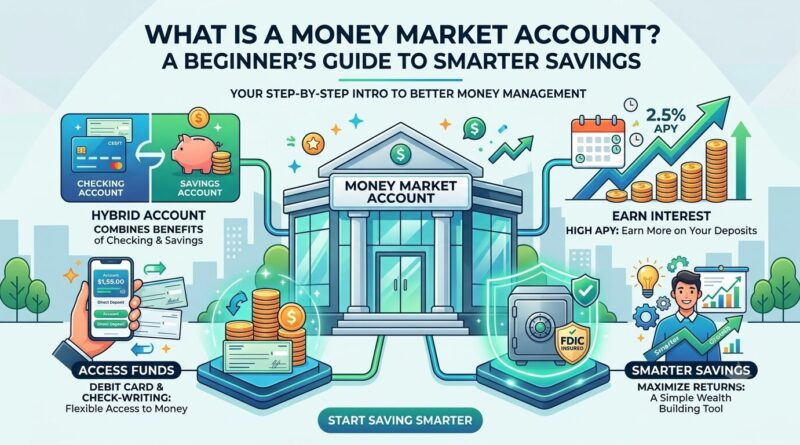
A money market account (MMA) is a hybrid bank account that blends the absolute best features of a checking account and a savings account.
Think of it as a financial Swiss Army knife. It gives you the high interest rates normally reserved for deep savings, alongside the convenient access tools—like a debit card or checkbook—that you usually get with a checking account.
Historically, to get a bank’s top interest rates, you had to choose between two extremes:
- A standard savings account: Easy to access, but it pays very little interest.
- A certificate of deposit (CD): Pays higher interest, but completely locks your money in a vault for months or years.
A money market account lands perfectly in the middle. It gives you a great interest rate while keeping your cash within arm’s reach for short-term goals or unexpected emergencies.
How Money Market Accounts Work
To fully answer the question of what is a money market account, we need to pull back the curtain on how banks operate.
When you deposit money into an MMA, it does not just sit in a dark room waiting for you. The bank pools your money with deposits from thousands of other customers. They use this massive pool of cash to fund low-risk investments and provide loans to other clients who want to buy cars or houses.
Because the bank is carefully screening these borrowers and backing the loans with large physical assets (like the house itself), the risk is exceptionally low. The bank earns money from the interest on those loans, and as a thank you for letting them use your cash, they pass a portion of those earnings back to you in the form of a high interest rate.
The Six-Withdrawal Rule
While an MMA gives you checking-like features like a debit card or the ability to write checks, it is legally classified as a savings product. Because of this, many financial institutions place a limit on your account: you are generally limited to six convenient withdrawals or transfers per month.
If you go over this limit, the bank will charge you a fee. This rule is designed to encourage you to leave your money alone so it can grow, rather than using it to pay for daily items like snacks or video games.
Money Market Accounts vs. Traditional Savings Accounts
While they look similar on paper, a few key distinctions separate a money market account from a traditional savings account.
[ Traditional Savings Account ] ➔ Low Interest Rate ➔ No Checking Features (No Debit/Checks)
[ Money Market Account ]       ➔ High Interest Rate ➔ Checking Features Included (Debit/Checks)
Historically, the biggest differentiator was the barrier to entry. In the past, banks only offered their top-tier money market rates to wealthy clients who could maintain a high minimum balance—often $2,500 to $10,000 at all times. If your balance dipped below that line for even a single day, the bank would hit you with a massive monthly maintenance fee.
Meanwhile, a traditional savings account had very low or zero balance requirements, making it the default choice for teens and beginners.
Fortunately, the banking landscape has completely shifted. The rise of digital banking means you no longer have to be rich to access these financial tools.
The Digital Banking Revolution: Lower Fees, Higher Rates
The internet completely changed how we handle money. Today, online-only banks and financial apps have disrupted the old way of doing business.
Because online banks do not have to pay for expensive physical buildings, electricity, and massive cleaning staffs on every street corner, their operational costs are incredibly low. They take those massive corporate savings and pass them directly to you.
As a result, many modern online banks now offer high interest money market accounts with:
- Zero minimum balance requirements: You can open an account with $5 or $10.
- Zero monthly service fees: You keep every penny of the interest you earn.
- Paperless discounts: Many apps offer their absolute highest rates if you agree to receive digital-only statements instead of paper mail, which further cuts down on waste and overhead costs.
Universal Safety: Is Your Cash Protected?
Whenever an account promises higher interest rates, beginners naturally wonder: Could I lose everything if the bank goes bankrupt?
The answer is a definitive no. Money market accounts are among the safest places on earth to keep your money. Unlike investing in stocks, bonds, or crypto—where your balance can crash overnight based on market whims—your deposits in a legitimate money market account are completely protected by government-backed insurance programs.
No matter how intensely the stock market fluctuates, your principal balance is safe. The name of this protective shield depends entirely on your location, but the rules are highly standardized worldwide:
| Country | Governing Body | Coverage Limit |
| United States | FDIC (Federal Deposit Insurance Corporation) | Up to $250,000 per depositor |
| United Kingdom | FSCS (Financial Services Compensation Scheme) | Up to £85,000 per person |
| Canada | CDIC (Canada Deposit Insurance Corporation) | Up to $100,000 CAD per category |
| Australia | FCS (Financial Claims Scheme) | Up to $250,000 AUD per institution |
Pro-Tip: Always verify the bank’s credentials on their app or website. Look for phrases like “Member FDIC” or “FSCS Protected.” If a financial app cannot prove it is backed by your government’s official regulatory body, do not give them your money.
Case Studies: Real-World Scenarios
Let’s look at how two different people handle their savings to see how choosing the right account impacts real-world goals.
Case Study 1: Chloe’s Emergency Fund Trap
Chloe is 18 and wants to build an emergency fund of $3,000 in case her old car breaks down. She puts her cash into a standard savings account at the local bank where her parents shop.
- The Account Setup: A traditional savings account earning a standard 0.01% interest rate.
- The Reality: Chloe has to transfer money back and forth online just to use it, and after a year, her account has earned a mere $0.30. When her alternator breaks down, she has exactly enough to fix it, but her money did absolutely nothing to help her carry the financial burden.
Case Study 2: Marcus’s Smart Money Strategy
Marcus is also 18 and saving the exact same $3,000 for college textbook expenses and car maintenance. He spends an hour researching online options and opens a top-tier money market account.
- The Account Setup: An online money market account earning a competitive 4.50% interest rate, complete with a dedicated debit card kept safely in his drawer.
- The Reality: Marcus leaves the money alone. Over the course of the year, his account earns roughly $135 in free interest. Even better, when he unexpectedly needs to pay for a lightning-fast car repair, he doesn’t have to wait days for an online bank transfer to clear—he simply pulls out his money market debit card and pays on the spot.
Pitfalls to Avoid with Money Market Accounts
While these accounts are fantastic financial tools, you can easily lose money if you do not pay attention to the fine print. Watch out for these three common traps.
1. The “Bait-and-Switch” Promotional Rate
Online banking is highly competitive, and apps love to use flashy marketing. A bank might advertise a massive, eye-popping interest rate on their homepage. However, if you dig into the fine print, you might discover that this rate is a temporary “teaser” that expires after 90 days, dropping down to a mediocre rate afterward.
- How to avoid it: Always ask a customer service representative or read the terms to find out exactly how long the advertised rate lasts and what the base rate becomes later.
2. Hidden Sneaky Fees
Even if an online bank proudly claims “No Monthly Fees,” they might hide penalties elsewhere. Look out for check-printing fees, paper statement fees, inactivity fees (if you don’t use the account for a year), or strict overdraft penalties.
- How to avoid it: Spend five minutes reviewing the bank’s official “Fee Schedule” page before hitting the sign-up button.
3. Confusing MMAs with Money Market Funds
This is the most dangerous pitfall for beginners. A Money Market Account (MMA) is a bank deposit account protected by government insurance. A Money Market Fund (MMF) is a mutual fund investment offered by investment brokers. While MMFs are generally stable, they are investments, meaning they are not government-insured and carry a tiny amount of risk.
- How to avoid it: Make sure you are opening the account through a regulated commercial bank, not an investment brokerage platform, unless you explicitly want to invest.
The Beginner Quiz: Is an MMA Right for You?
To figure out what type of banking solution will work best for your unique financial profile, ask yourself these four simple questions:
1. What amount do you have for an initial deposit?
If you have a large chunk of savings ($1,000+), traditional banks might give you a great money market rate. If you only have $20, look strictly for an online bank with zero minimum balance rules.
2. How long can you go without accessing your cash?
If you need this money to pay for groceries next week, keep it in a checking account. If you need it for an emergency or a goal 6 to 12 months away, a money market account is perfect. If you don’t need it for years, consider locking it into a CD for a slightly higher fixed return.
3. Do you want the convenience of checks or a debit card?
If you want the psychological barrier of keeping your savings completely separate from your spending tools, a standard high-yield savings account is better. If you want the security of knowing you can spend the money instantly during an emergency, choose an MMA.
4. Are you completely comfortable with banking online?
If you absolutely require a physical brick-and-mortar building where you can walk in and speak face-to-face with a human banker, you will have to accept the lower interest rates of local banks. If you are comfortable managing your cash via a smartphone app, online money market accounts will give you far more value.
Quick Action Checklist
Follow these concrete steps to safely transition your cash into a wealth-building machine:
- [ ] Step 1: Grab a notebook and write down your current savings balance and what you are saving for (e.g., an emergency fund, college, a trip).
- [ ] Step 2: Log into your current bank account, look at your monthly statement, and find your current interest rate. (Warning: It will likely be shockingly low!)
- [ ] Step 3: Research two popular online-only banks and check their money market account pages. Compare their current interest rates and look for the “Member FDIC” (or regional equivalent) logo.
- [ ] Step 4: Check the account’s fee page to ensure there are no monthly maintenance fees or hidden charges for paperless accounts.
- [ ] Step 5: Review your statement every single month moving forward to confirm the bank is accurately paying out your interest and that no unauthorized charges have occurred.