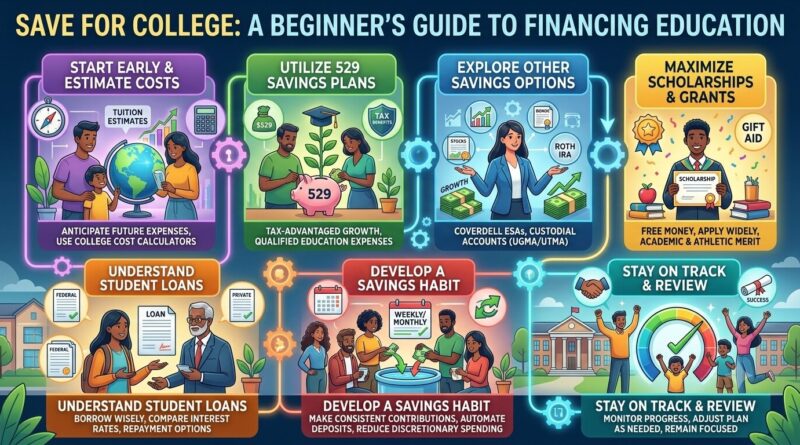
Save for College: A Beginner’s Guide to Financing Education
Thinking about higher education can feel like looking at a massive mountain. You know the view from the top—better career options, higher lifetime earnings, and new experiences—is incredible. But looking at the price tag at the bottom can make your stomach drop.
Here is the good news: you do not need to be a Wall Street math genius to figure out how to save for college. Financing your education is all about starting early, understanding your options, and using modern digital tools to your advantage. Whether you are a teenager planning for your own future or an absolute beginner trying to make sense of money management, this guide will break down exactly how to build a college fund without losing your peace of mind.
Why You Need a Strategy to Save for College Right Now
Let’s address the elephant in the room: the cost of university and college is rising faster than ever. Every year, tuition, textbooks, housing, and food get more expensive due to inflation—which is just a fancy word for how goods and services become pricier over time, meaning your money buys less than it used to.
Because of inflation, waiting until the last minute to find money for school usually leads to heavy borrowing. Taking out massive student loans can trap you in a cycle of debt for decades after you graduate.
The Golden Rule of Higher Education: Saving money is always cheaper than borrowing money. When you save, the money earns interest and grows. When you borrow, you have to pay interest, meaning you end up paying back far more than you originally took out.
If you start to save for college today—even if it is just the equivalent of a few dollars or pounds a week—you give your money time to work for you.
Understanding the Magic of Compound Interest
Before looking at specific accounts, you need to understand the most powerful tool in personal finance: compound interest.
Think of compound interest like rolling a snowball down a hill. When you start, you have a tiny ball of snow. As it rolls, it picks up more snow. The bigger it gets, the more snow it sticks to, growing faster and faster the longer it rolls.
In financial terms, compound interest means you earn interest (free money from the financial institution) on your original savings. Then, the next month, you earn interest on your original savings plus the interest you just made. Over five, ten, or fifteen years, this cycle turns small, regular deposits into a massive fund.
Here is a quick look at how starting early impacts your money, assuming a regular monthly savings habit:
| Age When Starting | Monthly Savings | Years to Grow | Total Estimated Result |
| Child is a Toddler | $50 / £50 | 15 Years | High Growth (Max Snowball Effect) |
| Child is a Pre-Teen | $50 / £50 | 7 Years | Moderate Growth |
| Child is a Teenager | $50 / £50 | 3 Years | Low Growth (Mainly Safety First) |
Where Should the Money Go? Universal Savings Strategies
When families begin to look for ways to save for college, they often get stuck on a big question: Should the savings account be in the parent’s name or the student’s name?
There is no single correct answer, as different structures have distinct pros and cons. Let’s look at the global options available to you, no matter where you live.
1. High-Yield Savings Accounts and Apps
A high-yield savings account is an account, often found at online-only banks or financial apps, that pays a much higher interest rate than a traditional neighborhood bank.
- Pros: The money is entirely safe, easy to access, and grows faster than a standard bank account.
- Cons: The interest rates, while better than traditional accounts, might not fully beat high rates of inflation over a 10-year period.
- Global Examples: You can find these everywhere. In the US, UK, Canada, and Australia, digital banking apps allow you to open these in minutes with zero minimum balance requirements.
2. Tax-Advantaged Savings Accounts
Many governments want to encourage families to save for education, so they offer special accounts that protect your savings from taxes. This means the government won’t take a cut of the profit your money makes while it grows.
- United States: The 529 College Savings Plan or Coverdell ESA. These let you invest money for school without paying taxes on the growth.
- United Kingdom: The Junior ISA (Individual Savings Account). Parents can put money away for children tax-free until they turn 18.
- Canada: The RESP (Registered Education Savings Plan). The Canadian government even chips in matching grants to help your money grow faster.
- Australia: Education Savings Bonds or dedicated investment bonds designed to fund schooling costs.
3. Investing via Micro-Investing Platforms
If university is still 5 to 10 years away, keeping all your money in a regular bank account might mean it loses purchasing power to inflation. Many beginners turn to investing—which means buying tiny pieces of large companies (stocks) or bundles of companies (funds) so your money can grow alongside the global economy.
Modern micro-investing apps let you invest your spare change by rounding up your everyday purchases to the nearest dollar or pound and investing the difference.
Case Studies: Two Paths to Financing School
To see how these choices play out in the real world, let’s look at two different students with different approaches to planning for their future.
Scenario A: Maya’s High-Yield App Strategy
Maya is 15 years old. She knows her parents cannot afford to pay for her entire university degree, so she takes matters into her own hands. She gets a part-time job at a local café and opens a high-yield savings app on her phone.
- The Action: Maya automates her savings. Every single week, $25 is automatically moved from her paycheck into her education fund.
- The Result: By the time she turns 18, Maya has saved nearly $4,000 through her own discipline, plus the interest the app paid her. She uses this money to pay for her textbooks, laptop, and daily transport, massively reducing the amount of money she needs to borrow.
Scenario B: Liam’s Tax-Advantaged Strategy
Liam’s parents started saving for his education using a country-specific tax-advantaged account when he was 8 years old. They deposited $100 a month into a balanced investment fund inside the account.
- The Action: Because they used an investment-focused education account, the money grew at an average rate of 6% per year, completely shielded from taxes.
- The Result: By the time Liam turns 18, the account has grown significantly due to compound interest. Because the account is legally earmarked for education, the funds cover his entire tuition, allowing him to graduate completely debt-free.
Pro-Tips for Maximizing Your College Fund
- Automate Your Savings: Do not rely on your willpower. Set up your banking app to automatically move money into your college fund the day you get paid or receive an allowance. If you never see the money in your main spending account, you won’t miss it.
- Look for Tuition Reimbursement: Many modern employers (including retail stores, fast-food chains, and tech companies) will actually pay for your university tuition if you work for them part-time. Always ask potential employers if they offer tuition assistance.
- Use Digital Budgeting Tools: Use free budgeting apps to track your spending. Cutting out one unused subscription can free up $15 a month to redirect toward your education.
Common Pitfalls to Avoid
The Financial Aid Trap
In many countries, if a savings account is legally registered in the student’s name rather than the parent’s name, the government sees it as a direct asset of the student. When you apply for grants, scholarships, or financial aid, the system might assume the student can pay for school out of pocket, which can drastically reduce the amount of free financial aid you receive.
Fix: Keep the majority of education savings in a parent-controlled account or a dedicated government education plan to protect financial aid eligibility.
The “All or Nothing” Mindset
Many beginners think, “If I can’t save tens of thousands of dollars, there is no point in saving at all.” This is completely wrong. Every single dollar, pound, or euro you save now is one less dollar you have to borrow later with heavy interest attached. Small numbers add up over time.
Quick Action Checklist
Ready to start taking control of your financial future? Follow these four simple steps today:
- [ ] Talk Money: Have an open conversation with your family about who is contributing what to your future education costs.
- [ ] Open the Right Account: Pick a high-yield savings account or a country-specific tax-advantaged education plan.
- [ ] Set Up Automation: Create an automatic transfer of at least a small, comfortable amount of money into that account every week or month.
- [ ] Audit Your Spending: Download a free budgeting app, review your last 30 days of spending, and identify at least one small expense you can eliminate to fund your education goal instead.