What Is a Mutual Fund? A Beginner’s Guide to Investing
If you want to grow your money but don’t want to spend hours reading corporate balance sheets or tracking individual stock prices, you are not alone. For most people, trying to pick individual winning stocks feels a lot like gambling.
Fortunately, the financial world has a built-in shortcut designed for regular people. If you are a teenager starting your wealth journey, an absolute beginner, or someone looking for a beginner portfolio guide, understanding what is a mutual fund is one of the most powerful steps you can take.
Mutual funds are widely considered the easiest entry point into the stock market because they offer a hands-off way to grow your money without the burden of daily management. Let’s break down exactly how they work, how they protect your savings, and how to use them to build smart investing habits.
1. The Core Concept: Pooling Money for Safety
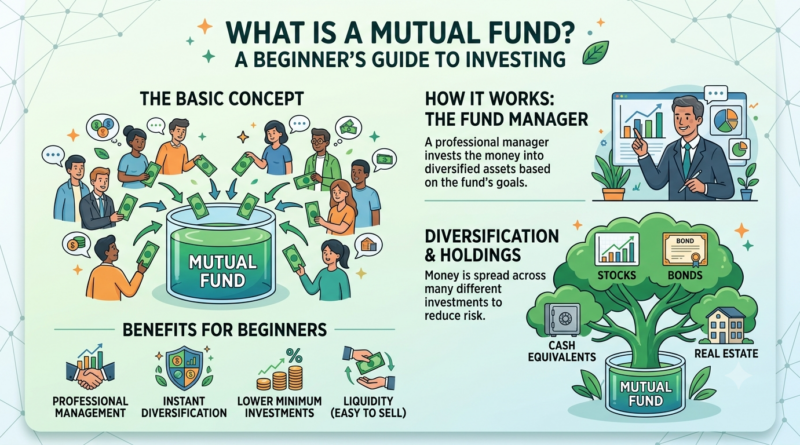
At its core, a mutual fund is a giant financial bucket. An investment company pools together cash from thousands of individual investors (like you) and hands it to a professional fund manager. The manager uses that massive mountain of shared cash to buy a vast, diverse collection of stocks and bonds.
[ Individual Investors ] ───> Pool Cash Together ───> [ Mutual Fund Bucket ]
                                                             │
                    ┌────────────────────────────────────────┴────────────────────────────────────────┐
                    ▼                                        ▼                                        ▼
         [ Global Technology Stocks ]              [ Government Bonds ]                   [ Real Estate Securities ]
When you buy a single share of a mutual fund, you instantly own a tiny slice of every single asset inside that bucket. Instead of relying on the success of just one company, your money is spread across:
- Global companies and fast-growing technology stocks.
- Small, local businesses with high growth potential.
- International bonds and real estate securities.
Why This Matters: The Power of Diversification
If you put all your savings into one company’s stock, and that company goes bankrupt, your money disappears. Diversification is the strategy of spreading your money across hundreds of different investments so you never have all your eggs in one basket.
By using a mutual fund, your risk is automatically allocated. If one company in the fund has a terrible year, the healthy growth of the other hundreds of companies balances out the damage, keeping your overall investment safe.
2. How Mutual Funds Work Daily: Pricing and Dividends
Unlike regular stocks (which bounce up and down in value every single second the market is open), mutual funds work on a much slower, steadier schedule.
Understanding Net Asset Value (NAV)
At the close of the stock market each business day, the fund manager totals up the value of every single asset inside the bucket, subtracts any operational costs, and calculates the exact value of the entire fund. This final daily price is called the Net Asset Value (NAV).
The NAV is the official price tag for a single share of the fund on that day. If you want to buy or sell shares, your transaction goes through at this fixed price at the end of the day.
How You Make Money: Distributions
When the companies inside the mutual fund make a profit, that money gets passed directly back to you. Fund owners typically receive payouts twice a year through two different streams:
- Income Distributions (Dividends & Interest):What is a Dividend? Think of a dividend like a loyalty reward from a company. If a corporation makes a profit, they slice up a portion of those earnings and distribute it to their shareholders. A mutual fund collects these cash payments from all its underlying stocks (alongside interest from its bonds) and splits them proportionately among the fund’s investors.
- Capital Gains: If the fund manager sells off some of the fund’s stocks or bonds because they have appreciated (grown significantly in value), those profits are called gains and are paid out to you.
Tax Warning: All dividends and capital gains paid out from a mutual fund are legally considered income. Even if your app automatically reinvests that cash back into the fund, you must report these earnings on your annual tax return!
3. The Automation Secret: Dollar-Cost Averaging
You do not need to time the market perfectly to build massive wealth. Trying to guess when prices are at their absolute lowest is a losing game. Instead, smart investors use a strategy called dollar-cost averaging.
1.Set an Automated Schedule
You instruct your investment app or bank to automatically withdraw a fixed amount of money (e.g., $50) from your checking account every single month.
2.Buying When Prices Are High
During a month when the stock market is booming and fund prices are high, your fixed $50 automatically buys fewer shares of the fund.
3.Buying When Prices Are Low
During a month when the market drops and prices are low, your fixed $50 automatically buys more shares on a discount.
4.The Long-Term Result
Over time, this completely removes the guesswork. You automatically end up buying more shares when they are cheap and fewer when they are expensive, securing an excellent average price for your portfolio.
4. Understanding the Risks and Regulations
While mutual funds are a fantastic tool, they are not magical money trees. You must be aware of the real-world rules before you dive in:
- No Guaranteed Profits: There will be years when a mutual fund fails to make a profit due to broad economic downturns. If the entire stock market drops, your fund’s value will drop too. Past performance never guarantees future results.
- No Insurance Safety Net: Unlike a regular bank savings account, your investment is not insured by government bodies like the FDIC (or equivalent systems globally). If the fund loses value, that loss is unprotected.
- The Regulatory Guardrails: While your money isn’t insured against loss, the industry is strictly policed. In the United States, funds are regulated by the Securities and Exchange Commission (SEC) to ensure investment companies are completely transparent, honest, and auditable. Similar watchdogs protect investors globally, such as the FCA in the UK and ASIC in Australia.
Quick Action Checklist
Ready to add mutual funds or ETFs to your financial toolkit? Use this beginner checklist to get started safely:
- [ ] Step 1: Research 2 to 3 reputable investment companies or micro-investing apps available in your country.
- [ ] Step 2: Look at the fund’s “Expense Ratio” (the annual fee the manager takes to run the bucket). Aim for low-cost index options with fees under 0.2%.
- [ ] Step 3: Confirm that the fund is well-diversified across multiple sectors (technology, healthcare, finance) rather than focused on just one industry.
- [ ] Step 4: Set up dollar-cost averaging by automating a small monthly transfer straight from your paycheck or bank account into your chosen fund.
- [ ] Step 5: Create a dedicated folder in your email or filing cabinet to store your semi-annual dividend statements for tax season.