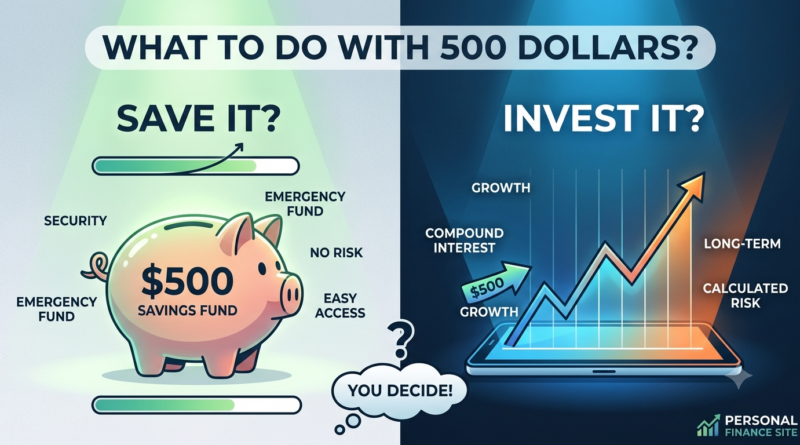
What to Do With 500 Dollars: Save It or Invest It?
Finding unexpected cash is an incredible feeling. Whether it is a tax refund, a birthday gift, or a freelance invoice you completely forgot about, landing a lump sum feels like “free money.” Your first instinct might be to plan a major shopping spree or a fun weekend trip.
However, the golden rule of personal finance is simple: give every dollar a specific purpose so your assets work for you. If you are a teenager starting your financial journey, an absolute beginner, or someone wanting a clear beginner portfolio guide, figuring out what to do with 500 dollars is the perfect sandbox for building smart investing habits.
A $500 windfall is a tool that can upgrade your security, eliminate stress, or seed future wealth. Let’s look at the absolute best ways to put that money to work based on your current financial situation.
1. Prioritize Your Foundation: Debt & Emergency Savings
Before you think about buying stocks or volatile assets, you must secure your financial perimeter. If you do not have a safety net, your $500 belongs in a guaranteed savings structure.
[ Your $500 Windfall ]
          │
          ├───> No Emergency Fund? ──────> [ High-Yield Savings Account ] (First Installment)
          │
          └───> Have High-Interest Debt? ─> [ Credit Card / Loan Payoff ] (Stop Hefty Interest)
Build a Starter Emergency Fund
A fully funded emergency stash should cover 3 to 6 months of your basic living expenses. If you don’t have one yet, use this $500 as your very first installment.
- Why it matters: The next time your car breaks down or an unexpected bill arrives, you won’t have to rack up high-interest debt on a credit card. You simply dive into your fund, pay the bill, and rebuild the balance later.
Eliminate Toxic Debt
If you owe money on high-interest credit cards, throwing $500 at the balance is one of the smartest investments you can make. Paying off a credit card with an 18% interest rate is functionally identical to earning a guaranteed 18% return on your investment. Becoming debt-free unlocks true financial freedom, allowing your future earnings to stay in your pocket rather than covering interest fees.
2. Introduce Your Cash to the Stock Market via ETFs
If your bills are covered and your emergency fund is stable, $500 is the perfect amount to kickstart a long-term investment plan. You do not need thousands of dollars or complex corporate data to participate in the stock market.
Instead of trying to pick individual stocks, look into an Exchange-Traded Fund (ETF).
What is an ETF? Think of an ETF like a pre-packaged basket of stocks traded on the stock market. When you buy a single share of an ETF, you instantly own a tiny portion of hundreds of different companies at once, giving you automatic diversification.
The Power of the S&P 500
An S&P 500 ETF tracks the performance of the 500 largest, most reliable publicly traded corporations in the United States. It is a favorite tool for both beginners and experienced investors because it keeps your fees incredibly low.
The three most popular, highly reputable ETFs that mirror the S&P 500 are:
- VOO (Vanguard S&P 500 ETF)
- IVV (iShares Core S&P 500 ETF)
- SPY (SPDR S&P 500 ETF Trust)
3. Fund Your Long-Term Goals
You can also use a $500 windfall to get a massive head start on milestone goals that usually feel too distant to worry about.
- Supercharge Retirement: It is never too early to start saving for retirement. Depositing $500 into a Roth IRA (an individual retirement account) gives your money decades to compound completely tax-free. Alternatively, putting it into a workplace 401(k) might trigger an employer match, instantly doubling your cash.
- Seed a College Fund: If you have children or plan to start a family, you can use a 529 Plan to seed a dedicated education fund. Higher education costs are notoriously intimidating, and giving your kids a head start blocks future student loan debt before it starts.
- Invest in Yourself: Sometimes the best return on investment comes from upgrading your own skills. Spending $500 on a professional certification course or specialized training can directly prepare you to ask for a raise or pivot into a higher-paying career path.
4. Protect Your Everyday Environment
If your investments are already running smoothly, consider using your $500 to tackle physical upgrades that save you money on your daily bills.
Option 1.Preventative Vehicle Maintenance
Basic car services like getting new tires, changing worn brake pads, or replacing filters keep your current car running safely. Spending $500 on maintenance now prevents a catastrophic mechanical breakdown that could cost thousands down the road.
Option 2.Energy-Efficient Home Adjustments:
Minor household fixes pay massive dividends. Cleaning out your heating ducts, weather-stripping drafty doors, or fixing leaking plumbing faucets drop your utility bills immediately, easily saving you hundreds of dollars over the year.
Option 3.Routine Health Screenings
Your health is your most valuable asset. Spending money out-of-pocket for preventative dental work, eye exams, or a comprehensive medical physical catches minor issues before they morph into costly medical emergencies.
Quick Action Checklist
Got $500 burning a hole in your pocket? Follow this step-by-step checklist to allocate it responsibly:
- [ ] Step 1: Check your bank account. If your savings balance is under $1,000, move the $500 immediately into a separate high-yield savings account as an emergency shield.
- [ ] Step 2: If savings are secure, look up your highest-interest debt balance and pay it down directly.
- [ ] Step 3: Open a low-cost brokerage account or IRA if you decide the stock market is your best next step.
- [ ] Step 4: Compare the expense ratios of basic index funds like VOO or IVV to ensure you keep management fees as close to zero as possible.
- [ ] Step 5: Automate a small monthly transfer ($25 to $50) to continue growing that initial $500 layout over time through dollar-cost averaging.