
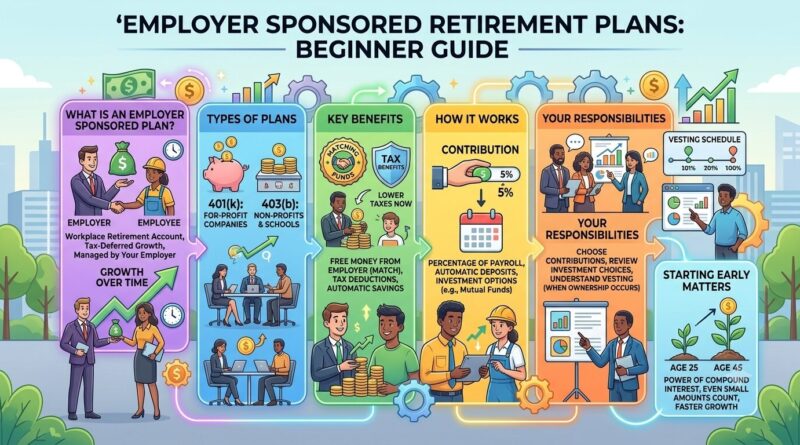
Employer Sponsored Retirement Plans: Beginner Guide
When you receive your very first paycheck from a new job, the immediate temptation is to plan how to spend it. Whether it is buying clothes, upgrading your tech, or paying for a night out with friends, immediate rewards always feel the most satisfying. However, if you rely entirely on the government or a basic bank account to secure your financial future, you might face a harsh wake-up call later in life.
With the ongoing shifts in public pension systems worldwide and the regular increase in the cost of living due to inflation, building personal wealth from day one is essential. Fortunately, one of the easiest ways to secure your future self is by fully leveraging employer sponsored retirement plans.
These special accounts allow you to automatically deduct a portion of your income straight from your paycheck before you ever have a chance to spend it. Instead of letting your cash sit idle, these plans put your money directly into the market where it can grow compound interest—which is the financial equivalent of a snowball gathering size as it rolls down a hill, earning money on top of the money it has already made.
What Are Employer Sponsored Retirement Plans?
An employer-sponsored retirement plan is a savings and investment account set up by a company for its workers. Instead of you having to open a private investment account completely from scratch, your company partners with a financial provider to offer a ready-to-use retirement package.
How the Automatic Deductions Work
The true beauty of these plans lies in automation. When you enroll, you choose a small percentage of your income (like 3%, 5%, or 10%) to save. Every single pay period, the payroll department subtracts that exact amount from your check before the remainder lands in your daily bank account.
Because you never see that money land in your main spending account, you quickly adapt to living without it. It removes human willpower from the equation. It is far easier to build massive savings when the temptation to spend that cash is entirely removed from your path.
Understanding the Tax Advantages
These accounts are highly popular because they come with significant tax-deferred benefits. In a standard setup, your contributions are taken out of your paycheck before national and local income taxes are calculated.
This means that if you earn $1,000 in a pay period and contribute $100 to your plan, the government only calculates your income taxes based on $900. You lower your tax bill today while building your wealth for tomorrow. The money inside the account then grows completely tax-free until you finally retire and withdraw it decades later.
Comparing Retirement Plans to a Traditional Savings Account
A common mistake made by teenagers and absolute beginners is assuming that all savings accounts are identical. They aren’t. Leaving your money in a traditional savings account at a neighborhood brick-and-mortar bank serves an entirely different purpose than an investment plan.
A basic bank savings account is built purely for short-term safety. It is a stable holding zone for pocket money or a minor emergency fund. Because the interest rates at local banks are usually incredibly low, money kept there permanently will actually lose its purchasing power over time due to inflation.
By contrast, an employer-sponsored plan is a long-term wealth engine. When your automatic deductions land in the account, you do not leave them as raw cash. You use that money to purchase actual investments, such as mutual funds or index funds (baskets of tiny pieces of hundreds of different companies). This market exposure is what allows your initial savings to truly grow over time.
| Feature | Traditional Savings Account | Employer Sponsored Retirement Plan |
| Primary Goal | Short-term safety & convenience | Decades-long wealth building |
| Growth Mechanism | Minimal fixed interest from the bank | Market investments compounding tax-free |
| Contribution Method | Manual transfers or app settings | Automatic payroll deduction before taxes |
| Annual Limits | Generally unlimited deposits | Strict annual caps set by the government |
| Access to Funds | Instantly available without penalties | Heavily restricted until retirement age |
The Ultimate Workplace Perk: The Employer Match
If the tax breaks weren’t enough to convince you, companies offer an additional incentive that is impossible to beat: the employer match.
To attract dedicated workers and keep them loyal to the company, many businesses promise to match a portion of whatever you personally choose to save. For example, a common corporate match policy is “100% up to 3%.” This means if you choose to invest 3% of your salary into the retirement plan, your company will take their own corporate money, match that 3% amount exactly, and dump it directly into your account alongside your contribution.
The Golden Rule of Finance: An employer match is literally free money. It represents an instant 100% return on your investment before the money even touches the stock market. If your job offers a match and you do not participate, you are intentionally turning down a free workplace raise.
A Global Translation Guide: What is it Called in Your Country?
Financial education articles often focus heavily on specific laws in the United States, leaving international readers completely confused by the terminology. While the core math of how money grows remains identical around the world, the specific names of these accounts vary by country:
1. United States
The main workplace account is widely known as a 401(k) plan for private corporations, or a 403(b) plan for public employees like teachers and nurses. The IRS sets strict rules for these plans. For example, the individual employee contribution limit allows workers to save thousands of dollars more per year compared to a private, standalone Individual Retirement Account (IRA). Self-employed workers or sole proprietors can also open specialized versions known as Solo 401(k)s to protect their earnings.
2. United Kingdom
In the UK, these are known as Workplace Pensions. The government enforces an “Auto-Enrolment” system, meaning if you meet the age and wage criteria, your employer is legally required to automatically enroll you in the pension plan and add their own compulsory employer contributions to your pot.
3. Canada
Canadians utilize a Group RRSP (Registered Retirement Savings Plan). Similar to the US system, your automatic contributions lower your current year taxable income, and your investments compound inside the plan without any immediate tax drag.
4. Australia
The Australian system is known as Superannuation (or simply “Super”). Employers are legally required by the government to pay a minimum percentage of an employee’s earnings into a designated Superannuation fund. Workers can also choose to make voluntary personal contributions out of their pre-tax pay to lower their overall tax liability.
Current Investment Rules & Dynamic Limits
To prevent people from sheltering all of their money from taxes indefinitely, governments update the legal boundaries of these accounts regularly based on the cost of living.
The rules allow you to build serious momentum. For instance, the employee elective deferral limit for a standard corporate plan allows an individual to contribute up to $24,500 out of their own salary. When you combine your personal savings with your employer’s matching contributions, the total annual additions to a single worker’s account can reach a massive maximum cap of $72,000.
The system also heavily rewards longevity and offers catch-up opportunities for older workers. If an employee is age 50 or older, they are legally permitted to make an additional “catch-up contribution” of $8,000 above the base limit to accelerate their path to retirement.
Furthermore, under modern guidelines, workers who fall between the ages of 60 and 63 get access to an even higher “super catch-up” limit of $11,250 per year.
Step-by-Step Guide: How to Properly Set Up Your First Account
If you are starting a new job or realized your current job offers a plan you haven’t touched yet, follow this tactical roadmap to maximize your wealth:
Step 1: Speak with Human Resources or Your Plan Administrator
During your onboarding process or by emailing your HR department, request the official enrollment documents for the company’s retirement plan. Ask specifically for the summary plan description, which outlines the eligibility requirements and details the exact corporate match policy.
Step 2: Determine Your Contribution Percentage
Look closely at your monthly budget. Your absolute baseline goal should be to contribute whatever percentage is required to trigger the full corporate match. If the company matches up to 4%, set your payroll deduction to at least 4%. If your budget allows it, aim to save 10% to 15% of your total income to give your cash maximum velocity.
Step 3: Decipher the Vesting Schedule
A vesting schedule is a set timeline that determines when the employer’s matching cash officially belongs to you. While the money you contribute out of your own paycheck is always 100% yours instantly, companies often require you to stay employed with them for a specific period—typically two to three years—before you “fully vest” and own their matching dollars completely. If you quit the job too early, the bank administrator will claw back the unvested portions of the corporate match.
Step 4: Choose Your Investment Options
Once your account is open, log into the secure online portal provided by the plan administrator. The average workplace plan offers roughly 15 to 20 distinct types of investment options. Avoid leaving your account balance in a raw cash holding tank.
- For absolute beginners: Look for a low-fee broad-market index fund or a Target Date Fund (TDF). A Target Date Fund is an automated mutual fund that adjusts its risk level entirely based on the year you plan to retire, starting out aggressive while you are young and gradually becoming safer as you age.
Step 5: Establish Your Account Beneficiaries
During setup, you will be prompted to name an heir or beneficiary. This is the designated person who will legally inherit the property and all accumulated value within the account in the event of your death. It takes two minutes to fill out but saves your family massive legal headaches down the road.
Case Studies: The Cost of Missing the Match
Let’s review two realistic scenarios to see exactly how these choices impact your long-term wealth building.
Case Study 1: Careless Connor (The Cash-Now Saver)
Connor is 22 years old and lands a job earning a stable salary of $50,000 a year. His employer offers a great retirement plan with a 100% match up to 4% of his income. Connor decides he wants as much immediate cash as possible in his checking account to buy a new car, so he opts out of the plan completely.
- Connor’s Contribution: $0
- Employer Match Added: $0
- Missed Opportunity: Connor completely walked away from $2,000 of free corporate cash every single year. Over a ten-year career at the company, he leaves tens of thousands of dollars on the table.
Case Study 2: Strategic Sophia (The Automated Investor)
Sophia is also 22 years old and starts at the exact same company earning the exact same $50,000 a year. She immediately logs into the portal and sets her automatic payroll deduction to 4% ($2,000 a year).
- Sophia’s Personal Contribution: $2,000
- Employer Match Added: +$2,000 (Free cash)
- The Snowball Effect: A total of $4,000 enters her investment account during her very first year. Because she started early, that initial $4,000 pool has decades to compound in the market. Assuming a standard 8% average return, that single year of automated savings will transform into roughly $100,000 by the time she retires, all stemming from her initial decision to save a tiny slice of her paycheck.
Common Pitfalls to Avoid
- Tapping the Vault Early (The 10% Penalty Trap): Because these accounts are explicitly designed by the government to support your post-career life, the rules strictly limit early access. If you attempt to withdraw money from your plan before you reach the designated age of 59½, you will be hit with a harsh flat 10% early withdrawal penalty fee from the tax authority, on top of paying regular income taxes on that distribution. Keep a separate emergency fund in a standard bank account so you are never forced to raid your retirement plan during tough times.
- Ignoring the Investment Allocation: Opening the account via your payroll department is only the first half of the battle. If you do not actively log into the financial portal and select actual funds, your automatic deductions will simply sit in a default cash sweep account earning almost zero interest. Always double-check your portfolio settings to confirm your cash is being actively deployed into market funds.
- Cashing Out When Changing Jobs: When you leave a company, you do not lose your retirement account. However, many young workers make the mistake of choosing to liquidating the account and taking a cash payout, which triggers taxes and penalty fees. Instead, utilize a rollover to move your funds safely into your new employer’s retirement plan or into a private individual account without triggering any penalties or tax events.
Quick Action Checklist
- [ ] Step 1: Locate your most recent work paycheck stub and check if there are any current retirement lines or automatic deductions listed.
- [ ] Step 2: Schedule a brief meeting or send an email to your human resources department to ask for the company’s official retirement plan details and match percentage.
- [ ] Step 3: Calculate the exact dollar amount needed per pay period to maximize the employer’s free matching funds.
- [ ] Step 4: Log into your employer’s financial portal and choose a diversified index fund or a target-date mutual fund rather than letting your balance sit in a low-interest cash tank.
- [ ] Step 5: If you have an old retirement account sitting at a previous job, contact a customer representative at your preferred investment brokerage to execute a clean, tax-free rollover into a new account.