
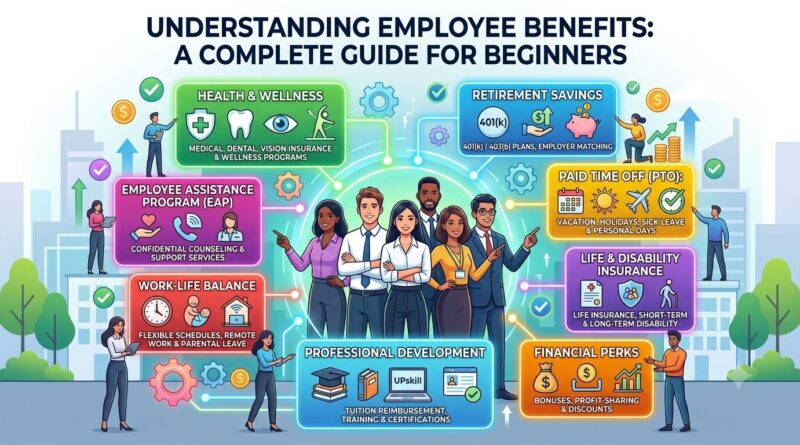
Understanding Employee Benefits: A Complete Guide for Beginners
When you are hunting for your first job, it is incredibly easy to focus entirely on one number: your hourly wage or annual salary. If Job A pays $15 an hour and Job B pays $17 an hour, choosing Job B seems like a no-brainer.
However, looking only at your base pay means you are missing half the picture. To truly maximize your income, you need to master understanding employee benefits.
Employee benefits—often called workplace perks or total compensation—are the non-cash rewards that an employer provides in addition to your regular paycheck. When global economic conditions fluctuate, companies might tighten their belts on base salaries while offering robust benefits packages to attract top talent. Knowing how these packages work ensures you do not leave thousands of dollars on the table.
The True Value of a Benefits Package
A job offer consists of two distinct parts: your direct compensation (your paycheck) and your indirect compensation (your benefits).
[ Your Total Compensation ] = [ Base Salary ] + [ Health Insurance + Retirement Match + Paid Leave + Perks ]
When you properly evaluate a job offer, you might find that a lower-paying job with incredible benefits actually leaves more money in your pocket at the end of the year than a higher-paying job with zero perks.
For example, if a company pays for your health insurance, matches your retirement savings, and helps pay for your bus pass, they are covering costs that you would otherwise have to pay out of your own pocket using your post-tax income.
Core Employee Benefits Explained
While workplace perks can vary from company to company, most standard professional employers offer a core trio of benefits: health care coverage, retirement savings plans, and educational assistance.
1. Health and Medical Insurance
Medical care can be astronomically expensive. To help protect workers, many employers sponsor group health insurance plans. Because the employer is buying insurance in bulk for hundreds or thousands of workers simultaneously, the cost is significantly lower than if you tried to buy an individual insurance plan on your own.
When reviewing an employer’s health plan, you will encounter three critical terms:
- Premium: The regular amount of money taken out of your paycheck every month just to keep the insurance active.
- Deductible: The amount of money you must pay out of your own pocket for medical care before the insurance company steps in to pay their share. For instance, if your deductible is $1,000, you pay the first $1,000 of medical bills that year.
- Co-pay: A small, flat fee you pay on the spot every time you visit a doctor or pick up a prescription (e.g., $20 per visit).
2. Employer-Sponsored Retirement Plans
As government pension programs face long-term funding challenges, taking personal responsibility for your future retirement is essential. Many companies offer retirement plans directly through payroll deductions.
The classic example is a pre-tax retirement plan (like a 401k in the US or a workplace pension in the UK). This allows you to invest a portion of your salary before taxes are taken out. The money grows silently over decades, but it has a catch: it is strictly locked away. If you try to withdraw those funds before you reach retirement age (typically age 55 to 59½ depending on the country), you will face heavy financial penalties and a surprise tax bill.
3. Tuition Assistance and Education Reimbursement
If you want to keep learning while you work, many modern companies offer to pay for your college courses or professional certifications. However, these programs always come with specific stipulations.
Most employers pay for tuition retroactively. This means you must pay for the class up-front out of your own pocket, pass the course with a specific grade (usually a ‘B’ or better), and show proof of completion before the company refunds your money. If you cannot afford the up-front cost, you may need a short-term student loan to bridge the gap.
Global Variations: How Benefits Look Around the World
The types of perks you receive depend heavily on where your job is located. Different countries have different legal frameworks for what employers are required to provide.
United States
Because the US does not have a universal healthcare system, health insurance is the single most critical benefit American workers look for. Additionally, workplace retirement plans like the 401(k) are highly popular, especially when employers offer a “matching contribution” (free money added to your account when you save).
United Kingdom
In the UK, health insurance is less critical due to the publicly funded National Health Service (NHS). Instead, workplace benefits focus heavily on “Auto-Enrolment” pensions (where employers are legally required to contribute to your retirement), extra paid annual leave (often 28+ days), and unique statutory perks like the Cycle to Work scheme.
Canada
Canadian workers have baseline medical coverage through provincial healthcare, but employer benefits are highly valued for covering things the government doesn’t fully pay for—such as dental care, prescription drugs, and vision care. Employers also offer group RRSPs (Registered Retirement Savings Plans) to help workers build wealth.
Australia
In Australia, retirement savings are legally mandated through a system called Superannuation. Your employer must pay a set percentage of your earnings into your chosen “Super” fund on top of your regular salary. Other common benefits include generous annual leave loading and salary packaging options.
Understanding Employee Benefits Case Studies: Comparing Job Offers Side-by-Side
Let’s look at two realistic scenarios to see how a complete understanding of employee benefits alters your true earning power.
Scenario A: Alex Chooses the High Salary
Alex finishes school and receives an offer from Job A. The job offers a base salary of $45,000 a year. However, the company does not offer health insurance, meaning Alex has to buy an individual health plan for $350 a month ($4,200 a year). The company also has no retirement matching program.
- Base Salary: $45,000
- Out-of-Pocket Medical Costs: -$4,200
- Retirement Match Added: $0
- True Realized Value: $40,800
Scenario B: Taylor Evaluates the Whole Package
Taylor receives an offer from Job B. The base salary is lower, sitting at $42,000 a year. However, the company completely covers the cost of Taylor’s health insurance premium. Even better, they offer a 3% retirement match, adding an extra $1,260 of free money into Taylor’s retirement account.
- Base Salary: $42,000
- Out-of-Pocket Medical Costs: $0 (Covered by employer)
- Retirement Match Added: +$1,260
- True Realized Value: $43,260
The Takeaway: Even though Job A looked better on paper by $3,000, Taylor’s complete benefits package at Job B made it the financially superior choice by over $2,400.
Common Pitfalls to Avoid When Evaluating Benefits
- Ignoring the Probationary Period: Many companies enforce a 30, 60, or 90-day probation period when you first get hired. During this window, you are an official employee, but you do not have access to health insurance or perks yet. Make sure you have a financial backup plan for your healthcare needs during your first three months on the job.
- Missing the “Vesting Schedule”: If a company puts matching money into your retirement account, read the fine print regarding vesting. Vesting means you must work for the company for a specific amount of time (like 1 or 2 years) before that matching money officially belongs to you. If you quit the job after six months, the company can legally take their matching dollars back.
- Overlooking Restrictive Health Networks: Some workplace health insurance plans use strict networks, meaning they will only pay for your medical bills if you see specific doctors inside their approved list. If you see a doctor outside that network without prior authorization, you could be stuck with a massive unexpected bill.
4 Questions to Ask Before Accepting a Job Offer
When an employer offers you a position, do not be afraid to politely ask for a copy of their full summary of benefits. Review it carefully by asking yourself these four questions:
- What is my actual out-of-pocket cost for the health care plan? Check the premium deductions and the deductible size so you know what you will pay before coverage kicks in.
- Does the company offer a retirement match, and what is the vesting schedule? Find out exactly how much free money you can get by automating your savings.
- Are there strict stipulations on the tuition assistance program? Verify if your major or classes must be directly tied to your current job role before they will refund your money.
- What does the paid time off (PTO) policy look like? Find out how many days of sick leave and vacation time you accumulate each year.
Quick Action Checklist
- [ ] Step 1: Request a complete “Summary of Benefits” document from your current or potential employer.
- [ ] Step 2: Calculate your total compensation by adding the cash value of your workplace perks to your base salary.
- [ ] Step 3: Check your retirement plan settings to ensure you are contributing enough money to trigger the maximum employer match.
- [ ] Step 4: Review your health insurance deductible so you can build an emergency fund large enough to cover that amount if you get sick.
- [ ] Step 5: Read through your company’s policy on continuing education to see if you can get them to pay for your next professional course or certification.