Tax Advantaged Savings Accounts: A Guide for Beginners
When you are young, retirement feels like a lifetime away. Between paying for gas, saving for a first car, or buying textbooks, thinking about what your life will look like at age 60 can feel irrelevant.
However, with the unpredictable future of government pension systems worldwide and the rising cost of everyday items due to inflation, building your own personal safety net is no longer a luxury. The absolute best tool at your disposal to secure your future is the collection of specialized government-approved buckets known as tax advantaged savings accounts.
The phrase “tax advantaged” sounds like scary financial jargon, but it simply means the government gives you special tax breaks to encourage you to save money for your future. If you leave your money in a standard savings account, you pay taxes on any interest you earn every single year. With tax-advantaged savings accounts, you either pay no taxes up front, or you pay zero taxes when you withdraw your money decades later. This simple shield allows your money to grow significantly faster.
The Basics: Pre-Tax vs. Post-Tax Accounts
To truly understand how these accounts work, you need to understand the two main styles of tax breaks:
Pre-Tax (Traditional) and Post-Tax (Roth style).
Pre-Tax (Traditional) Accounts
With these accounts, you put money in before taxes are taken out of your paycheck. This reduces your taxable income today, meaning you pay less money to the government right now. The catch? When you grow old and retire, you will pay standard income tax on the money you pull out of the account.
Post-Tax (Roth Style) Accounts
With these accounts, you put in money that has already been taxed (like the cash you get from your regular job’s paycheck). Because you already paid your dues to the government today, a beautiful rule kicks in: all the money you make on your investments inside that account grows completely tax-free, and you will pay zero taxes when you withdraw it in retirement.
Traditional Savings Accounts vs. Tax-Advantaged Savings Accounts
A common mistake absolute beginners make is assuming that a tax-advantaged retirement account is just like a standard bank account. They are fundamentally different beasts.
A traditional savings account is ultra-conservative. It is designed to preserve your cash, not aggressively grow it. The interest rates are typically low, meaning your money won’t beat inflation over long periods.
By contrast, tax-advantaged accounts act as investment holding buckets. When you put a contribution (the technical word for the cash deposits you add to the account) into a retirement account, you don’t just let it sit as raw cash. You use that cash to buy diverse investments like index funds or exchange-traded funds (ETFs).
This setup allows your money to actively grow compound interest by investing in pieces of the world’s largest companies.
[ Your Contribution ] ➔ Invested in Market Funds ➔ Earns Compound Interest ➔ Compounded Gains Grow Tax-Free
| Feature | Standard Savings Account | Tax-Advantaged Account |
| Primary Goal | Short-term safety & emergencies | Long-term retirement wealth building |
| How Money Grows | Modest interest paid by the bank | Market investments compounding over time |
| Tax Rules | You pay taxes on interest earned every year | You pay zero taxes while the money grows |
| Withdrawal Rules | Access your cash anytime without penalty | Restrictions or penalties apply if withdrawn early |
A Global Translation Guide: What Are These Called in Your Country?
Financial content often uses US-centric terminology, which can leave international readers incredibly confused. While the underlying financial math is the same globally, different governments use different acronyms.
Here is how these general concepts look around the world:
1. United States
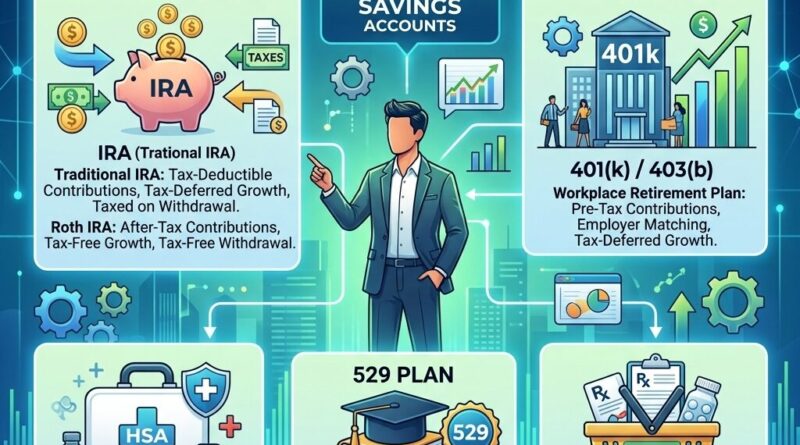
- Individual Accounts: Known as a Traditional IRA or a Roth IRA. Anyone with earned income can open one through an app or investment brokerage.
- Workplace Accounts: Known as a 401(k) or 403(b). These are employer sponsored retirement plans set up by the company you work for, allowing you to save money directly out of your regular paycheck.
2. United Kingdom
- Individual Accounts: Known as an ISA (Individual Savings Account), specifically a Stocks & Shares ISA or a Lifetime ISA (LISA). Money grows completely free of capital gains taxes.
- Workplace Accounts: Known as Workplace Pensions, which include automated auto-enrolment rules where employers are legally forced to contribute cash to your account alongside you.
3. Canada
- Pre-Tax Style: Known as an RRSP (Registered Retirement Savings Plan). Deposits lower your current income tax bill.
- Post-Tax Style: Known as a TFSA (Tax-Free Savings Account). An incredibly flexible account where investments grow and can be withdrawn completely tax-free at any point.
4. Australia
- The Main System: Known as Superannuation (or “Super”). Your employer is required to pay a percentage of your earnings directly into your Super fund. You can make extra pre-tax contributions (concessional) or post-tax contributions (non-concessional) to maximize your growth.
Step-by-Step Guide: How to Start Investing Early
If you are ready to use these accounts to make your future self incredibly wealthy, follow this clear step-by-step process.
Step 1: Check for an Employer Match
If you have a formal job that offers employer sponsored retirement plans, talk to your manager or human resources representative. Many companies offer a matching program—for example, if you contribute 3% of your paycheck to your retirement plan, the company will match that exact amount and deposit free money into your account. Always grab the match first; it is literally a 100% return on your money instantly.
Step 2: Choose an Investment Brokerage
If you are opening an individual account (like an IRA or a TFSA/ISA) on your own, look for a reputable, modern online investment brokerage or micro-investing app. Pick a provider that advertises “$0 account minimums” and “$0 stock trading fees” so you aren’t nickel-and-dimed for small deposits.
Step 3: Complete the Identity Check
To prevent financial crime, you will fill out a digital form with your official legal identity information. If you are under 18 years old, you will need a parent or guardian to sign up with you on a “Custodial Account,” which hands full ownership over to you the second you hit legal adult age.
Step 4: Automate Your Micro-Investing
You do not need thousands of dollars to build an account. Thanks to modern investment apps, you can buy tiny fractions of shares with as little as $5. Set an automatic rule to move a tiny fraction of your earnings ($10 a week or $25 a month) directly into your account on payday.
Step 5: Choose Your Underlying Investments
Remember, simply putting cash into the account is not enough—you have to use that cash to buy actual investments! For beginners, the safest and easiest option is a broad-market index fund (an investment fund that automatically buys tiny pieces of hundreds of top companies simultaneously, protecting you if one single company fails).
Scenarios: The Shocking Power of Time
Let’s look at two hypothetical examples to prove why starting your savings journey at age 16 or 18 gives you an almost unfair economic advantage over people who wait until their 30s.
Scenario A: Early Earned Emily (The Teen Starter)
Emily starts working a part-time retail job at age 16. She learns how to grow compound interest early and opens a post-tax tax-advantaged account. She commits to investing $100 a month ($1,200 a year). She does this for just 10 years and stops completely at age 26, never adding another penny.
- Total Cash Invested: $12,000
- The Math: Assuming an average annual stock market return of 8%, her account snowballs silently over time. By the time Emily reaches age 65, her account is worth roughly $320,000. Because she used a post-tax tax-advantaged account, she can withdraw all of it completely tax-free.
Scenario B: Late-Start Luke (The Wait-and-See Saver)
Luke ignores retirement advice as a teenager. He waits until he is 30 years old to start saving. Realizing he is behind, he decides to invest that same $100 a month ($1,200 a year). To make up for lost time, he keeps investing that money every single month for 35 straight years until he turns 65.
- Total Cash Invested: $42,000 (More than three times what Emily invested!)
- The Math: Despite investing way more of his own hard-earned cash, Luke missed out on the critical early compounding years. At age 65, his account is worth roughly $210,000.
The Lesson: Time is vastly more valuable than money when it comes to investing. Emily ended up with over $100,000 more than Luke simply because she started fourteen years earlier.
Common Pitfalls to Avoid
Because the government gives you special tax breaks on these accounts, they put strict rules in place to make sure you use them for their intended purpose: long-term security. Watch out for these three major traps.
1. Early Withdrawal Penalties
If you treat your tax-advantaged retirement accounts like a casual ATM for buying concert tickets or clothes, you will face severe consequences. Many countries will hit you with a flat 10% penalty fee plus a surprise tax bill if you pull your earnings out before you reach retirement age (typically age 59½ to 65 depending on regional laws).
- Exception: Some post-tax accounts (like the US Roth IRA or Canadian TFSA) allow you to withdraw your original contributions without penalties during an emergency, but you still cannot touch the earnings without fees.
2. Over-Contributing Across Your Limits
Governments do not want wealthy people hiding unlimited amounts of money from taxes, so they set strict annual maximum contribution caps. For example, in the US, the maximum combined amount you can put into personal IRAs is $7,500 per year. If you accidentally contribute more than the legal limit, you can be hit with a painful 6% tax penalty every year until you fix it.
- The Fix: Keep track of your annual limits and never let your total combined contributions across your personal accounts exceed your country’s legal cap.
3. Leaving Your Money in Raw Cash
This is the single biggest tragedy in personal finance. Many beginners open a tax-advantaged account, link their bank, transfer $500 into it, and walk away thinking they are done. Years later, they log back in and realize their account balance is still exactly $500 because it sat there as cash instead of being used to buy actual investments.
- The Fix: Every time a deposit lands in your account, immediately execute an order to buy your chosen index fund or ETF.
Quick Action Checklist
Use this scannable guide to move from a beginner observer to an active investor:
- [ ] Step 1: Find out if your part-time or full-time employer offers employer sponsored retirement plans and ask if they offer a contribution match.
- [ ] Step 2: Research your country’s annual contribution caps for individual tax advantaged savings accounts so you know your boundaries.
- [ ] Step 3: Choose a top-rated investment app or online brokerage that charges zero account management or transaction fees.
- [ ] Step 4: Set up a recurring, automatic transfer of just $10 or $20 a month to build a lifelong habit of consistency.
- [ ] Step 5: Select a broad-market index fund within your new account to ensure your deposits are working to grow compound interest safely.