Credit Unions Explained: Are They Better Than Banks?
When you look for a place to store your money or borrow cash for a major purchase, your first thought is probably to check out a massive commercial bank. However, commercial banks are not the only option on the financial map. Millions of people bypass traditional institutions entirely in favor of a unique model: the credit union.
If you are a teenager mapping out your very first account, an absolute beginner, or someone exploring alternative ways to build smart investing habits, getting credit unions explained clearly can save you thousands of dollars over your lifetime.
Credit unions are famous for offering a highly personalized atmosphere, individual advice, and significantly lower interest fees. Let’s look at how these financial cooperatives operate, why their ownership structure changes everything, and how they keep your money safe.
1. The Critical Difference: Not-For-Profit vs. Wall Street
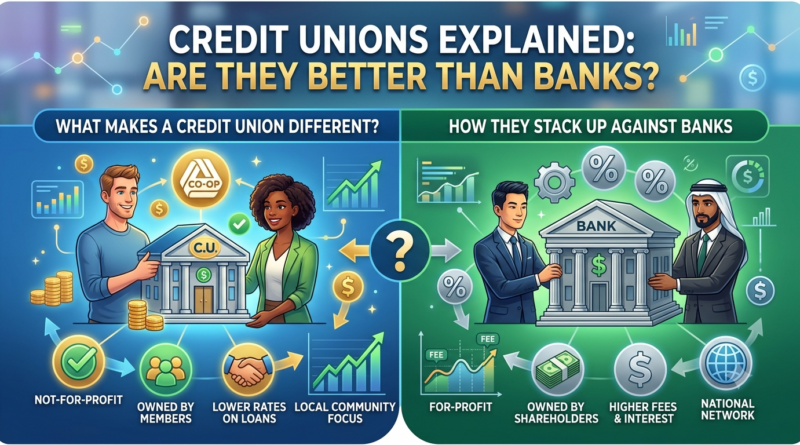
The fundamental difference between a bank and a credit union comes down to who owns the business and where the profits go.
[ Commercial Bank ]  ───> Profit Goes To ───> Outside Stockholders (Wall Street)
[ Credit Union ]     ───> Profit Goes To ───> The Members (Higher savings rates, cheaper loans)
The Commercial Bank Model
Traditional commercial banks are built to make money for outside stockholders. When a bank collects fees or charges high interest on a loan, that money is funneled directly to investors on the stock market.
The Credit Union Model
A credit union is a not-for-profit financial cooperative. It is completely owned and operated by the very people who bank there—the members. Instead of trying to maximize profits for external investors, a credit union uses its excess earnings to benefit its community. Any surplus cash is pumped directly back to the members in the form of:
- Higher interest returns on regular savings accounts.
- Lower interest rates on car loans, mortgages, and personal signatures loans.
- Fewer hidden maintenance and overdraft fees.
2. Who Can Join a Credit Union?
Historically, credit unions were highly exclusive organizations. They were typically formed by specific labor unions, military branches, or large corporate employers to serve their own workers. The credit union offices were often located directly inside the employer’s building, keeping overhead operational costs incredibly low.
Today, while some employer-based credit unions still exist, the industry has opened its doors wide to the public. Most modern credit unions use a “community charter.” This means you can easily qualify to join if you simply live, work, attend school, or worship within a specific city, county, or geographic region.
3. Financial Stability and the Insurance Safety Net
During economic downturns or stock market crashes, commercial banks frequently struggle under the weight of risky corporate investments. Historically, credit unions have shown incredible resilience during financial crises, often experiencing massive spikes in new business and mortgage lending while traditional corporate banks pull back.
Despite market fluctuations, you can navigate your banking choices with confidence—provided you verify that your chosen institution carries a government safety net.
1.Identify the Institution Type:Step 1.
Determine if you are opening an account at a traditional commercial bank or a cooperative credit union.
2.Look for the Bank Safeguard:Step 2.
If you are using a standard bank, look for the FDIC (Federal Deposit Insurance Corporation) logo. The FDIC ensures that if the bank goes bankrupt, the federal government steps in to return your cash up to legal limits.
3.Look for the Credit Union Safeguard:Step 3.
If you are using a credit union, check that it is backed by the NCUA (National Credit Union Administration). The NCUA manages the NCUSIF (National Credit Union Share Insurance Fund).
4.Verify Government Backing:Step 4.
The NCUSIF is a federal agency headquartered in Alexandria, Virginia, run by a board appointed directly by the U.S. President. It provides the exact same full faith and credit protection as the FDIC, ensuring your credit union savings are completely safe.
Quick Action Checklist
Ready to explore your local banking alternatives? Use this step-by-step checklist to evaluate your options:
- [ ] Step 1: Search online for credit unions operating within your local zip code or city boundaries.
- [ ] Step 2: Check the “Field of Membership” or eligibility requirements on their website to confirm you qualify to join.
- [ ] Step 3: Scan the homepage or footer of the credit union’s website to verify the official “Federally Insured by NCUA” stamp is present.
- [ ] Step 4: Compare the interest rates (APY) offered on their savings accounts against your current commercial bank to see if you are leaving money on the table.
- [ ] Step 5: If you are planning to buy a car or house soon, request a loan quote from a local credit union—their rates frequently beat traditional bank offers by a full percentage point.