
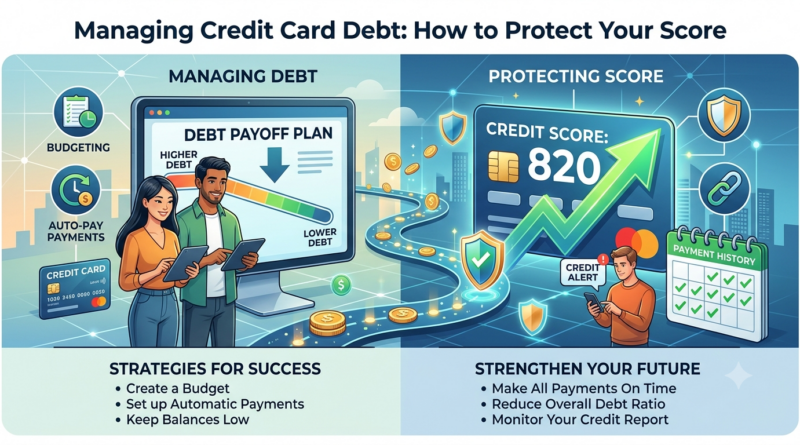
Managing Credit Card Debt: How to Protect Your Score
Credit cards are one of the most polarizing tools in personal finance. Used responsibly, they build your credit score, unlock valuable travel rewards, and provide consumer protection. Used poorly, they become a high-interest trap that can drain your income for years.
If you are a young adult opening your first account, an absolute beginner, or someone wrestling with balances, mastering managing credit card debt is essential to building long-term financial freedom. Credit card companies make billions because most people spend more than they can afford and pay bills late.
To keep your hard-earned money in your own pocket, you need to understand how credit limits affect your score, how to utilize account history as bargaining power, and how to close accounts without hurting your financial standing.
1. The Core Rule: Master the 30% Utilization Barrier
The average consumer carries multiple credit cards in their wallet. While having multiple accounts open can actually help your long-term credit history, your total balance matters much more than the number of cards you own.
To maintain a high credit score, financial experts recommend never using more than 30% of your total available credit at any given time. This calculation is called your Credit Utilization Ratio.
[ Total Available Credit Limit: $10,000 ]
                     │
     ┌───────────────┴───────────────┐
     ▼                               ▼
[ Safe Zone: Under $3,000 ]     [ Danger Zone: Over $3,000 ]
(Max 30% Utilization)           (Hurts Your Credit Score)
If you have a total credit limit of $10,000 across all your cards, keeping your combined balances below $3,000 shows credit reporting agencies that you are a responsible borrower who isn’t relying too heavily on borrowed money.
2. Using Account History as Financial Leverage
If you find yourself overwhelmed and want to eliminate cards, do not just close accounts at random. Look closely at the age and quality of each account before making a move.
The Power of Longevity
A credit card account with a long, clean history of on-time payments is incredibly valuable. The older your average account age, the higher your credit score climbs. Furthermore, a long-standing relationship gives you significant bargaining power with your creditors:
- Negotiating Lower Interest Rates: If you have been a loyal customer for years with minimal late payments, you can call your card issuer and directly ask them to lower your interest rate (APR).
- Waiving Annual Fees: Many premium credit cards charge an annual fee to keep the account active. If you call the bank and mention that you are thinking about closing the account due to the fee, they will frequently waive it or offer you a custom statement credit to keep you as a customer.
- Forgiving Late Mistakes: If an unusual emergency causes you to miss a payment deadline, a bank you have traded with for years is far more likely to waive the late fee as a one-time courtesy.
3. The Correct Way to Close a Credit Card Account
If you decide that a specific card carries unreasonable fees or tempts you to overspend, you must close it correctly. Simply taking a pair of scissors to the physical plastic does not cancel the account with the bank.
Step 1. Pay the Balance to Zero:
Ensure your outstanding balance is completely paid off. Check for any pending transactions or automated monthly subscriptions attached to the card and transfer them to a different account.
Step 2. Call to Formally Cancel:
Call the customer service phone number listed on the back of your card. State clearly to the representative that you want to close the account completely at the customer’s request.
Step 3. Request Official Documentation:
Ask the credit card company to send you a final written statement and a formal notice confirming that the account is closed. Request that they notify the major credit bureaus that the card was closed at the customer’s request so it doesn’t look like the bank revoked your credit.
Step 4. Securely Destroy the Card:
Once confirmation is complete, run the physical card through a heavy-duty shredder, ensuring the account number, magnetic strip, and smart chip are completely unreadable.
Watch Out for “Trailing Interest”
A major trap that trips up consumers occurs during the final billing cycle. Many credit card companies assess interest after a billing cycle closes. Even if you paid your balance to zero and closed the account on Tuesday, a small amount of “trailing interest” might generate on your next official statement date.
Never ignore mail or statements from an old provider under the false assumption that they cannot bill you anymore. Always open the correspondence and call to confirm if a residual balance is valid to protect your credit score from accidental default.
Quick Action Checklist
Take control of your revolving lines of credit today using these baseline steps:
- [ ] Step 1: Add up the total available credit limits across every single credit card you own.
- [ ] Step 2: Calculate your current 30% maximum safety threshold so you know your target limit.
- [ ] Step 3: List your cards by their opening date, identifying your oldest, most valuable accounts to preserve.
- [ ] Step 4: Review the rewards dashboard on your active accounts to ensure you are redeeming cash back or points before they expire.
- [ ] Step 5: Call your highest-interest card issuer this week to politely request a lower interest rate based on your clean payment record.