Personal Finance Basics: A Beginner’s Guide to Money Terms
Trying to learn how to manage your money can quickly feel like an exercise in information overload. The internet is packed with articles, videos, and financial influencers throwing around words that sound like a completely different language.
But here is a secret: you do not need an economics degree to build smart money habits. Once you strip away the complicated walls of text, managing your money comes down to a few core building blocks.
Whether you are a teenager tracking your first paycheck, an absolute beginner trying to figure out adulting, or looking for a financial checklist for beginners, this guide breaks down the essential terms you need to know. Let’s look at banking services explained simply, alongside the basic tools of saving and investing.
1. Navigating the Banking World
Where you choose to keep your money matters. Different financial institutions serve completely different purposes, and choosing the right bank depends entirely on your personal or business goals.
Commercial Banks
These are the massive financial institutions you see on city street corners and high streets worldwide (such as Chase, Bank of America, HSBC, or Barclays). They handle large deposits, serve big corporations, and offer extensive networks of physical branches and ATMs. While they offer great convenience and cutting-edge mobile apps, they often charge higher monthly fees and pay lower interest on savings.
Private & Independent Banks
These are smaller, locally owned and operated banks. They are not owned by massive global corporations. Because they are local, they often offer highly personalized customer service and focus heavily on supporting small businesses within their immediate community.
Credit Unions
Credit unions are member-owned, non-profit financial institutions. Because they do not have to answer to Wall Street shareholders, they use their excess earnings to benefit their members. This translates into lower interest rates on loans (like car loans) and more competitive, higher returns on your savings accounts.
Online Banks (Branchless Banks)
These are modern banks that operate entirely online with no physical branch locations.
The Trade-Off: Because they do not have to pay for expensive physical buildings, they pass those savings directly to you by offering much higher interest rates on your deposits. The downside is that you cannot walk in to talk to someone face-to-face, which can occasionally make complex customer service issues trickier to resolve. For tech-savvy users, they are usually an excellent deal.
2. Smart Ways to Save: Growing Your Cash Safely
Leaving all your extra cash in a standard checking account is a mistake—it earns virtually no interest, making it easy to accidentally spend. Instead, look to utilize specialized savings tools designed to protect and grow your cash safely.
[ Your Cash ] ───> 1. High-Yield Savings (Best for: Flexible Emergency Funds)
              ───> 2. Certificate of Deposit (Best for: Locked, Fixed-Term Goals)
High-Yield Savings Accounts (HYSAs)
A high-yield savings account (or money market account) is a savings account that offers a significantly higher-than-average interest rate on your money. They are ideal for holding your emergency fund. To encourage you to keep your money parked, these accounts may limit how many times you can withdraw cash each month, but your money remains fully safe and insured by government bodies (like the FDIC in the US).
Certificates of Deposit (CDs)
A CD (known internationally as a Term Deposit) is an agreement where you promise to leave a specific amount of money untouched in the bank for a fixed period of time—ranging from a few months to several years. In exchange, the bank pays you a guaranteed, higher interest rate than a regular savings account.
The Catch: If you withdraw your money before the official “date of maturity” (the end of the agreed term), you will face a financial penalty. They are completely safe and government-insured, making them perfect for fixed, short-term goals like saving for a car next year.
3. The Basics of Investing
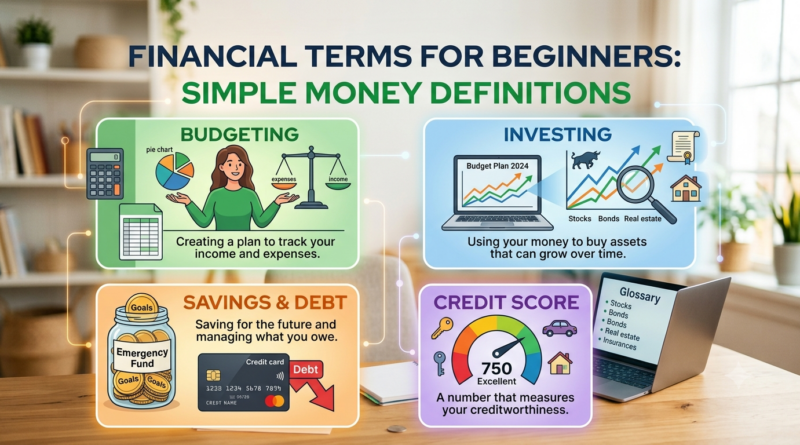
Once your emergency fund is safely parked, it is time to look at the next pillar of personal finance basics: investing. Investing is simply the act of putting your money to work so that it grows over time and beats inflation (the gradual rising of everyday prices that erodes your cash’s buying power).
There are three primary asset building blocks you need to know:
Stocks (Equities)
When you buy a stock, you are purchasing a tiny certificate of ownership in a real corporation (like Apple, Sony, or Nike). If the company makes a profit and grows, your shares become more valuable, and you may receive a portion of those profits (called a dividend). As a shareholder, you also gain the right to vote on major corporate decisions. Stocks carry the highest potential for profit, but they also carry the highest risk because their prices fluctuate daily.
Bonds (Fixed Income)
A bond is essentially a loan you make to a government entity or a corporation. Instead of owning a piece of the company, you act as the lender. The organization promises to pay you back your initial investment at a specified date, while paying you a fixed rate of interest along the way. They are much more stable than stocks but offer lower overall growth.
Mutual Funds and ETFs
If you only invest in one company’s stock, you are risking your entire savings on their success. Mutual funds and ETFs (Exchange-Traded Funds) solve this by pooling money from thousands of investors to buy a massive basket of diversified stocks and bonds simultaneously.
What is Diversification? Imagine spreading your money across hundreds of different companies globally. If one company suffers a bad year, the healthy growth of the other companies balances out the damage, reducing your overall risk while keeping your profit potential intact.
4. Planning for Your Future: Tax-Advantaged Accounts
Every country offers special, government-approved accounts designed to encourage citizens to save for their future and retirement. These accounts provide major tax breaks, helping your investments compound much faster.
Because these accounts look different depending on where you live, let’s break them down globally:
| Account Type | How It Works | US Equivalent | UK Equivalent | Canada Equivalent | Australia Equivalent |
| Employer-Sponsored Account | Automatic deductions from your paycheck before taxes are taken out. Employers often match your contributions (free money!). | 401(k) | Workplace Pension | Group RRSP | Superannuation (Employer Super) |
| Individual Tax-Deferred Account | You contribute money and don’t pay taxes on the earnings until you withdraw it much later in life. | Traditional IRA | Personal Pension | RRSP | Personal Super Contributions |
| Individual Tax-Free Account | You pay tax on the money now, but your investments grow completely tax-free, and withdrawals in retirement are 100% tax-free. | Roth IRA | Cash or Stocks & Shares ISA | TFSA (Tax-Free Savings Account) | Tax-Free Super Withdrawals (Age 60+) |
Quick Action Checklist
Ready to put these personal finance basics into action? Use this step-by-step checklist to organize your financial life this week:
- [ ] Step 1: Review your current bank account. Identify if it is a commercial bank, credit union, or online bank, and check what fees you are paying.
- [ ] Step 2: Open a High-Yield Savings Account (HYSA) to act as your dedicated financial safety net.
- [ ] Step 3: Check if your current employer offers a retirement matching program (like a 401k, workplace pension, or Superannuation match)—if they do, sign up to capture the free match.
- [ ] Step 4: Research a low-cost, diversified index fund or ETF to begin practicing your long-term investing habits.
- [ ] Step 5: Set up an automatic transfer of even just $5 or $10 a week into your savings or investment account to build consistency.