Should I Cancel My Credit Card? Protect Your FICO Score
When you are in a rush to break bad financial habits and end a cycle of overspending, the most obvious solution seems to be getting rid of your cards entirely. But before you grab a pair of scissors and cut up your plastic, you need to pause.
If you are an absolute beginner, a young adult trying to establish a rock-solid credit foundation, or someone researching a beginner portfolio guide, asking yourself “Should I cancel my credit card?” requires a deep understanding of how credit reporting actually works.
Closing an open line of credit can frequently do far more harm than good to your long-term financial health. Let’s look at the math behind your credit score, how closing accounts changes your debt ratios, and why changing your habits matters more than destroying your plastic.
1. Credit History is Permanent: The 7-Year Rule
A common misconception is that closing a credit card wipes the slate clean and erases past mistakes. In reality, once you open a credit card account, it is permanently etched into your credit profile.
                                  [ Open Credit Card Account ]
                                               │
               ┌───────────────────────────────┴───────────────────────────────┐
               ▼                                                               ▼
   [ Negative Payment History ]                                   [ Positive Payment History ]
• Late payments, over-limit fees,                               • On-time payments and low balances
  and defaults stick around for                                   remain a permanent testament to
  at least 7 years.                                               your financial maturity.
Any historical missteps, such as late payments, over-the-limit fees, or charge-offs, will remain on your credit report for at least seven years. However, the exact same rule applies to your good financial behavior. Keeping an old account active and current serves as a permanent testament to your financial maturity.
2. Deciphering the FICO Score Formula
To make an educated decision about your accounts, you need a brief understanding of how a FICO score operates. First developed by Fair Isaac & Co. in the 1950s, the FICO score is the universal mathematical formula that major credit reporting bureaus (Experian, TransUnion, and Equifax) use to grade your reliability as a borrower.
When you close an account, you directly alter two core pillars of this formula:
- The Length of Your Credit History (15% of your score): The credit bureaus look at the average age of all your accounts combined. Generally, 15% of your total score is based entirely on how long you have been borrowing money. If you close a card that you opened when you were 18 years old, you instantly shorten your credit history, which can cause your score to drop.
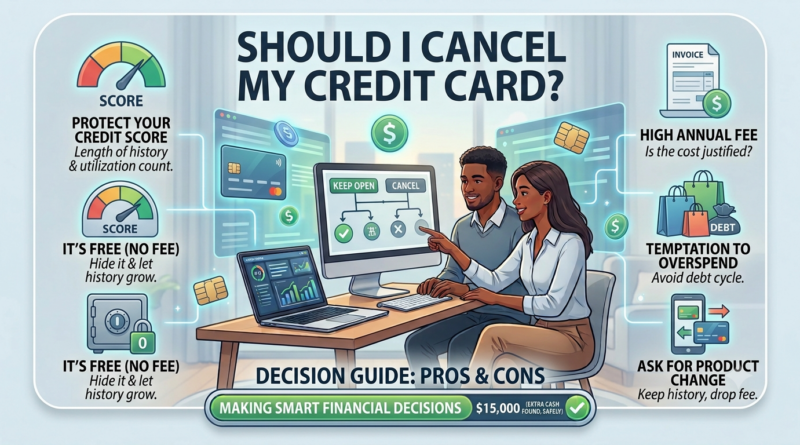
- The Debt-to-Credit Ratio (30% of your score): Credit reporting agencies want to see that you use less than 30% of your total available credit limit. If you have two credit cards with a $5,000 limit each (a total of $10,000 available credit) and you close one of them, your available pool drops to $5,000. If you owe $2,000 in debt, your utilization ratio instantly jumps from a safe 20% to a dangerous 40%, harming your score.
3. When Does Closing a Card Make Sense?
While preserving your accounts is generally best for your FICO score, there are specific guidelines where closing down a credit line makes long-term sense.
1.Audit the Excess Account Count:
As a general personal finance guideline, aim to limit your active credit cards to a total of seven accounts or fewer. Managing an excess number of cards increases your risk of missing due dates.
2.Calculate Your Current Ratios:
Before calling your bank, add up your current balances and total credit limits across your remaining cards. Ensure that removing one account’s limit will not push your overall credit utilization above the 30% threshold.
3.Identify Unjustifiable Maintenance Fees:
If an account carries an expensive annual fee and the bank refuses to waive it or offer premium banking services to offset the cost, closing the card is a valid way to protect your monthly cash flow.
4.Execute a Formal Cancellation:
If the account passes these checks and needs to be shut down, call the issuer to cancel it formally. Request written confirmation stating that the account was closed “at the customer’s request” to protect your file at the major bureaus.
Scissors Cannot Fix Spending Habits
If your primary motivation for closing a credit card is simply that you cannot control your impulse spending, cutting up the plastic will not solve the underlying issue. Overspending is an emotional and behavioral habit; if you don’t address it, the pattern will simply continue using cash or debit cards instead.
If you lack spending control, you don’t need a pair of scissors—you need a realistic budget plan. Rebuilding your daily routines, tracking your expenses manually, and forming smart investing habits will do far more to secure your financial freedom than destroying a credit account.
Quick Action Checklist
Before making a permanent change to your credit lines, execute these steps to protect your FICO score:
- [ ] Step 1: Log into your online portal and find the original opening date for each credit card you own.
- [ ] Step 2: Identify your oldest active account and commit to keeping it open to protect your length of credit history.
- [ ] Step 3: Total up your aggregate credit card debt and divide it by your total available credit limits to find your current utilization ratio.
- [ ] Step 4: Count your total number of credit accounts; if you have more than seven, pinpoint the newest, highest-fee card as a candidate for closure.
- [ ] Step 5: If an account has an annual fee, call the number on the back of the card today and ask if they can transition you to a free, zero-fee version instead of canceling it.