Difference Between Stocks and Bonds: A Beginner’s Guide to Investing
Imagine you are standing at the starting line of your financial journey. You keep hearing that the secret to long-term wealth is to make your money work for you, rather than just letting it sit under your mattress losing value to inflation (the sneaky process where everyday things like shoes, concert tickets, and groceries get more expensive over time, meaning your money buys less than it used to).
When you look into investing for beginners, two massive terms constantly pop up: stocks and bonds. They are the twin pillars of the investing world, but they work in completely opposite ways.
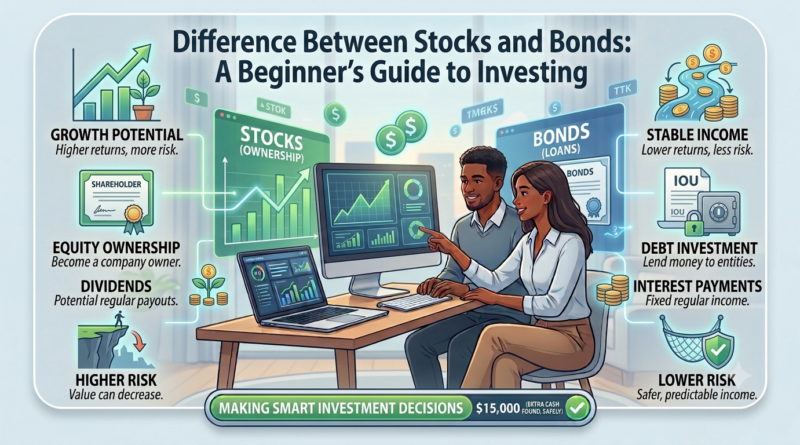
The core difference between stocks and bonds comes down to a simple choice: Do you want to own a tiny piece of a company, or do you want to lend that company some money? Understanding how these two options balance each other out is your first major step toward learning how to build wealth safely and effectively. Let’s break down exactly how they work, why they matter, and how to use them.
1. What Are Stocks? (The Power of Ownership)
When you buy a stock (also known as shares or equity), you are buying a literal, microscopic piece of a company.
If you buy one share of Apple, Disney, or Sony, you become a shareholder. You don’t get to walk into their corporate offices and start ordering people around, but you do own a tiny slice of their buildings, their technology, and their future success. In the past, people received physical paper certificates to prove ownership; today, it is all tracked digitally through apps on your phone.
How You Actually Make Money with Stocks
Stock investors make money in two primary ways:
- Capital Gains: This is the classic “buy low, sell high” strategy. If you buy a share of a gaming company for $10 and its new console becomes a global phenomenon, the value of that share might jump to $25. If you sell it, your $15 profit is a capital gain.
- Dividends: Think of dividends as a company’s way of saying “thank you for trusting us with your money.” When huge, established corporations make a massive profit, they sometimes choose to distribute a portion of that cash directly back to their shareholders. If a company pays a dividend of $1 per share every year and you own 50 shares, you get $50 cash deposited into your account just for holding the stock.
The Catch: Companies are under no legal obligation to pay dividends or guarantee that their stock price will go up. If a company performs poorly, its stock price can plummet, and you could lose the money you put in.
2. What Are Bonds? (The Power of Lending)
If stocks are about ownership, bonds are entirely about debt. Buying a bond means you are acting as a bank. You are lending your money to a government or a large corporation because they need cash to fund a major project, like building a new highway, a school, or a massive data center.
When you buy a bond, you do it at face value (the initial amount you lend). The organization borrowing your money promises two things:
- To pay you a fixed rate of interest over time, traditionally called a coupon.
- To give you your original money back on a specific date, known as the maturity date.
The Anatomy of a Bond Trade
Imagine you buy a 10-year government bond with a face value of $1,000 and a 4% coupon rate.
- Every year for the next 10 years, the government will pay you $40 in interest.
- When the 10 years are up (the maturity date), the government hands you back your original $1,000.
Because the interest rates and dates are locked in from day one, bonds offer a level of predictability that stocks simply cannot match. You know exactly when you will get paid and precisely how much you will earn.
3. Side-by-Side Comparison: Stocks vs. Bonds
To see the direct difference between stocks and bonds at a glance, let’s look at how they stack up against each other across the core categories of investing.
| Feature | Stocks (Shares) | Bonds (Fixed Income) |
| Your Role | You are an owner. | You are a lender. |
| Financial Reward | Capital gains (price growth) and potential dividends. | Regular, fixed interest payments (coupons). |
| Risk Level | Higher risk. Prices can swing wildly day to day. | Lower risk. Returns are legally guaranteed by the issuer. |
| Growth Potential | Practically unlimited if the company dominates the market. | Capped. You will only ever make the agreed interest rate. |
| Voting Rights | Yes. Shareholders can vote on major corporate decisions. | No. Lenders do not get a say in how the company is run. |
4. Understanding Risk and Reward
In the financial world, risk and reward are tied together like a see-saw. If you want the chance to make a lot of money, you have to accept the risk that you might lose money. If you want absolute safety, you have to accept that your money will grow very slowly.
The Risk of Stocks
Stocks are volatile. A bad earnings report, a PR disaster, or a sudden change in consumer trends can cause a stock’s price to crash overnight. If the company goes completely bankrupt, shareholders are the very last people to get paid, meaning your investment could drop to zero.
The Risk of Bonds
Bonds are significantly safer than stocks, but they are not entirely risk-free. Their primary threats are:
- Default Risk: This happens if the company or government you lent money to goes broke and cannot pay you back. To help you avoid this, global credit rating agencies (like S&P, Moody’s, and Fitch) grade bond issuers using letters like AAA (extremely safe) down to D (in default/junk status).
- Inflation Risk: Because bond returns are fixed, a sudden spike in global inflation can ruin your profits. If your bond pays a 3% return but the cost of living is rising by 6%, your money is technically losing purchasing power while locked away.
5. Real-World Scenarios: Meet Maya and Leo
To see how the difference between stocks and bonds plays out in real life, let’s look at two fictional beginners who took completely different approaches to investing.
Case Study 1: Maya’s High-Growth Stock Journey
Maya is 18 and decides to invest $500 into a mix of high-tech and clean-energy stocks. She knows she won’t need this money for at least seven to ten years.
- Year 1: A major economic downturn hits. Maya’s portfolio value drops from $500 down to $350. Because she is young and doesn’t need the cash immediately, she doesn’t panic. She leaves the money alone.
- Year 5: The economy recovers, and two of the tech companies she invested in release groundbreaking AI tools. Her portfolio surges.
- The Outcome: By the time Maya turns 25, her initial $500 investment has grown to $1,200. She endured a scary rollercoaster ride, but her patience rewarded her with massive growth.
Case Study 2: Leo’s Steady Bond Strategy
Leo is 19 and saving up for a down payment on an apartment he hopes to buy in three years. He cannot afford to lose a single dollar of his $500 savings, so he buys short-term government bonds paying a reliable 4% annual interest.
- Year 1 to 3: While the stock market is swinging wildly up and down, crashing Maya’s portfolio, Leo completely ignores the noise. Every year, his account safely ticks upward as interest payments roll in.
- The Outcome: At the end of year three, Leo receives his original $500 back, plus roughly $60 in total interest. He didn’t get rich overnight, but his money was perfectly protected, and he has exactly what he needs for his apartment goal.
6. How Global Differences Affect You
The basic concepts of stocks and bonds are identical whether you live in London, Tokyo, New York, or Sydney. However, the specific accounts and tools you use to buy them will look a little different depending on your passport.
When you start researching how to build wealth through tax-advantaged accounts (special government-approved accounts that help you save on taxes), keep these local variations in mind:
- United States: Investors heavily utilize 401(k)s (employer-sponsored plans) and IRAs (Individual Retirement Accounts) to hold their stocks and bonds. Your personal credit reliability is tracked via a FICO score.
- United Kingdom: Citizens use an ISA (Individual Savings Account), specifically a Stocks & Shares ISA, which allows you to invest in the market completely tax-free up to a certain limit each year.
- Canada: Young Canadians utilize a TFSA (Tax-Free Savings Account) or an RRSP (Registered Retirement Savings Plan) to purchase market assets.
- Australia: Workers automatically build wealth through Superannuation (often called “Super”), an employer-sponsored system where a percentage of your earnings is automatically channeled into various stock and bond funds.
7. The Golden Rule of Investing: Diversification
You should never have to choose between only buying stocks or only buying bonds. The smartest investors use both. This strategy is called diversification—the financial equivalent of “not putting all your eggs in one basket.”
By owning a mixture of stocks and bonds, you create a smoother financial ride. When the stock market is booming, your stocks will drive the growth of your wealth. If the stock market suddenly crashes, your bonds act as a safety net, holding their value and paying steady interest while you wait for the stock market to recover.
The Age-Based Roadmap
Because your investment goals change as you move through life, your balance of stocks and bonds should change too.
[ Your Youth: 10-30s ] ===> Highly Focused on Stocks (90% Stocks / 10% Bonds)
                             * Goal: Maximum growth. You have decades to recover from market drops.

[ Mid-Career: 40-50s ]  ===> Balanced Transition (60% Stocks / 40% Bonds)
                             * Goal: Protecting what you've built while still growing.

[ Retirement: 60s+ ]   ===> Highly Focused on Bonds (20% Stocks / 80% Bonds)
                             * Goal: Extreme stability. You need reliable income right now.
As a teenager or absolute beginner, time is your ultimate superpower. Because you have decades ahead of you before retirement, you can afford to hold a portfolio heavily weighted toward stocks. If the market dips next week, you don’t need to sweat it—you have plenty of time to watch it recover and climb higher.
8. Modern Tools for Beginners
You no longer need thousands of dollars or a fancy suit to start investing. The rise of modern financial technology has completely leveled the playing field for beginners.
- Micro-Investing Apps: Platforms like Acorns, Raiz, or Plum allow you to round up your everyday purchases to the nearest dollar and invest the spare change directly into diversified portfolios of stocks and bonds.
- Fractional Shares: If a single share of a massive company costs $300, you don’t have to save up the full amount. Many modern brokerages let you buy “fractional shares,” meaning you can invest as little as $1 to buy a tiny crumb of that stock.
- High-Yield Savings Apps: If you aren’t ready for bonds yet but want guaranteed returns, modern digital banking apps offer high-yield accounts that pay significantly more interest than traditional old-school banks.
Pro-Tips and Common Pitfalls to Avoid
- Pro-Tip: Use Index Funds and ETFs. Instead of trying to guess which individual stock will succeed, buy an Index Fund or Exchange-Traded Fund (ETF). These are baskets that bundle hundreds of stocks or bonds together into a single purchase, giving you instant diversification.
- Pitfall: Checking Your Account Daily. Investing is a long-term game. Checking your portfolio every day will only make you anxious when prices fluctuate naturally. Check it once a month or once a quarter instead.
- Pro-Tip: Automate Your Savings. Set up your banking app to automatically transfer a small, manageable amount of money into your investing account every single month. This builds a habit of consistency without you needing to think about it.
- Pitfall: Investing Money You Need Soon. Never invest money that you will need for rent, school fees, or emergencies within the next two to three years. Keep that money safe in a standard bank account.
Quick Action Checklist
Ready to take your first steps? Here is a simple, actionable sequence to get you started:
- [ ] Build an Emergency Fund: Before investing a single dollar in stocks or bonds, save up at least 3 to 6 months’ worth of basic living expenses in a standard savings account for safety.
- [ ] Research Local Apps: Look up the top-rated, low-fee investing apps available in your specific country. Ensure they are fully regulated by your government’s financial authorities.
- [ ] Determine Your Timeline: Decide what you are saving for. Is it a vacation next year (choose high-yield savings or short-term bonds) or retirement/long-term wealth (choose a high percentage of stocks)?
- [ ] Start Small: Open an account and make your first small investment—even if it is just $5 or $10. The habit of starting early is far more valuable than the actual dollar amount.