
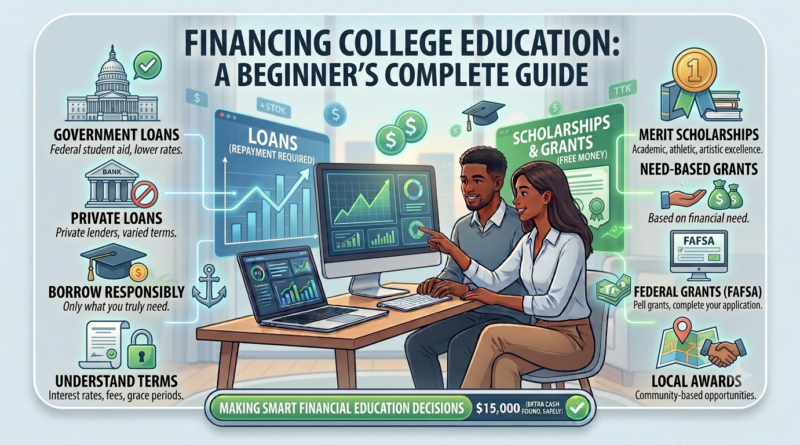
Financing College Education: A Beginner’s Complete Guide
There is a famous saying in personal finance: the best time to start saving for the future was yesterday; the second best time is today. When it comes to financing college education, this rule could not be more accurate.
With the global cost of tuition and housing rising faster than almost any other everyday expense, putting together a solid roadmap for paying for university has become a critical team sport for families worldwide. Let’s face it: figuring out how to save for higher education can feel incredibly overwhelming when you are just starting out. But taking the time to understand your options right now is one of the most powerful financial moves you can make.
The math is simple: saving money ahead of time is always significantly cheaper than borrowing money later. When you save, your money earns interest and grows over time. When you borrow via student loans, you have to pay back the original amount plus interest, making your education drastically more expensive in the long run. Let’s dive deep into exactly how to fund this major life milestone without drowning in debt.
1. The Ultimate Reality Check: Why Saving Beats Borrowing
To understand why a proactive plan for financing college education is so important, we need to talk about the massive gap between saving and borrowing.
When you put money into a savings account or an investment fund, you benefit from a magical concept called compound interest.
The Coffee Cup Analogy: Imagine you plant a single coffee bean. It grows into a small tree that produces ten more beans. If you plant those ten beans, you get ten trees producing a hundred beans. Compound interest is exactly like that, but with money. Your money earns interest, and then that interest earns its own interest, causing your savings to snowball over time.
On the flip side, if you do not plan ahead, you may find yourself relying heavily on student loans. Borrowing money flips compound interest completely against you. Instead of your wealth snowballing, your debt snowballs. You find yourself paying back thousands of dollars more than you originally borrowed, which can delay major life goals after graduation, like buying a car, traveling, or moving into your own apartment.
The Lifetime Value of a Degree
Is the effort to save for higher education truly worth it? Statistically, yes. Globally, workers with a university degree or an advanced technical certification earn significantly more over their lifetimes compared to those with only a high school qualification. Think of higher education as an investment in your personal “earning machine”—yourself. The goal is to get that premium education at the lowest possible cost, keeping your financial future bright and unburdened.
2. Whose Name Goes on the Account? The Great Debate
When families begin researching options for financing college education, they immediately run into a fundamental structural question: Should the savings account be opened in the parent’s name, or should it be opened in the student’s name?
Both approaches have distinct advantages and hidden traps. Let’s break down the mechanics of each side so you can make an informed choice.
Option A: Opening an Account in the Child’s Name
Putting the account directly in the teenager’s or child’s name sounds like a great, supportive gesture, and it does come with specific financial benefits—primarily regarding taxes.
- The Tax Advantage: In most countries, children and teenagers are in a much lower tax bracket (the category that determines what percentage of your income goes to the government) because they either do not work or work only part-time. Because their income is so low, any interest or investment growth earned inside an account under their name is taxed at a microscopic rate, or completely tax-free.
- The Trust Provision: Many legal systems have provisions—traditionally called custodial accounts or standard legal gifts—that allow parents to gift a specific amount of money to their child’s account each year without triggering any gift taxes. The money legally belongs to the minor, but an adult manages it until the child hits the age of majority (usually 18 or 21).
The Hidden Pitfalls of Child-Owned Accounts
While the tax savings are attractive, child-owned accounts carry two massive warnings:
- The Financial Aid Trap: When higher education institutions calculate how much financial assistance or grants to give a student, they look at assets. Wealth held directly in a student’s name is heavily penalized. The system assumes a student can spend a large percentage of their own money on tuition, which drastically reduces their eligibility for need-based financial aid.
- The Freedom Dilemma: Once a minor reaches the legal age of majority, that money is entirely theirs. There are no legal strings attached. If your teenager decides they no longer want to go to university and would rather buy a modified sports car or fund a year-long vacation, they have the absolute legal right to clear out the account.
Option B: Keeping the Account in the Parent’s Name
Retaining ownership of the fund gives parents complete control over how and when the money is deployed.
- The Control Benefit: If the child chooses a different path—like starting a business, taking an apprenticeship, or entering the workforce directly—the parents can keep the cash, use it for another sibling, or redirect it toward their own long-term goals. Furthermore, parent-owned assets are looked upon much more favorably by financial aid formulas, meaning the student remains eligible for more grants and assistance.
- The Downside: The parents will have to pay taxes on any interest or capital gains generated by the account based on their adult tax brackets, which are typically much higher than a teenager’s.
3. Global Vehicles for Financing College Education
Thankfully, you do not have to rely on standard, basic bank accounts to handle the heavy lifting. Governments around the world realize that paying for university is a massive burden on families, so they have created specialized, tax-advantaged education accounts. These accounts act like protective financial bubbles: money goes in, grows over the years, and can be pulled out completely tax-free, provided it is used to cover legitimate educational costs like tuition, books, and student accommodation.
Because these accounts are local, their names and specific rules shift depending on what country you live in. Let’s look at the global landscape:
United States
- 529 Investment Plans: These are state-sponsored plans that allow you to invest money in the stock market for a child’s education. The money grows entirely tax-free, and withdrawals are tax-free if used for qualified education expenses.
- Coverdell Education Savings Accounts (ESAs): Similar to a 529, but restricted to individuals under the age of 24, with lower annual contribution limits but more flexibility on using the funds for elementary and high school expenses.
United Kingdom
- Junior ISAs (Individual Savings Accounts): Parents can open a Stocks & Shares Junior ISA for their children. Anyone can contribute to it up to a set annual government limit. The investments grow completely insulated from tax, and the funds automatically convert into a standard adult ISA when the child turns 18.
Canada
- Registered Education Savings Plans (RESP): This is an incredible system where the Canadian government actively matches a portion of your savings. Through the Canada Education Savings Grant (CESG), the government will add a percentage of free money directly into your RESP based on how much you contribute annually, giving your savings an instant, massive boost.
Australia
- Investment Bonds / Education Bonds: These are specialized, tax-effective structures designed specifically for long-term savings goals like paying for university. The earnings are taxed within the bond at a flat corporate rate, and if held for at least ten years, the final payouts can be distributed completely tax-free to cover education costs.
4. Modern Strategies: Beyond Traditional Savings
Successfully financing college education in the modern world requires thinking outside the box. You do not have to rely solely on money saved up over a decade. There are highly effective alternative methods to drastically lower the total bill.
Strategy 1: Employer Tuition Reimbursement
An incredibly underutilized pathway is finding an employer willing to pay for your degree. To attract and retain motivated young talent, thousands of companies—ranging from global tech giants and banks to retail chains and coffee brands—now offer tuition reimbursement programs.
Under this setup, you work for the company part-time or full-time while attending classes. If you pass your courses with a certain grade, the company writes a check to cover your tuition costs. This allows you to graduate with a degree and years of professional work experience on your resume, placing you miles ahead of your peers.
Strategy 2: The Two-Year Degree Split (The Community College Model)
One of the easiest ways to slash your higher education bill in half is to change where you spend your first two years. Many students spend astronomical amounts of money on tuition and dorm rooms during their freshman and sophomore years just to take basic, introductory courses.
Instead, you can complete your general education requirements at a local, affordable community college or regional technical institute while living at home. As long as you ensure your credits are fully transferable, you can transition to a prestigious four-year university for your final two years. Your final degree will bear the name of that prestigious university, but you will have paid a fraction of the price.
Strategy 3: Digital Micro-Scholarships and Crowdfunding
The internet has completely revolutionized scholarships. You no longer need to be the valedictorian or an Olympic-level athlete to get free money for school. Modern platforms allow students to apply for “micro-scholarships” starting in early high school by logging good grades, participating in community service, or writing short essays. Additionally, dedicated educational crowdfunding platforms allow family members and community circles to contribute directly to a student’s tuition fund in place of traditional birthday or holiday gifts.
5. Case Studies: Two Paths to Financing College Education
Let’s look at two realistic, hypothetical scenarios to see how these different strategies function in the real world.
Case Study 1: The High-Debt Track (Alex’s Story)
Alex and his family did not focus on financing college education during his teenage years. When he was accepted into his dream university, they decided to figure it out as they went.
- The Process: Alex took out maximum student loans every year to cover tuition, expensive campus housing, and meal plans. Because he didn’t have savings to buffer the cost, he put his text books and lifestyle expenses onto high-interest credit cards.
- The Outcome: Alex graduated with a great degree, but he carried a massive $60,000 debt burden. Between the student loan payments and credit card interest, a huge portion of his monthly paycheck from his first job was instantly drained, forcing him to live at home with his parents for years to pay it off.
Case Study 2: The Strategic Combination (Chloe’s Story)
Chloe and her family started planning early, using a balanced, modern approach to save for higher education.
- The Process: Her parents contributed a modest $50 a month into a tax-advantaged education account since she was a child. When Chloe turned 16, she used a digital app to track down small, niche local scholarships. To save on housing, she spent her first two years studying online and at a regional college while living at home, before transferring to her final university. To cover her books, she worked 15 hours a week at a local company that offered tuition assistance.
- The Outcome: Because Chloe combined early family savings, smart institutional choices, and part-time work benefits, she graduated with the exact same degree as Alex but owed absolutely zero dollars. She was able to immediately sign a lease on her own apartment and start investing her income into building long-term wealth.
6. Pro-Tips and Common Pitfalls to Avoid
- Pro-Tip: Automate Your Educational Savings. Do not rely on saving “whatever is left over” at the end of the month, because there will never be anything left. Treat your college fund like a mandatory bill. Set up an automatic transfer from your main checking account into your dedicated education account the day after you get paid.
- Pitfall: Sacrificing Retirement for College. This is a critical message for parents: You can get a loan for college, but you cannot get a loan for retirement. It is a massive financial mistake to completely drain your retirement funds to pay for your child’s university degree. Protecting your own financial future prevents you from becoming a financial burden on your children later in life.
- Pro-Tip: Always Apply for Financial Aid Early. Fill out your regional financial assistance applications (like the FAFSA in the US or student finance forms in the UK) the absolute moment they open for the year. Financial aid is frequently distributed on a first-come, first-served basis. If you apply late, the funding pool might already be empty.
- Pitfall: Ignoring Hidden Costs. Tuition is only one piece of the puzzle. When calculating your budget, many absolute beginners forget to factor in textbooks (which can cost hundreds of dollars per term), student health insurance, technology fees, laboratory costs, and transportation. Always add a 15% buffer to your educational budget to cover these surprises.
Quick Action Checklist for Beginners
Ready to build your roadmap for financing college education? Take these step-by-step actions to clear the confusion and take control:
- [ ] Calculate the True Target Cost: Research the current total cost of tuition, fees, and living expenses for three local universities or colleges you might want to attend to establish a realistic baseline.
- [ ] Identify Your Local Tax Bubble: Look up the exact name of the tax-advantaged education account offered by the government in your country (e.g., 529 in the US, RESP in Canada, JISA in the UK) and review the rules for opening one.
- [ ] Check for Free Money First: Before looking at loans, spend one weekend exploring modern scholarship search engines. Look for hyper-local, weird, or specific grants that match your hobbies, background, or intended field of study.
- [ ] Build an Emergency Fund Buffer: Ensure you have a separate pool of standard savings set aside for everyday life emergencies (car repairs, dental work, broken laptops) so you never have to raid your dedicated education fund for non-school expenses.
- [ ] Talk as a Family: Sit down with your parents, guardians, or mentors to have an open, transparent conversation about who is contributing what, creating a unified plan before application deadlines arrive.