How to Invest Money Wisely: A Beginner’s Guide to the Market
The idea of investing can feel incredibly intimidating. You see headlines about stock market crashes, complicated charts, and overnight millionaires trading obscure digital assets. But true investing isn’t a high-stakes poker game at a casino. When you learn how to invest money wisely, it becomes a slow, methodical, and highly predictable way to build long-term wealth.
If you are a teenager with your first paycheck, an absolute beginner, or someone who recently received an inheritance, the rules of the game are exactly the same. True investing is about mastering smart investing habits, protecting your downside, and letting time do the heavy lifting.
Let’s strip away the wall-street jargon and look at a realistic, step-by-step roadmap to get your money working for you safely.
The Pre-Investment Audit: Are You Actually Ready?
Before you buy a single stock, you must take a strict inventory of your current financial situation. A common mistake is jumping into the market simply because an investment is advertised with high growth potential.
Every investment carries a balance of risk and reward. If you cannot afford to absorb financial risk, you are not ready to start. For example, if you receive a financial windfall or inheritance, it might feel tempting to throw it all into the stock market. But if that cash is your only financial asset, risking it is a major gamble.
Step 1: Secure Your Financial Safety Net
Your emergency fund must be fully intact before you touch the stock market. Think of this cash buffer like a financial shield.
What is an Emergency Fund? A separate, easily accessible pot of cash reserved exclusively for unexpected events (like a broken laptop, car repairs, or sudden job loss).
Having a solid emergency fund ensures that if the stock market drops tomorrow, you won’t be forced to sell your investments at a loss just to pay your bills. Protect your everyday lifestyle first, then use your extra cash to build your nest egg.
Understanding Asset Allocation Basics
When you are ready to invest, you will split your money across three primary building blocks, known as asset classes. Deciding how much money goes into each bucket is a strategy called asset allocation basics.
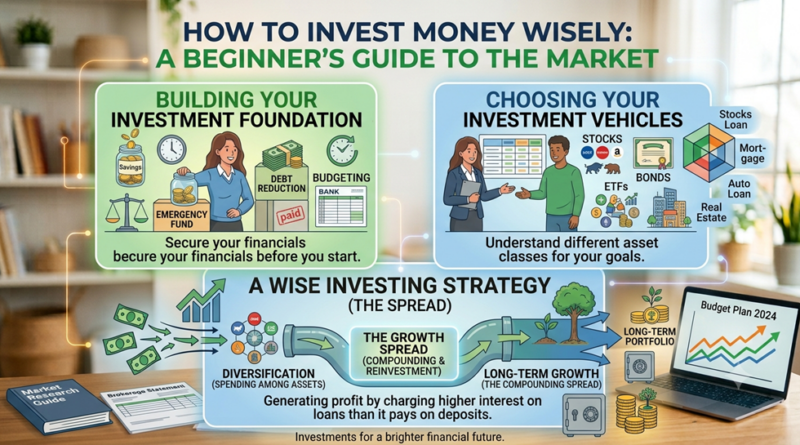
As shown in the visual above, your portfolio will typically be divided among these three foundational pillars:
1. Stocks (Equities)
- What they are: Buying a tiny piece of ownership in a real corporation (like Apple, Sony, or Nike).
- The Risk/Reward Profile: High risk, high reward. Stocks carry the highest potential for long-term profit, but their prices can swing wildly from day to day.
2. Bonds (Fixed Income)
- What they are: Actling like a lender. You lend your money to a government or a large corporation, and they promise to pay you back over time with a fixed amount of interest.
- The Risk/Reward Profile: Medium risk, medium reward. They are much more stable than stocks but offer lower overall growth potential.
3. Cash & Money Market Accounts
- What they are: Ultra-safe, interest-bearing bank accounts or short-term government debt instruments.
- The Risk/Reward Profile: Low risk, low reward. While your growth will be slow, you face almost zero risk of losing your initial deposit. They are an ideal place to hold your cash reserves.
The Core Strategy: Diversification
If you take only one concept away from this guide, let it be this one: Never put all your eggs in one basket.
If you invest all your savings into a single company’s stock, and that company goes bankrupt, your life savings disappear. Diversification means spreading your money across hundreds or thousands of different investments. If one company suffers a massive loss, the healthy companies in your portfolio provide breathing room and balance out the damage.
The Beginner’s Fast-Track: Mutual Funds and ETFs
As a beginner, you don’t need to manually pick individual stocks. The easiest way to diversify instantly is through Mutual Funds or ETFs (Exchange-Traded Funds).
What is an ETF or Mutual Fund? Imagine a basket filled with tiny pieces of hundreds of different top global companies. When you buy just one share of the fund, you instantly own a tiny piece of everything inside that basket.
By prioritizing diversified funds that hold shares in large, stable corporations, you drastically lower your risk while capturing the upward growth of the global economy.
Play the Long Game: The 5-Year Rule
Investing is very different from trading. Trading is buying and selling quickly to make a fast buck. Investing is purchasing an asset with the intention of holding it for years to let it grow.
When learning how to invest money wisely, treat the stock market like purchasing a home. You wouldn’t buy a house today and sell it next week just because the housing market dipped slightly.
- The 5-Year Horizon: Ideally, any money you put into the stock market should be money you do not need to touch for at least five years.
- Avoid the Noise: Do not constantly tweak or adjust your investments based on daily news headlines. Sit tight, stay comfortable with your risk level, and let your money snowball. As you become more educated and confident, you can gradually adjust your strategy.
Common Pitfalls to Avoid
- Chasing Hype: Avoid buying assets simply because they are trending on social media. If an investment sounds too good to be true, it usually is.
- Investing Rent Money: Never invest cash that you need for your immediate living expenses or short-term goals.
- Ignoring Fees: High management fees can eat away at your investment profits over time. Look for low-cost index funds with low internal expenses.
Quick Action Checklist
Ready to take your first steps into the market safely? Use this step-by-step checklist:
- [ ] Step 1: Calculate your total net worth by listing your assets (savings, cash) and subtracting any liabilities (debts).
- [ ] Step 2: Ensure your emergency fund has at least $1,000 (or 3 months of basic living expenses) parked safely in a high-yield account.
- [ ] Step 3: Open a tax-advantaged investment account based on your country’s local options (e.g., an IRA in the US, an ISA in the UK, or a TFSA in Canada).
- [ ] Step 4: Look for a broad, low-cost index fund or ETF that tracks major global corporations to achieve instant diversification.
- [ ] Step 5: Set up an automatic monthly contribution (even if it’s small) to build consistency and practice long-term wealth building.