
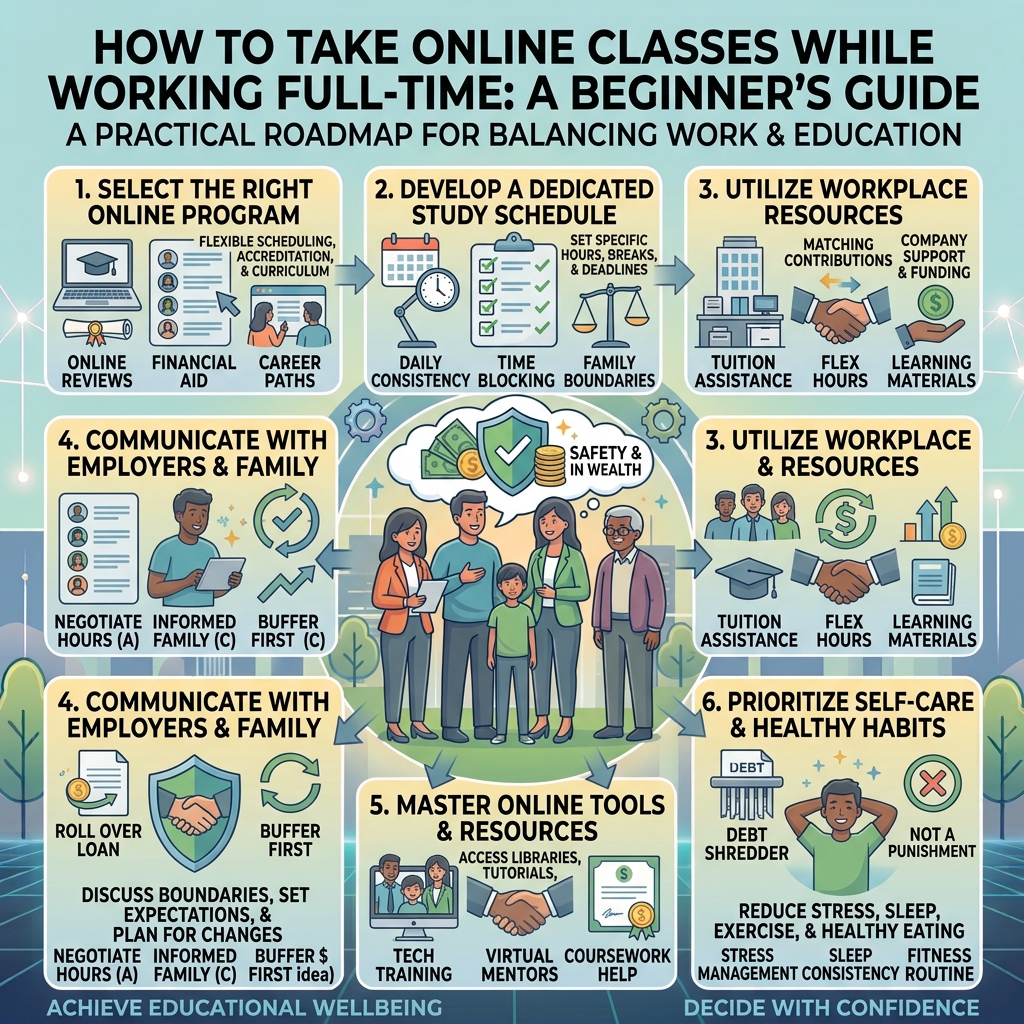
How to Take Online Classes While Working Full-Time: A Beginner’s Guide
Investing in your education is one of the single best financial moves you can make over a lifetime. According to the Association of Public and Land-grant Universities (APLU), bachelor’s degree holders earn an average of $32,000 more per year than high school graduates, while master’s degree holders command even higher lifetime earning potential.
However, traditional higher education has historically forced adults to make a difficult choice: keep earning a steady living or leave the workforce to attend daytime lectures.
Fortunately, distance education has transformed how adults upskill. Over 7 million students are enrolled in online degree programs, allowing working professionals to advance their careers without giving up their paychecks.
While taking online classes while working full-time is completely doable, it requires clear priorities, strict boundaries, and disciplined time management. Here is your ultimate survival guide to balancing a 40-hour work week with higher education.
The Core Advantages of Online Classes for Full-Time Workers
Online degree programs are designed around the schedules of busy adults rather than traditional campus routines.
- Flexible Scheduling: You are not locked into a 9:00 AM lecture. You can watch course materials, participate in discussion boards, and read assignments early in the morning, late at night, or over the weekend.
- Zero Commute Costs: Your classroom is wherever you have a laptop and a stable internet connection. Eliminating travel to a physical campus saves hours of commute time every week—plus money on fuel, parking passes, and wear-and-tear on your car.
- Continuous Income Stream: More than 50% of traditional college dropouts leave school simply because they cannot afford tuition, rent, or childcare while studying. Online learning lets you keep earning your regular income to cover basic living expenses while building your credentials.
- Immediate Career Application: What you learn in class on Tuesday evening can often be applied directly to your job on Wednesday morning, making you a more valuable asset to your team right away.
Step 1: Secure Employer Tuition Assistance
Before paying for tuition out-of-pocket or taking on federal student loans, check if your current employer offers educational benefits.
[Your Workplace] ──(Tuition Assistance Program)──> [Tax-Free Education Grant]
                                                            │
                                                            ▼
                                                Up to $5,250 / year in
                                                 Direct Tuition Savings
Under current tax regulations in major jurisdictions (such as Section 127 in the United States), employers can provide up to $5,250 per year in tax-free tuition assistance to eligible employees.
How to Pitch Your Manager for Tuition Coverage:
- Highlight the ROI for the Business: Explain how your coursework directly upgrades your technical or management skills, allowing you to solve higher-level problems for the company.
- Emphasize the Tax Benefits: Remind your HR department or supervisor that tuition assistance up to the annual limit is tax-deductible for the business and tax-free for you.
- Commit to Retention: Employers finance education to retain top talent. Assure them that you intend to bring your new skills back to the company long-term.
Step 2: Set Work and Personal Boundaries
Trying to excel at a 40-hour job, maintain an intense social life, raise a family, and complete a college degree simultaneously is a recipe for severe burnout. You must set firm expectations early.
Workplace Boundaries
- Inform Your Manager: Let your supervisor know you are enrolled in a degree program. A supportive employer can help you avoid unexpected weekend overtime or mandatory team-building events during finals week.
- Disconnect After Hours: Establish clear off-hours communication rules. Unless you are on paid call, avoid checking work email late at night when you should be focusing on coursework.
Home & Family Boundaries
- Schedule Support with Partners: If you have children, coordinate childcare schedules with your partner or family members so you can have dedicated, uninterrupted study hours.
- Protect a Self-Care Window: Block out at least one afternoon or evening a week strictly for rest, exercise, or hobbies to reset your mental battery.
Step 3: Master Time Management & Distraction Control
Balancing a job and university courses leaves very little room for wasted hours. Treating your study time with the same professionalism as your work commitments is vital.
                      [Balancing Your Weekly 168 Hours]
                                     │
         ┌───────────────────────────┼───────────────────────────┐
         │                           │                           │
  [Full-Time Work]            [Sleep & Health]            [Online Study]
    (40 Hours)                   (56 Hours)                 (15–20 Hours)
         │                           │                           │
         └───────────────────────────┼───────────────────────────┘
                                     │
                        [Remaining Personal Buffer]
                              (52–57 Hours)
| Strategy | How It Works | Key Benefit |
| The Pomodoro Technique | Study intently for 25 minutes, then take a strict 5-minute break. Repeat 4 times before a longer 20-minute break. | Maintains focus and prevents mental fatigue during dense readings. |
| Digital Fasting | Turn off TV background noise and put your smartphone in another room while studying. | Stops social media doom-scrolling from stealing your study blocks. |
| Micro-Studying | Use 15-minute work lunch breaks to read a chapter, outline an essay, or review flashcards. | Chips away at weekly assignments so weekends stay manageable. |
| Dedicated Workspace | Set up a clean desk in a quiet room rather than studying from bed or the couch. | Signals your brain that it is time to focus and accomplish tasks. |
Case Studies: Two Approaches to Working and Studying
Scenario A: Maya’s Structured Path
Maya worked full-time as an administrative assistant while taking two online courses per term toward a business degree.
- The Strategy: She negotiated $3,000 in annual tuition assistance with her employer, studied from 7:00 PM to 9:00 PM every weeknight, and kept weekends dedicated to family and rest.
- The Result: Maya completed her degree in three years with zero debt, using her new credentials to secure a promotion to Operations Manager with a 35% salary increase.
Scenario B: Dave’s Overloaded Schedule
Dave enrolled in a full-time 4-course load online while working a demanding 45-hour sales job without setting boundaries.
- The Strategy: He tried to maintain his weekend social schedule while cramming all his coursework late Sunday night.
- The Result: Exhaustion led to missed work deadlines and declining grades. Dave ended up withdrawing from two courses mid-term, losing his tuition deposit.
Frequently Asked Questions
How many hours a week do online classes take?
As a general rule, expect to spend 3 to 4 hours per week for every credit hour you take. A standard 3-credit course usually requires 9 to 12 hours of total study time per week, including reading, watching lectures, and completing assignments. Most full-time workers start with 1 or 2 courses (6 credits) per term to test their capacity.
Are online degrees respected by employers?
Yes. Modern employers evaluate the regional accreditation of the institution rather than whether the classes were taken online or in person. Diplomas issued by accredited universities generally do not state “online” on the degree certificate.
Quick Action Checklist
- [ ] Audit Your Employer’s Benefits: Ask HR if your company offers a tax-free tuition assistance program.
- [ ] Calculate Your Available Hours: Outline a weekly calendar grid to identify 15 dedicated study hours.
- [ ] Choose a Low-Load Starting Term: Register for just 1 or 2 courses for your first semester to adjust your routine without overwhelming yourself.
- [ ] Build Your Study Space: Set up an ergonomic desk space with reliable high-speed internet, noise-canceling headphones, and distraction-blocking apps.