
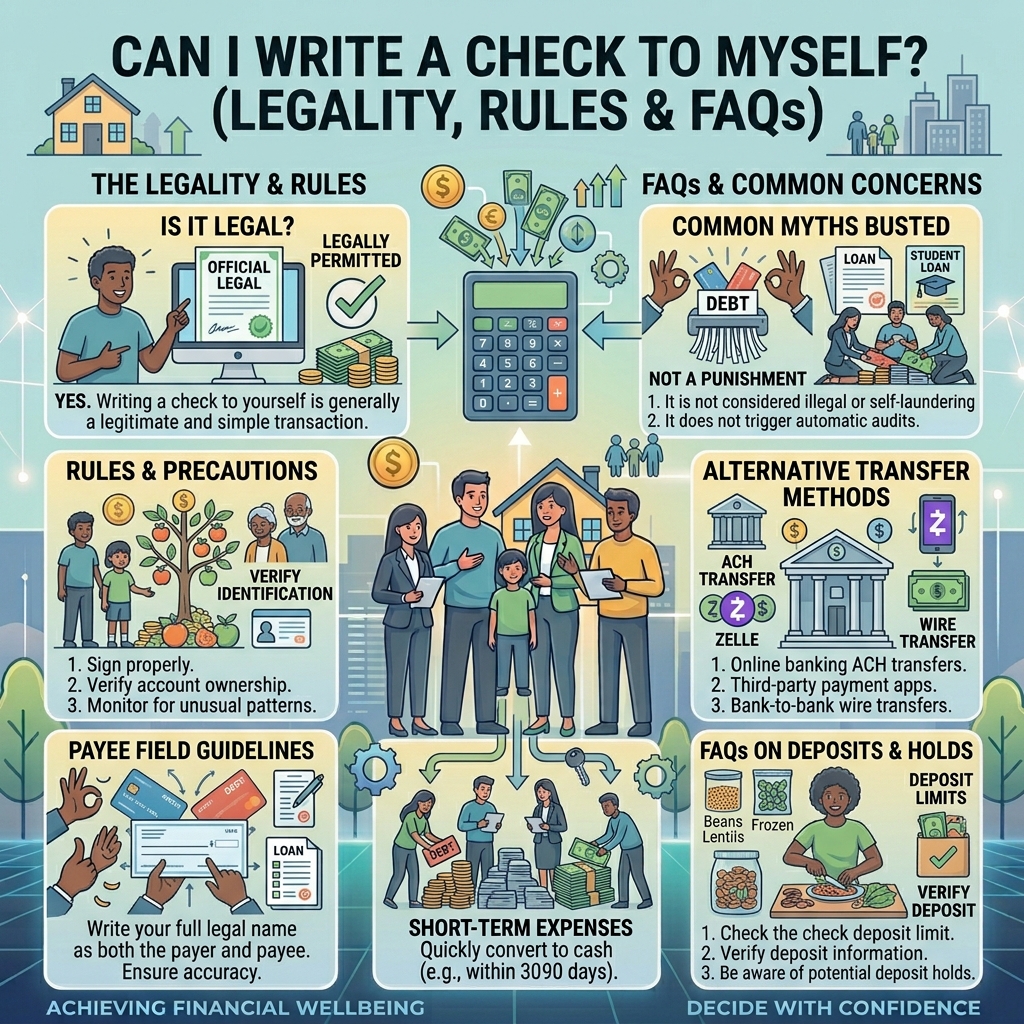
Can I Write a Check to Myself? (Legality, Rules & FAQs)
Writing a physical paper check may seem like a habit from a bygone era, especially in an age dominated by instant online transfers and mobile payment apps. However, paper checks remain a reliable, secure way to move money between accounts.
If you have ever wondered whether it is legal to write a check to yourself—and why someone would want to—the short answer is yes, it is completely legal.
Whether you are transferring money from a checking account at one bank to a savings account at another, paying yourself from a small business account, or moving money out of a joint account, writing a check to yourself is a safe and standard transaction.
Here is everything you need to know about the legality, the step-by-step process, common safety traps, and modern alternatives.
Is It Legal to Write a Check to Yourself?
Yes, writing a check to yourself is 100% legal. A check is simply a written instruction authorizing a financial institution to transfer funds from one account to another. Legally, it does not matter whether the recipient (the payee) is a third party or the account owner.
[Account A: Issuing Bank] ──(Paper Check / Authorization)──> [Account B: Receiving Bank]
As long as you have sufficient cleared funds in the issuing account to cover the check amount, you can write as many checks to yourself as you need.
Why Would Someone Write a Check to Yourself?
Even with online banking, there are several practical reasons to write a check to yourself:
- Transferring Money Between Unlinked Banks: If you hold accounts at two different banks or credit unions that are not linked electronically, writing a check is often faster than setting up a new electronic link.
- Moving Large Sums Beyond Daily Transfer Limits: Many digital apps and bank wire services place daily cap limits (e.g., $2,000 to $5,000 per day) on electronic transfers. A check allows you to move larger amounts without daily digital caps.
- Paying Yourself from a Business Account: Sole proprietors, freelancers, and small business owners with signatory authority routinely write checks drawn on their business account to deposit into their personal account as an owner’s draw or salary payment.
- Maintaining a Paper Trail: Physical checks leave a clear, documented record of money moving between personal or business accounts for tax and accounting audits.
- Bypassing Card or System Outages: If your debit card is lost, damaged, or undergoing a system outage, writing a check to deposit into another active account ensures uninterrupted access to cash.
How to Correctly Fill Out a Check to Yourself
Filling out a check to yourself follows the same steps as writing a check to anyone else, with one critical distinction:
┌────────────────────────────────────────────────────────────────────────┐
│ YOUR NAME                                                   CHECK #101 │
│ 123 Street Name                                                        │
│ Date: [ Today's Date ]                                                 │
│                                                                        │
│ Pay to the Order of: [ YOUR FULL LEGAL NAME ]          $ [ Amount ]     │
│                                                                        │
│ Amount in Words: [ Dollars and Cents Written Out ]           DOLLARS   │
│                                                                        │
│ Memo: [ Account Transfer ]         Signature: [ YOUR SIGNATURE ]       │
└────────────────────────────────────────────────────────────────────────┘
- Date: Write the current date in the upper right corner.
- Payee Line (“Pay to the Order of”): Write your full legal name exactly as it appears on the receiving bank account.
- Numerical Amount Box: Enter the exact dollar amount (e.g.,
$1,500.00). - Written Amount Line: Write out the word representation of the amount (e.g., One thousand five hundred and 00/100).
- Memo Line (Optional): Add a reference note like “Transfer to Savings” or “Owner’s Draw”.
- Signature Line: Sign your legal signature on the line in the bottom right corner.
Critical Safety Warning: Never write “Cash” on the payee line. A check payable to “Cash” becomes a bearer instrument—meaning anyone who finds or intercepts it can legally cash it. Always write your full legal name on the payee line so that only you can deposit or cash the check.
Avoid “Check Kiting” and Bouncing Penalties
While writing a check to yourself is completely legal, doing so without sufficient funds in the issuing account is a serious crime.
                  [Writing a Check to Yourself]
                                │
        ┌───────────────────────┴───────────────────────┐
SUFFICIENT FUNDS IN ACCOUNT                     INSUFFICIENT FUNDS
        │                                               │
• Funds transfer smoothly                       • Check bounces (NSF fees apply)
• No risk of fraud charges                      • Account closure risk
                                                • Potential Check Kiting criminal liability
What Is Check Kiting?
Check kiting is an illegal scheme where an individual takes advantage of the “float time”—the 24- to 48-hour period it takes for funds to move between banks—by writing checks back and forth between accounts to access non-existent funds.
If you write a check to yourself knowing your issuing account lacks the necessary balance, expecting to cover it later or taking advantage of provisional credit provided by the receiving bank, your check will bounce.
Bouncing a check can result in:
- Overdraft and Non-Sufficient Funds (NSF) fees ($25 to $35+ per instance).
- Negative reporting to banking consumer networks like ChexSystems, which can prevent you from opening future bank accounts.
- Civil or criminal charges for fraud or writing bad checks.
4 Modern Alternatives to Moving Money
If you want to move money between accounts without physical paper checks, consider these common digital alternatives:
| Transfer Method | Processing Time | Cost / Fees | Best Used For |
| ACH Bank-to-Bank Transfer | 1 to 3 business days | Typically Free | Moving routine funds between linked personal accounts. |
| Mobile Check Deposit | 1 to 2 business days | Free | Depositing a self-written paper check via smartphone app. |
| Peer-to-Peer (P2P) Apps | Instant to 1 business day | Free (Standard) / ~1.5% (Instant) | Moving small amounts using linked debit cards. |
| Wire Transfer | Same day (Hours) | $15 to $35+ fee | Moving large, urgent sums safely (e.g., real estate down payments). |
Frequently Asked Questions
Is there a dollar limit on how big of a check I can write to myself?
There is no legal limit on the dollar amount you can write to yourself. As long as the full balance is available and cleared in the issuing account, you can write a check for any amount. However, deposits over $10,000 may trigger standard regulatory reporting under government anti-money laundering frameworks.
How do I deposit a check written to myself using a mobile app?
To deposit a self-written check on your banking smartphone app:
- Make out the check to your full legal name and sign the front.
- Turn the check over and sign the endorsement line on the back.
- Beneath your endorsement signature, write “For Mobile Deposit Only at [Bank Name]” (or check the box if present).
- Take clear photos of the front and back of the check within the app to complete the deposit.
Where can I cash a check written to myself?
You can cash or deposit a check made out to yourself at:
- Your local bank branch or credit union teller window.
- A participating ATM belonging to your receiving bank.
- Your bank’s mobile app via smartphone photo deposit.
- Authorized check-cashing retail locations (such as Walmart or local grocery service desks), subject to ID verification and transaction fees.
Quick Action Checklist
- [ ] Verify Available Funds: Confirm your issuing bank account has sufficient cleared funds to cover the check before writing it.
- [ ] Use Your Full Legal Name: Always write your name on the payee line—never write “Cash”.
- [ ] Endorse Properly for Mobile Use: If depositing via app, include “For Mobile Deposit Only” under your signature on the back.
- [ ] Keep the Physical Check Secure: Retain the physical check in a safe place for 14 to 30 days until the funds fully clear in your destination account, then shred it.
Disclaimer: The content on this website is for informational and educational purposes only and should not be construed as professional financial, investment, tax, or legal advice. I am not a licensed financial advisor. While I strive to keep the information accurate and up to date, financial markets and laws change frequently. Always consult with a qualified financial professional before making any financial or investment decisions based on the information provided on this site.