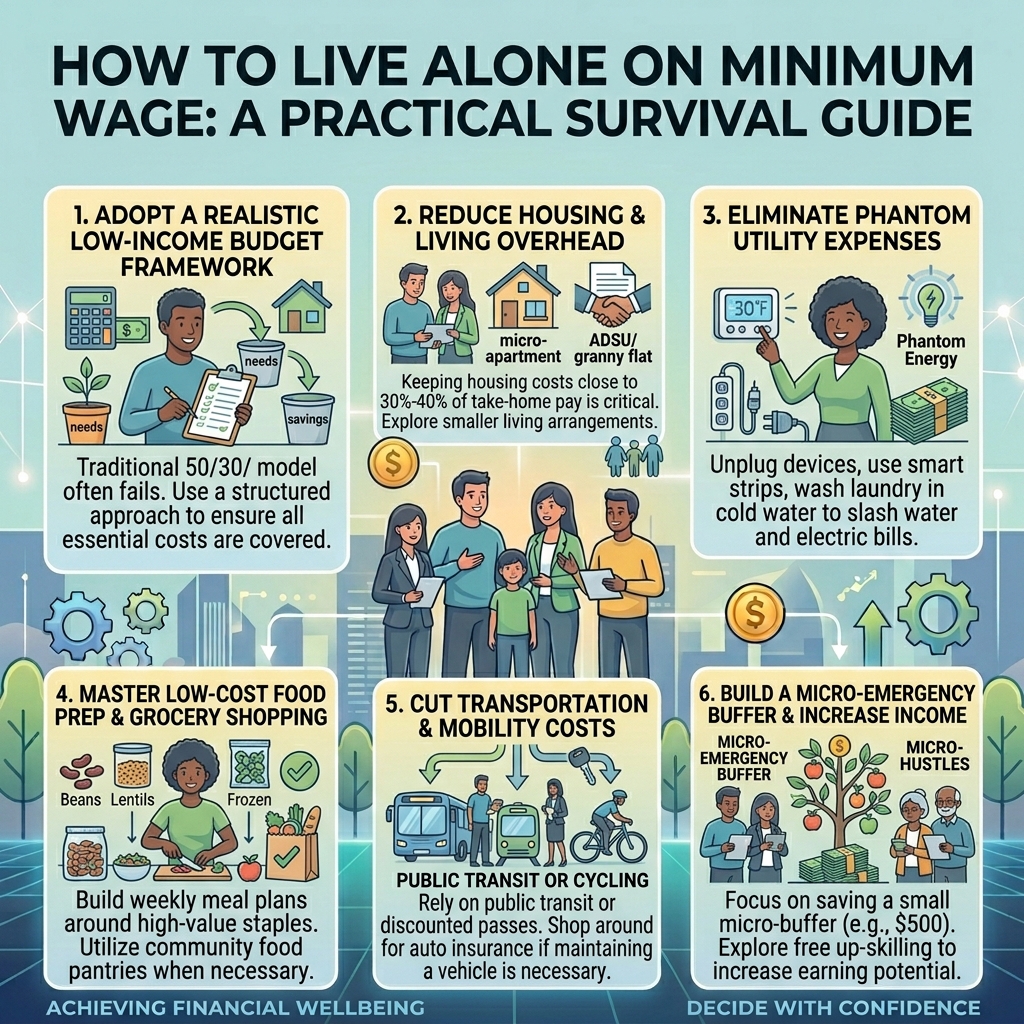
How to Live Alone on Minimum Wage: A Practical Survival Guide
Moving into your own place brings incredible freedom. Having total control over your space, routine, and lifestyle is an major milestone. However, the reality of solo living can quickly feel overwhelming when you are responsible for rent, utilities, grocery bills, and transportation all on your own.
While the U.S. federal minimum wage sits at $7.25 per hour, many states, municipalities, and entry-level employers offer baseline wages starting around $12.00 per hour.
At $12.00 an hour working a full-time 40-hour work week, your gross annual earnings equal approximately $24,960 (roughly $2,080 per month before taxes and withholdings).
Can you comfortably live alone on a $12 hourly wage in America today? Yes, but it requires intentional planning, strict budget tracking, and making strategic choices across your major daily expenses.
Here is a step-by-step blueprint on how to make living alone on minimum wage work for you.
The $12/Hour Monthly Income Benchmark
Before diving into expense management, let’s look at what your real takeaway pay looks like on a $12.00 hourly income:
| Income Metric | Gross Amount | Estimated Net (After ~15% Taxes/FICA) |
| Hourly Rate | $12.00 / hour | ~$10.20 / hour |
| Weekly Pay (40 Hours) | $480.00 / week | ~$408.00 / week |
| Monthly Income | $2,080.00 / month | ~$1,768.00 / month |
| Annual Earnings | $24,960.00 / year | ~$21,216.00 / year |
The Golden Rule of Minimum Wage Budgeting: Every single dollar must have a job. When living solo on a tight margin, your goal is to minimize fixed costs (rent, transit) so you always have a cash cushion for unexpected emergencies.
Step 1: Track Your Money via Bank Statements
The very first step to living independently on a limited income is gaining total transparency over your cash flow.
At the end of every month, download your bank and credit card statements and group every line item into four core categories: Housing, Food, Transportation, and Discretionary Spending.
[Net Monthly Pay: ~$1,768] ──┬──> 1. Fixed Essentials (Rent & Utilities: Target ~50%)
                             ├──> 2. Variable Essentials (Groceries & Transit: Target ~30%)
                             └──> 3. Safety Net & Goals (Emergency Savings & Debt: Target ~20%)
Look closely for hidden money leaks:
- Unused streaming subscriptions or app trials that auto-renewed.
- Recurring monthly maintenance or bank account service fees.
- Frequent small convenience store or coffee purchases that silently add up to $100+ per month.
Step 2: Master the 4 Core Expense Fronts
To thrive while living alone on minimum wage, you must optimize four major areas of daily spending:
1. Groceries & Meals
Eating out or relying on meal delivery apps is the fastest way to destroy a minimum wage budget. Single restaurant meals routinely cost $15 to $25—the equivalent of two full hours of work at $12/hour.
- Embrace Whole Foods: Base your diet around versatile, budget-friendly staples like rice, beans, eggs, seasonal produce, oats, and frozen vegetables.
- Meal Prep on Weekends: Cooking batch meals (like chilis, stews, or grain bowls) on Sunday prevents impulse takeout orders after a tiring workday.
- Shop Local Markets: Visit regional farmers’ markets or discount grocery chains (like Aldi or Lidl) for affordable fresh produce rather than high-end supermarkets.
2. Rent & Housing Costs
Housing is your largest single monthly expense. When living solo on $12/hour, keeping housing costs below 30% to 40% of your take-home pay is vital.
                    [Where Do You Choose to Live?]
                                  │
       ┌──────────────────────────┴──────────────────────────┐
  HIGH-COST STATES / METROS                           LOW-COST STATES / REGIONS
  (CA, NY, MA, HI, NJ)                                (MS, AR, AL, OK, OH)
  • Studio rents often exceed $1,200/mo                • Studio rents average $500–$750/mo
  • Requires roommates or suburban commuting          • Solo studio living is realistic
- Location Strategy: Living in high-cost states makes solo renting near impossible without assistance. If relocating is an option, lower-cost regions offer significantly lower baseline rent.
- Choose Studio Units or Micro-Apartments: Skip larger one-bedroom units in favor of studio apartments or basement suites, which carry lower utility heating and cooling bills.
- Consider No-Income-Tax States: Living in states with zero state income tax (such as Florida, Texas, Washington, Tennessee, Nevada, or Wyoming) lets you keep slightly more of your gross paycheck.
3. Transportation & Commuting
Owning a vehicle carries high fixed costs—including loan interest, auto insurance, state registration, fuel, and routine maintenance (tires, oil, repairs)—averaging $400 to $700 per month.
- Public Transit: Utilizing monthly subway or bus passes cuts your commuting costs down to $70–$120 per month. Many employers also offer tax-free commuter benefits that reduce transit costs further.
- Bicycles & Micro-Mobility: If you live within 3 to 5 miles of work, investing in a reliable bicycle or e-scooter eliminates fuel and parking costs completely while providing daily exercise.
- Carpooling & Ridesharing: If public transit isn’t viable, arrange a carpool split with coworkers to divide gas costs.
4. Smart Apparel & Everyday Shopping
Buying brand-new, full-price clothing on a minimum wage income drains savings unnecessarily.
- Thrift & Consignment Shops: Source quality workplace and casual wear from thrift stores (like Goodwill or local consignment shops) or digital secondhand platforms (Poshmark, ThredUp, eBay) for a fraction of retail prices.
- Capsule Wardrobe: Maintain a small collection of versatile, neutral clothing items that can be mixed and matched easily.
Step 3: Managing Debt & Building an Emergency Cushion
Living paycheck-to-paycheck without a safety net means a single surprise bill—like an urgent medical expense or dental fix—can force you into high-interest credit card debt.
1.1. Establish a $500 Starter Emergency Fund: Build a minimal buffer first.
Direct $25 to $50 from every paycheck into a high-yield savings account until you reach $500. Keep this money separate from your daily checking account.
2.2. Inventory All Outstanding Debts: Organize your obligations.
List all credit cards, personal loans, or student debt balances alongside their minimum monthly payments and interest rates (APR).
3.3. Apply the Debt Avalanche Method: Focus extra payments strategically.
Pay the required minimum on all debts, then direct any spare savings toward the card or loan with the highest interest rate to eliminate costly interest charges first.
The 50/30/20 Budget Framework for Minimum Wage
A helpful tool for organizing your paycheck is the 50/30/20 Budget Rule, adapted for entry-level incomes:
[Take-Home Pay: ~$1,768/month]
   │
   ├── 50% NEEDS (~$884)       ──> Rent, essential utilities, basic groceries
   ├── 30% WANTS (~$530)       ──> Phone plan, internet, low-cost hobbies, dining out
   └── 20% SAVINGS/DEBT (~$354)──> Emergency fund deposits & debt repayments
- 50% Needs ($884): Rent, electric, water, essential groceries.
- 30% Wants ($530): Basic phone/internet plans, low-cost recreation, small personal treats.
- 20% Savings/Debt ($354): Emergency fund contributions and debt payoff.
Note: In higher-cost areas, your “Needs” allocation may temporarily expand to 60% or 70% of your net pay while you work on increasing your hourly earning power.
Frequently Asked Questions
Can you live alone on $12 an hour in expensive cities like New York or Los Angeles?
Renting a solo apartment in high-cost tier-1 cities on $12/hour without external income assistance is practically impossible, as average studio rents exceed total monthly net earnings. In high-cost metro areas, working at $12/hour requires living with roommates, renting a room in a shared house, or moving to outer suburban transit corridors.
What is the fastest way to increase income when earning minimum wage?
Focus on upskilling through free online courses, pursuing internal workplace promotions, or picking up targeted side-hustles (such as pet sitting, food delivery, or weekend freelancing) to raise your baseline hourly earning power above $15 to $20+ per hour.
Quick Action Checklist
- [ ] Calculate Net Monthly Pay: Determine your exact take-home income after payroll deductions.
- [ ] Review Past 30 Days of Spending: Print out your bank statements and highlight non-essential costs to trim.
- [ ] Set Up a High-Yield Savings Account: Automate a small transfer (e.g., $20/week) into a starter emergency fund.
- [ ] Audit Grocery & Food Spending: Switch to meal prepping and buy baseline pantry staples to keep weekly food costs under control.
Disclaimer: The content on this website is for informational and educational purposes only and should not be construed as professional financial, investment, tax, or legal advice. I am not a licensed financial advisor. While I strive to keep the information accurate and up to date, financial markets and laws change frequently. Always consult with a qualified financial professional before making any financial or investment decisions based on the information provided on this site.