
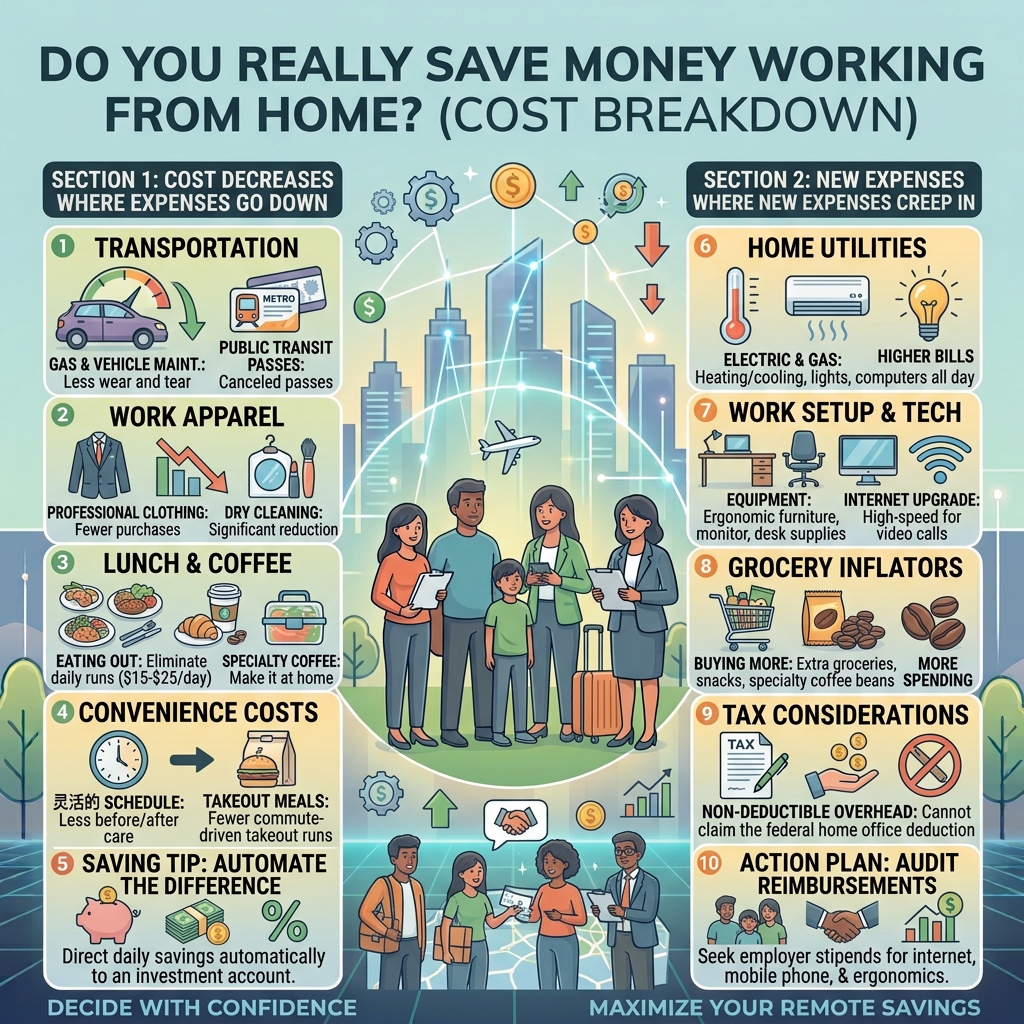
Do You Really Save Money Working From Home? (Cost Breakdown)
Meta Description:
Category: Remote Work & Personal Finance
Tags: working from home savings, wfh budget breakdown, remote work tax deductions, commuting costs savings, hybrid work flexibility
How Much Money Do You Actually Save Working From Home?
The shift toward remote and hybrid work completely transformed the traditional workplace. While many employers have issued return-to-office (RTO) mandates, employees remain strongly resistant—with survey data showing that over 35% of remote workers would consider quitting if forced back into a full-time office setting.
Beyond the obvious perk of skipping a daily commute, the financial benefits of working from home are substantial. A full-time remote worker can save anywhere from $3,000 to $6,000 per year in out-of-pocket expenses.
Here is a complete breakdown of where those savings come from, the hidden costs to watch out for, and how the numbers stack up.
Annual Savings Breakdown: Office vs. WFH
| Expense Category | Typical Annual Office Cost | Typical Annual WFH Cost | Estimated Annual Savings |
| Commuting (Gas, Maintenance, Tolls) | $1,800 – $4,500 | $0 – $500 | $1,800 – $4,000 |
| Work Wardrobe & Dry Cleaning | $1,200 – $2,000 | $200 – $500 | $1,000 – $1,500 |
| Dining Out, Coffee & Happy Hours | $2,500 – $4,000 | $800 – $1,500 | $1,700 – $2,500 |
| Pet Sitting / Dog Walking | $1,500 – $3,000 | $0 – $500 | $1,500 – $2,500 |
| ESTIMATED TOTAL SAVINGS | $3,000 – $6,000+ / year |
6 Major Ways Working From Home Saves You Money
  ┌──────────────────────────────────────────────────────────┐
  │                 MAJOR WFH SAVINGS DRIVERS                │
  └─────────────────────────────┬────────────────────────────┘
                                │
   ├── 1. Commute & Auto Costs  ──> Gas, insurance, wear & tear
   ├── 2. Apparel Expenses      ──> Formal wear, shoes, dry cleaning
   ├── 3. Food & Socializing    ──> Daily lunches, coffee runs, happy hours
   └── 4. Pet & Child Services  ──> Dog walkers, day care, transit time
1. Commuting, Fuel, and Vehicle Depreciation
Commuting is consistently cited as the top expense eliminated by remote work.
- Gas & Wear: An average 30-mile daily roundtrip commute burns around 12 to 15 gallons of gas monthly in a standard sedan. At average fuel prices, plus routine wear-and-tear (tires, oil changes, brake pads), driving to work costs $150 to $400 per month ($1,800 to $4,800 annually).
- Time Savings: Spending 30 to 60 minutes commuting each way equals roughly 10 hours a week—or over 400 hours a year—returned to your personal schedule.
2. Work Apparel and Dry Cleaning
Maintaining a professional office wardrobe comes with recurring costs. Business casual attire, formal footwear, and frequent dry cleaning easily add up to $100–$160 per month. Working remotely allows you to rely on everyday casual wear, dramatically extending the lifespan of your clothing and reducing maintenance costs.
3. Food, Daily Coffee, and Socializing
- Lunches & Coffee: Grabbing a $12 takeout lunch and a $5 specialty coffee every workday costs over $3,500 per year. Making meals and brewing coffee at home cuts that bill by 70% or more.
- Happy Hours: Post-work drinks and team dinners add up quickly. Reducing workplace socializing can save upwards of $1,000 to $2,000 annually.
4. Pet Care & Daycare Services
For pet owners, working an 8-to-10-hour day away from home often requires hiring dog walkers or paying for doggy daycare—services that typically run $20 to $40 per day. Working remotely allows you to handle midday walks yourself, turning a former expense into a health-boosting break.
5. Employer-Provided Stipends
While WFH employees in the U.S. generally cannot claim federal home office tax deductions (as the federal home office deduction for W-2 workers was eliminated under the Tax Cuts and Jobs Act through 2025; it is reserved exclusively for self-employed individuals and freelancers), many corporate employers offer WFH stipends. These one-time or monthly allowances help cover home office furniture, monitors, high-speed internet, and cell phone usage.
The Hidden Costs of Working From Home
While remote work eliminates commuting and lifestyle costs, it can introduce new expenses:
- Higher Utility Bills: Running heating, air conditioning, lighting, and electronics all day increases home electricity and gas costs by 10% to 25%.
- Housing Upgrades: Research from the National Bureau of Economic Research found that long-term remote workers frequently move to larger apartments or houses to accommodate a dedicated home office. Upgrading living space can offset a portion of your WFH savings if not managed carefully.
- Ergonomic Investments: Setting up a proper ergonomic desk, supportive chair, and external displays requires an upfront cost if not subsidized by your employer.
Frequently Asked Questions
Can W-2 employees deduct home office expenses on their federal taxes?
No. Under current U.S. federal tax law, standard W-2 employees cannot claim the federal home office tax deduction.The home office deduction (using either the simplified $5 per square foot method or actual expenses) is restricted solely to self-employed individuals, sole proprietors, and independent contractors filing a Schedule C.
How much do companies save when employees work from home?
Employers save significantly on overhead. On average, companies save approximately $11,000 per employee per year for those working remotely half-time, and up to $22,000 per full-time remote employee, primarily through reduced commercial real estate leases, office utilities, and in-office perks.
Is taking a pay cut worth it to stay remote?
Surveys show that nearly 60% of remote workers would accept a modest pay cut (around 5%–10%) to maintain full-time WFH status. When factoring in eliminated transit, apparel, and food expenses—alongside saved commuting time—the net financial outcome often remains positive even with a slight reduction in base pay.
Action Plan: Maximize Your WFH Savings
- [ ] Audit Your Transportation Expenses: Lower your auto insurance mileage limits with your provider to reflect your reduced driving.
- [ ] Request Employer Equipment Stipends: Check if your HR department reimburses home internet, mobile usage, or ergonomic furniture.
- [ ] Meal Prep Home Lunches: Keep quick, healthy lunch ingredients stocked to prevent ordering last-minute food delivery.
- [ ] Review Home Energy Usage: Use smart thermostats or power strips to keep utility bills low while working during peak energy hours.
Disclaimer: The content on this website is for informational and educational purposes only and should not be construed as professional financial, investment, tax, or legal advice. I am not a licensed financial advisor. While I strive to keep the information accurate and up to date, financial markets and laws change frequently. Always consult with a qualified financial professional before making any financial or investment decisions based on the information provided on this site.