
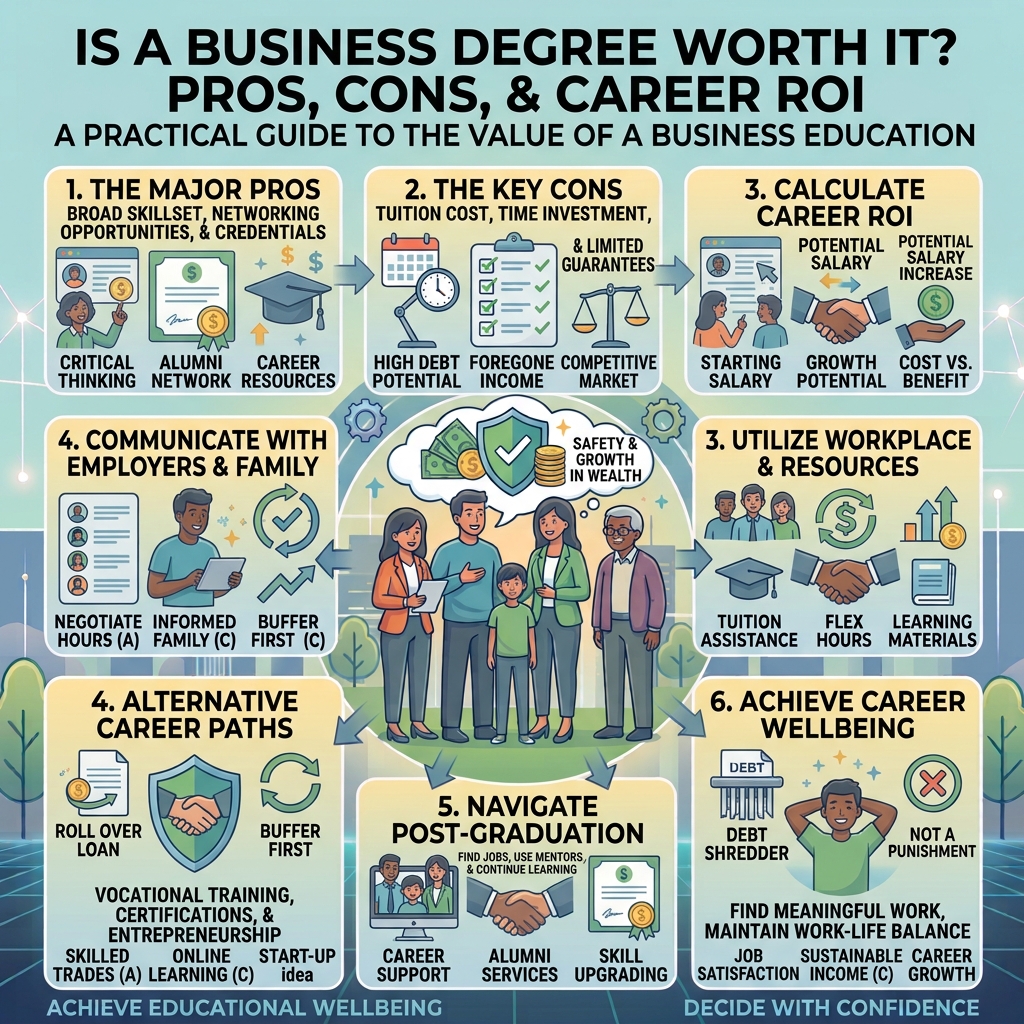
Is a Business Degree Worth It? Pros, Cons, and Career ROI
Whether you are a high school graduate mapping out your university options, a working professional seeking a promotion, or an aspiring entrepreneur, deciding to pursue a business degree is a major life decision.
Business majors remain among the most popular academic choices worldwide. However, earning a degree requires a massive commitment of time, energy, and financial capital. With rising tuition costs and alternative learning avenues available today, many prospective students ask: Is a business degree actually worth the investment?
The short answer: Yes, for most students, a business degree offers a strong positive Return on Investment (ROI)—provided your career goals align with what the degree delivers.
Here is a comprehensive look at what a business degree involves, the key benefits and drawbacks, financial ROI metrics, and how to decide if it is the right path for you.
What Is a Business Degree?
A business degree is an academic credential focused on the operational, financial, and strategic mechanics of organizations. Programs range from broad foundational degrees to highly specialized graduate credentials.
[Undergraduate / Foundational] ──> BBA / BS in Business (Broad business functions)
                                           │
                                           ▼
[Specialized / Advanced]        ──> MBA / MS Degrees (Finance, Marketing, Analytics, HR)
- Generalist Degrees: Programs such as a Bachelor of Business Administration (BBA) or Bachelor of Management cover a broad spectrum of core functions—including accounting, corporate finance, marketing, operations, and organizational leadership.
- Specialized Degrees: Advanced programs, such as a Master of Business Administration (MBA) or a specialized Master of Science (MS), allow students to master a single discipline—such as financial engineering, supply chain management, human resources, or digital marketing.
6 Major Pros of Getting a Business Degree
1. High Financial Return on Investment (ROI)
According to data analyzed by The Foundation for Research on Equal Opportunity (FREOPP), business degrees deliver a positive ROI 98% of the time. This means that the vast majority of business graduates earn significantly more over their working careers than the total cost of their tuition and lost income while studying.
2. Highly Transferable Skill Set
Unlike niche technical degrees that restrict you to a single industry, a business degree teaches universal skills needed across every sector:
- Budgeting, corporate finance, and financial reporting.
- Data analysis, market trend forecasting, and strategic planning.
- Project management, team supervision, and executive communication.
- Creative problem-solving and risk mitigation.
3. Career Flexibility Across Industries
Every industry—from healthcare and technology to media, sports, and green energy—requires skilled business professionals to manage finances, lead teams, and drive growth. A business degree gives you the flexibility to switch industries without starting your career over from scratch.
4. Fast-Tracked Career Advancement
When competing against peers for management or executive roles, holding a business degree (especially an advanced credential like an MBA) often gives you a distinct advantage. It signals to employers that you understand broader corporate strategy beyond day-to-day task execution.
5. Access to Powerful Professional Networks
One of the most valuable aspects of business school is the network you build. Top business programs provide access to:
- Extensive alumni networks in leading global firms.
- Dedicated career resource centers and corporate recruiting events.
- Peers, mentors, and potential co-founders for future business ventures.
6. Solid Stepping Stone for Advanced Degrees
A bachelor’s degree in business establishes a strong baseline if you eventually plan to pursue an MBA, a Master’s in Finance, or a specialized law or executive leadership degree later in your career.
4 Cons and Challenges to Consider
While the advantages are significant, you should evaluate these common hurdles before enrolling:
| Challenge | Impact on Students | How to Manage It |
| High Financial Cost | Tuition, materials, and lost earning time can accumulate significant student debt. | Apply for scholarships, leverage employer tuition assistance, or start at a low-cost community college. |
| Time & Effort Demands | Rigorous coursework in quantitative subjects (accounting, statistics, economics) demands total focus. | Build strong time-management habits and utilize study groups. |
| High Market Competition | Because business is a popular major, standing out in entry-level job markets requires extra effort. | Secure real-world internships, earn industry certifications, and build a strong LinkedIn presence. |
| Requires Genuine Interest | Pursuing a business degree purely for money without personal interest often leads to burnout. | Align your major with your natural strengths (e.g., analytical vs. creative/interpersonal). |
Do You Need a Business Degree to Start Your Own Business?
A common question among aspiring founders is whether they need a business degree to launch a startup.
[Do You Need a Business Degree to Launch a Startup?]
                         │
        ┌────────────────┴────────────────┐
       NO                                YES (Helpful)
        │                                 │
  • Brilliant product ideas               • Navigating financial statements & tax compliance
  • Self-taught execution                 • Pitching venture capital investors
  • Practical field experience            • Managing cash flow & scaling operations safely
Strictly speaking, you do not need a degree to be an entrepreneur. Many successful founders are self-taught or learn through real-world trial and error.
However, a formal business education provides key advantages for founders:
- Financial Literacy: Helps you read balance sheets, manage cash flow, and avoid costly tax or accounting errors.
- Risk Mitigation: Teaches risk assessment methodologies to prevent early-stage capital losses.
- Investor Readiness: Prepares you to craft professional business plans and pitch decks to raise capital from banks or angel investors.
High-Demand Business Careers & Earning Potential
A business degree opens doors to diverse, high-paying career tracks. According to official labor statistics, top business roles feature competitive median salaries:
- Financial Managers: Oversee corporate investment strategies and financial health (Median annual pay: $130,000+).
- Sales Managers: Lead commercial distribution and sales teams (Median annual pay: $130,000+).
- Human Resources Managers: Direct talent acquisition and workplace operations (Median annual pay: $120,000+).
- Management Analysts / Consultants: Help organizations optimize efficiency and profitability (Median annual pay: $90,000+).
- Marketing Managers: Expand brand awareness and drive customer acquisition (Median annual pay: $135,000+).
Frequently Asked Questions
Which business major is best for beginner students?
A Bachelor of Business Administration (BBA) or a Bachelor of Science in Finance or Accounting offers the broadest foundational knowledge and highest initial job market flexibility for beginners.
Do employers accept online business degrees?
Yes. Modern employers focus primarily on an institution’s regional accreditation and overall academic reputation rather than whether classes were taken online or on campus. Most accredited universities issue the exact same degree diploma for online and on-campus graduates.
Is an MBA worth it if I already have a bachelor’s degree in another field?
Yes. An MBA is specifically designed to help non-business graduates (such as engineers, healthcare workers, or arts majors) gain business leadership skills to pivot into managerial and executive roles.
Quick Action Checklist
- [ ] Define Your Ultimate Career Goal: Decide whether you want to climb the corporate ladder, pivot industries, or launch your own company.
- [ ] Run an ROI Calculation: Compare prospective program tuition costs against the average starting salary of graduates from those schools.
- [ ] Explore Financial Aid: Check for academic scholarships, state grants, or employer tuition assistance programs.
- [ ] Evaluate Online vs. On-Campus Options: Decide if an online or part-time format works best to balance your income while studying.