
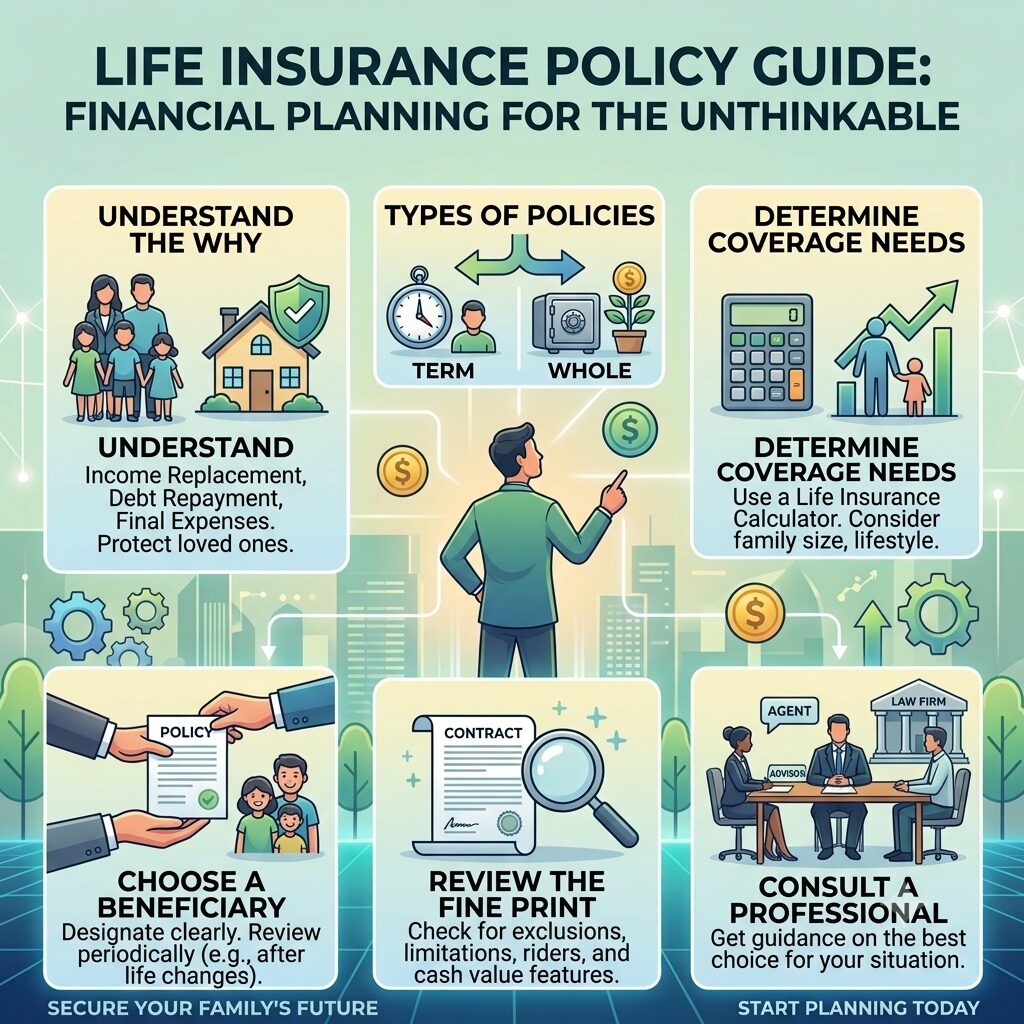
Life Insurance Policy Guide: Financial Planning for the Unthinkable
No one wants to talk about death. It is uncomfortable, sad, and completely unromantic. When people think about the future with their loved ones, they picture road trips, career wins, and quiet weekends—not funeral homes or legal paperwork.
But part of building financial independence is preparing for the unexpected. If a primary earner or family member passes away, the emotional toll is devastating. If you do not have a financial safety net in place, that emotional heartbreak is immediately multiplied by severe financial stress. Suddenly, the surviving family members are left struggling to pay for everyday living expenses, the rent or mortgage, and car payments.
Having a solid life insurance policy ensures that if the unthinkable happens, the people you care about are protected. Whether you are a teenager learning the ropes of personal finance or an absolute beginner looking to secure your family’s future, this comprehensive guide will break down how life insurance works, the different types available globally, and how to build a plan that fits your budget.
What is a Life Insurance Policy? (The Basics)
At its core, a life insurance policy is a legal contract between you and an insurance company.
How it works: You agree to pay a small, regular amount of money (called a premium) every month. In exchange, the insurance company promises that if you pass away while the contract is active, they will pay a large tax-free lump sum of money (called a death benefit) to the people you choose (your beneficiaries).
Think of it like paying a small monthly subscription for a massive financial umbrella. If it never rains, you just pay your subscription. But if a massive storm hits, that umbrella opens up to keep your family dry and financially safe.
Many young adults assume they do not need to think about a life insurance policy until they have children or buy a home. However, securing protection early is incredibly smart. Even without dependents, it ensures your partner or parents aren’t saddled with sudden funeral costs or shared debts you took out together.
Term vs. Permanent Life Insurance: The Two Main Options
When shopping for coverage, you will primarily choose between two main categories of insurance. Understanding the difference is crucial so you do not buy a product that is wrong for your goals.
1. Term Life Insurance (The Affordable Shield)
This option provides coverage for a specific chunk of time—a “term” of 10, 20, or 30 years.
- How it works: You pay a fixed monthly premium, and if you pass away during those 25 years, the policy pays out. If the term ends and you are still healthy, the coverage simply stops.
- Why it is popular: It is incredibly cheap. Because it has an expiration date, insurance companies can offer massive payouts for very low monthly costs. Depending on your age and health, a young person can often secure a major policy for the price of a couple of takeout coffees a month.
- Best for: Families who need coverage during their most vulnerable years—like while raising kids or paying off a 30-year home loan.
2. Permanent Life Insurance (The Whole Life Option)
Unlike term insurance, permanent life insurance covers you for your entire lifetime, as long as you keep paying the premiums.
- How it works: A portion of your monthly payment goes toward the insurance safety net, while another portion goes into a built-in savings element. This savings portion accumulates a cash value over time, which means it appreciates and acts like a small investment fund that you can borrow against while you are still alive.
- The Catch: Because it lasts forever and includes a savings account, the monthly premiums are drastically higher—often five to ten times more expensive than term insurance for the exact same payout amount.
- Best for: High-earning individuals looking for complex investment vehicles or long-term estate planning strategies.
Global Framework: What Insurance Looks Like Across Borders
While the basic math of a life insurance policy is the same everywhere, different countries use slightly different terms, tax rules, and structures.
- United States: Most individual policies are completely separate from government programs. Payouts are generally 100% tax-free to beneficiaries, and families frequently combine them with private trust funds.
- United Kingdom: Often referred to as “Life Assurance” if it is a permanent policy, or “Life Cover.” Many people tie their policies directly to their home mortgages to ensure the debt is instantly paid off if they pass away.
- Canada: Offers unique “Joint First-to-Die” policies for couples, which pay out when the first partner passes away, instantly helping the survivor manage shared family costs.
- Australia: Uniquely, most Australians automatically receive basic life insurance through their compulsory retirement accounts (known as Superannuation). However, these automatic policies are often quite low, meaning individuals usually need to buy extra private cover to protect a family fully.
Case Studies: Two Families, Two Distinct Results
Let’s look at how two different families approached their financial protection plans.
Scenario A: Marcus and Chloe’s Proactive Choice
Marcus and Chloe were in their late 20s when they had their first child. Money was tight, but they decided to prioritize a 20-year term life insurance policy for Marcus, who was the main earner.
- The Plan: They shopped around, compared three top companies, and locked in a $500,000 policy for a low, fixed monthly premium.
- The Outcome: Sadly, Marcus passed away unexpectedly in a car accident eight years later. Because the policy was active, Chloe received the $500,000 payout completely tax-free. It allowed her to pay off the remaining home loan, take time off work to support their child through grief, and keep their family home stable during a tragic time.
Scenario B: Ryan and Tara’s Workplace Reliance
Ryan and Tara decided not to buy private insurance because Ryan’s employer offered a basic life coverage benefit through his job.
- The Plan: They relied entirely on the free corporate benefit, assuming they were completely safe.
- The Outcome: At age 42, Ryan changed industries and left his job to start a small independent business. Two years later, he became severely ill and passed away. Because his insurance was tied exclusively to his old job, he had zero coverage when he died. Tara was left to manage their mortgage and daily expenses entirely on her own, resulting in severe financial hardship.
The Critical Role of Wills and Estate Planning
Buying a life insurance policy is only half the battle. You also need to state exactly who gets your assets when you pass away. This is called estate planning—which is just a professional term for mapping out how your money, property, and possessions are managed and distributed after you are gone.
The most important tool in estate planning is a will. If you die without a valid will, you die “intestate.” This means your local government and a specialized court system (known as a probate court) get to decide who receives your money, your home, and even who becomes the legal guardian of your underage children. This court process can take months, cost thousands in legal fees, and cause major family arguments.
Pro-Tip on Wills: While you can technically write your wishes on a plain piece of paper, sign it, date it, and have it witnessed, it is incredibly easy to make mistakes that render it invalid in court. For long-term peace of mind, use reputable digital legal tools or speak with a local estate attorney to ensure your intentions are legally ironclad.
Quick Comparison: Workplace vs. Individual Policies
Many people assume their workplace benefits provide enough protection. Let’s compare a corporate policy against a private, individual life insurance policy:
| Feature | Workplace Coverage | Individual Private Policy |
|---|---|---|
| Portability | ✗ You lose it if you quit, change jobs, or get laid off. | ✓ Stays with you no matter where you work. |
| Customization | ✗ Basic cookie-cutter amounts based on generic group rates. | ✓ Tailored exactly to your specific debt and income needs. |
| Price (Under 40) | 📷 Can be more expensive because it averages out unhealthy workers. | ✓ Very cheap if you are young and in good physical health. |
| Medical Exams | ✓ Usually zero health checks required to sign up. | ✗ Often requires a basic physical exam or health check to qualify. |
Common Pitfalls to Avoid
Over-Shopping and the “Bait-and-Switch”
When looking for a policy, compare rates across a maximum of three reputable insurance firms. If you spend months inputting your details everywhere, you will run into premium traps. Some companies will quote a beautifully cheap initial rate online, only to dramatically raise the price after you complete their medical questionnaire or blood test. Find a competitive, fair rate from a trusted provider and lock it in.
Forgetting to Update Beneficiaries
Life moves fast. People get married, have kids, or experience divorces. If you bought a policy ten years ago and listed an ex-partner or a sibling as the beneficiary, that person legally gets the money when you pass away—regardless of what your current family situation looks like. Review your policy details every few years to make sure the money goes exactly where it is needed.
Quick Action Checklist
- [ ] Calculate Your Number: Add up your major debts (like a mortgage or car loan) plus five years of your current income to find your target insurance payout amount.
- [ ] Get Three Quotes: Request simple term insurance quotes from three separate, highly rated insurance providers to compare baseline monthly costs.
- [ ] Check Your Workplace Benefits: Log into your employment portal or talk to human resources to see exactly what temporary life or disability coverage you currently have.
- [ ] Draft a Simple Will: Protect your family by creating an official document that names your beneficiaries and assigns a trusted guardian for any children or pets.
Disclaimer: The content on this website is for informational and educational purposes only and should not be construed as professional financial, investment, tax, or legal advice. I am not a licensed financial advisor. While I strive to keep the information accurate and up to date, financial markets and laws change frequently. Always consult with a qualified financial professional before making any financial or investment decisions based on the information provided on this site.