
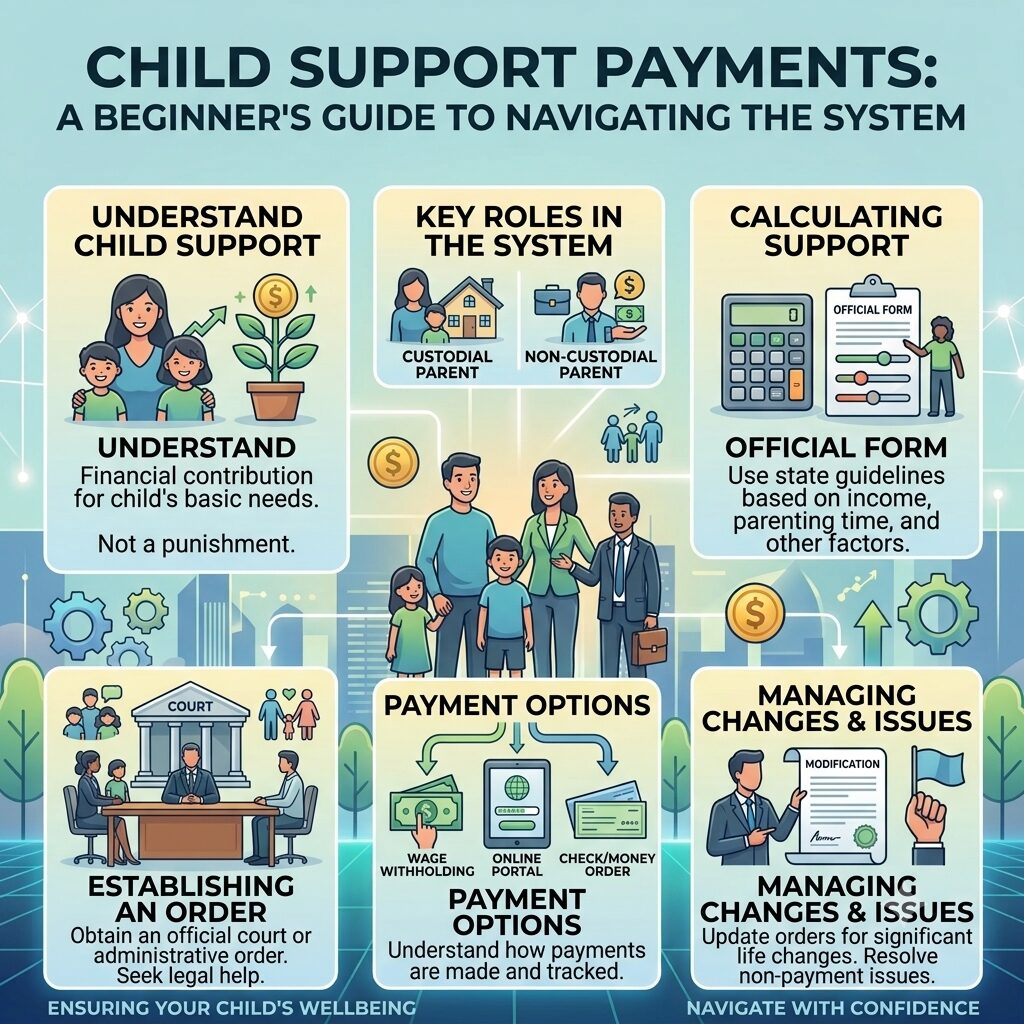
Child Support Payments: A Beginner’s Guide to Navigating the System
Raising a child is one of the most rewarding journeys in life, but let’s be entirely honest—it is also incredibly expensive. From groceries and clothing to childcare and school supplies, the everyday costs of parenting add up quickly. In fact, standard economic data shows that the baseline cost of raising a child to adulthood routinely climbs well past a quarter-million dollars.
When parents do not live together, splitting these structural expenses can become a massive source of stress and conflict. Whether you are a custodial parent (the primary caregiver who lives with the child most of the time) trying to secure fair financial help, or a parent who is falling behind on your mandatory child support payments, the financial and legal systems can feel completely overwhelming.
The good news is that you do not need to navigate this alone. This guide breaks down exactly how child support works globally, how to manage your family budget during a split, and how to find free community resources to keep your child’s future secure.
What Exactly is Child Support?
At its core, child support is a regular, court-ordered cash transfer paid by one parent to the other to help cover the everyday costs of raising their shared children.
The Golden Rule of Co-Parenting Finance: Child support is not a punishment for one parent, nor is it a financial jackpot for the other. Legally and ethically, child support belongs entirely to the child. It is designed to ensure that the child enjoys a stable standard of living, regardless of which parent’s house they are sleeping at on any given night.
Many people avoid using the formal legal system because they lack time, money, or feel intimidated by courthouses. However, leaving child support up to casual, verbal agreements often leads to broken promises and deep resentment. Keeping a formal agency or court involved protects both sides by setting clear, binding rules based on real data.
How Child Support is Calculated Across the Globe
Every country handles family law a bit differently, but almost all modern legal systems calculate child support payments using specific math formulas rather than random guesswork. These formulas look at both parents’ income levels and how much physical time the child spends with each person.
Here is a quick look at how different countries handle these calculations:
- United States: Most states use either the “Income Shares Model” (which combines both parents’ income and splits the cost proportionally) or the “Percentage of Income Model” (which takes a fixed percentage of the non-custodial parent’s income).
- United Kingdom: Managed by the Child Maintenance Service (CMS). They calculate payments using a strict formula based on the paying parent’s gross weekly income, their tax records, and the number of nights the child stays with them each year.
- Canada: Uses the Federal Child Support Guidelines. The required “table amount” is determined simply by the paying parent’s gross annual income and the total number of children.
- Australia & New Zealand: Both countries use a comprehensive formula system run by central government tax agencies. They evaluate the costs of children based on the combined income of both parents, subtract a baseline self-support reserve, and adjust the total based on care percentages. They even have a reciprocal agreement to enforce payments across borders.
Step-by-Step Guide: What to Do if You Fall Behind
Life happens. Sudden changes—like losing a job, losing healthcare benefits, or facing an unexpected medical crisis—can cause anyone’s finances to fall apart. If you are the parent responsible for making child support payments and you suddenly cannot afford them, you must act immediately.
Ignoring the problem will not make it go away; instead, it triggers severe legal penalties.
1.Communicate Immediately:Do not ignore the system.
As soon as you lose your job or experience a financial drop, contact your local child support agency or the other parent. Do not simply stop paying without warning.
2.Document Your Financial Hardship:Gather paper proof.
Collect physical evidence of your income change. This means gathering your formal redundancy letter, final pay slips, termination notices, or medical bills.
3.File for an Official Modification:Ask for a recalculation.
Child support orders do not automatically adjust when your income drops. You must formally request a “modification” from the agency or court. The court will review your new paperwork and may lower your monthly payment to a level you can actually afford based on your current reality.
Warning for Paying Parents: If you stop paying without a formal court modification, the system will track your unpaid balance as “arrears” (debt). This debt cannot easily be erased, and the state can garnish your wages, seize your tax refunds, suspend your driver’s license, or even pursue criminal charges.
Case Studies: Two Different Approaches to Support
Let’s look at two hypothetical scenarios to see how communication and organization impact child support outcomes.
Scenario A: Jordan’s Accurate Budget Strategy
Jordan is a custodial parent raising two young kids. Her ex-partner was consistently late with payments, claiming that Jordan was asking for way too much money just to punish him.
- The Action: Instead of getting angry, Jordan built a bulletproof family budget. She used a free digital spreadsheet to track every single kid-related expense for three months—keeping copies of receipts for groceries, school uniforms, and dental visits. She took this organized data directly to a local legal clinic.
- The Result: When they sat down with a case officer, Jordan presented factual, realistic numbers rather than emotional guesses. The official checked the local formula, found her numbers completely reasonable, and set up an official payment schedule that was fair to both sides. Because the numbers were clear, the conflict stopped.
Scenario B: David’s Avoidance Trap
David lost his factory job when the business downsized. Because he was embarrassed and stressed, he completely stopped communicating with his ex-spouse and stopped making his child support payments.
- The Action: David assumed that because he had no income, the court would automatically understand. He ignored letters from the state family agency and avoided opening his mail for six months.
- The Result: Because David never filed for an official modification, his debt kept building at the original rate. The state eventually suspended his driver’s license, making it incredibly difficult for him to travel to job interviews and get back on his feet. It took him years of extra stress to resolve the legal freeze.
Using Free Community Resources and Counseling
Many child support arguments have nothing to do with the actual math. Often, a parent refuses to pay because they disagree with how the child is being raised, or because there is deep emotional distrust between the former partners.
Instead of spending thousands of dollars on expensive private lawyers—money that should be going toward your child’s well-being—look into local community measures first:
- Free Legal Clinics: Most cities and regions have non-profit legal clinics or university law schools that offer free advice on how to correctly fill out family court paperwork.
- Sliding-Scale Family Counseling: If emotional tension or parenting disagreements are blocking successful communication, look for non-profit counseling services. Many offer a “sliding-fee scale,” which means the cost of the therapy session drops based on what you can afford to pay.
- Non-Profit Credit Counseling: If poor budgeting habits or a personal debt crisis are preventing a parent from making their payments, encourage them to seek free credit counseling. A certified counselor can help them build a manageable budget, manage their debt, and get their finances stable enough to support their family.
Common Pitfalls to Avoid
Inflating Your Expenses
When presenting your family budget to a court or case officer, never inflate your numbers with unnecessary luxury expenses in an attempt to maximize the payment or punish the other parent. Judges see right through this. An honest, straightforward number crunch speaks volumes. If your numbers are unrealistic, the court may reject your claims, making the process much longer and harder.
Mixing Visitation with Financial Support
This is the most common mistake co-parents make. Legally, child support and visitation rights are completely separate issues. A custodial parent cannot lock the front door and block visitation just because the other parent is late on a payment. Likewise, a non-custodial parent cannot withhold their child support payments just because they are angry about a missed weekend visit. Breaking these rules puts you in direct violation of the law.
Quick Action Checklist
- [ ] Track Every Expense: Spend the next 30 days saving every receipt and logging every child-related cost into a dedicated budget file or app.
- [ ] Locate Your Local Agency: Find the official government child support portal for your specific state, territory, or country to see what rules apply to you.
- [ ] Review Income Files: Gather your last three months of income statements, tax returns, and any current support orders so your records are fully up to date.
- [ ] Schedule Free Guidance: If you are stuck or experiencing high conflict, look up a local non-profit family clinic or credit counselor to get professional, low-cost mediation help.
Disclaimer: The content on this website is for informational and educational purposes only and should not be construed as professional financial, investment, tax, or legal advice. I am not a licensed financial advisor. While I strive to keep the information accurate and up to date, financial markets and laws change frequently. Always consult with a qualified financial professional before making any financial or investment decisions based on the information provided on this site.