What Is Financial Literacy? A Beginner’s Guide to Money Management
There is a common misconception that to be good with money, you need to be a math genius.
In reality, financial literacy is not the same as mathematical literacy. You do not need to understand complex calculus or high-level algebra to build a secure financial future. Financial literacy is simply about understanding how money works in everyday life—how you earn it, where it goes, and how to use it as a tool to protect your family and achieve your goals.
Unfortunately, despite how straightforward money management can be, there is a staggering lack of personal finance education in modern society. Most traditional school systems do not teach basic budgeting, taxes, or investing, leaving millions of adults to figure it out on their own.
Whether you are employed, looking for work, or simply trying to get a better grip on your personal bank accounts, this guide breaks down what financial literacy actually means, why it matters, and how you can start building your money skills today.
What Does It Mean to Be Financially Literate?
Being financially literate means having the foundational knowledge and confidence to effectively manage, save, and grow your money.
To test your current level of financial health, ask yourself these core questions:
[Income Source] ──> How do you earn your money?
                          │
                          ▼
[Cash Flow Check] ─> Where does your money go when it leaves your account?
                          │
                          ├─> EXPENSES (Consumables, bills, debt interest)
                          └─> ASSETS (Savings, investments, income-generators)
- Do you know exactly how much money comes in each month?
- Do you track where your money goes when it leaves your wallet?
- When you spend money, is it going toward an asset (something that grows in value) or an expense (something consumed immediately)?
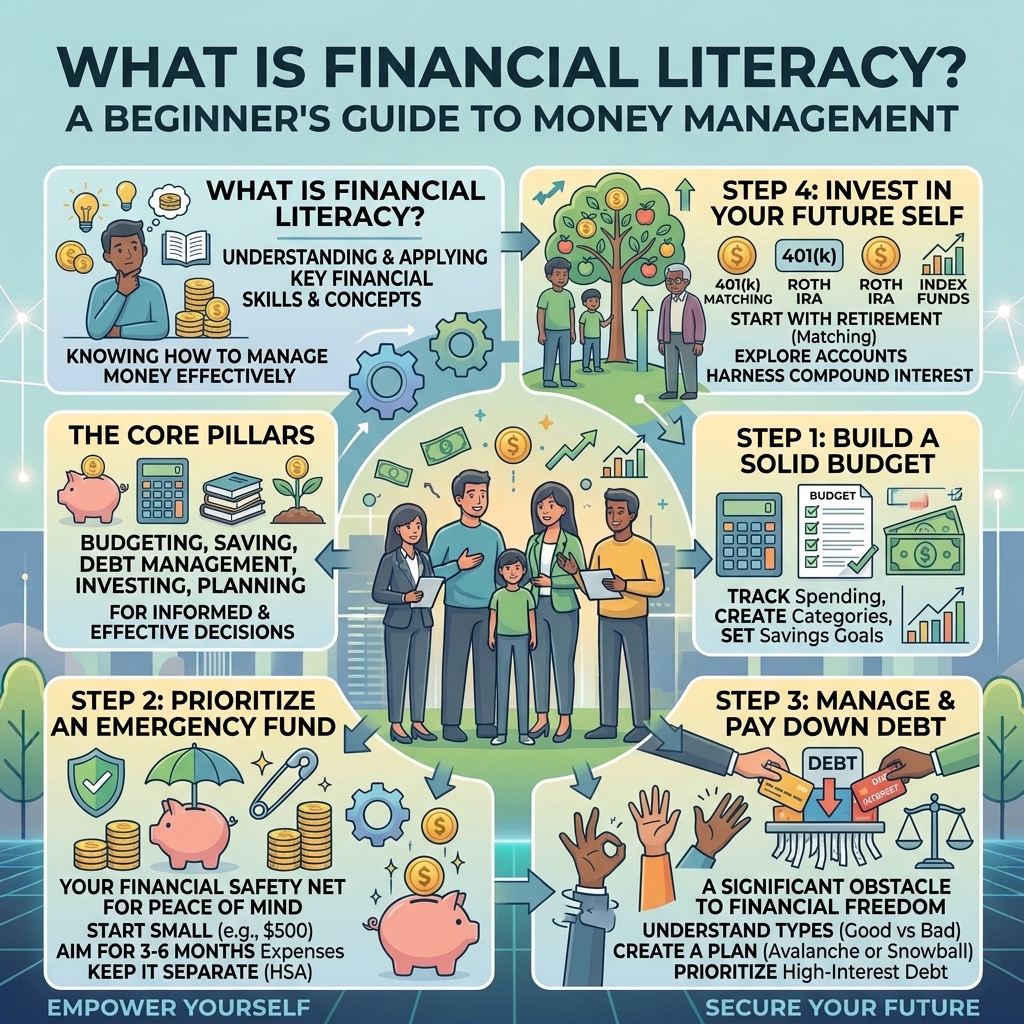
Financial literacy covers a range of everyday topics, including managing debt, building an emergency fund, understanding credit card terms, buying a home, planning for retirement, and filing taxes.
Why Financial Literacy Matters: The Numbers
When people lack basic financial knowledge, the consequences can be severe. A lack of money management skills often leads to high debt loads, inadequate savings, and ongoing financial stress.
Look at these eye-opening personal finance benchmarks across American households:
| Metric / Benchmark | Population Impact | Key Takeaway |
| Financially Healthy Households | ~28% of adults | Over 70% of adults struggle with overall financial stability. |
| Emergency Fund Reserve | ~44% cannot cover a $400 bill | Minor unexpected expenses often force families into high-interest debt. |
| Retirement Readiness | ~56% have under $10,000 saved | Over half of adults risk relying solely on basic state benefits in old age. |
| Credit Card Debt | ~38% carry balances month-to-month | Millions pay heavy interest charges on everyday purchases unnecessarily. |
8 Practical Ways to Improve Your Financial Literacy
Improving your financial knowledge does not require an expensive business degree. It is a deliberate, step-by-step process that you can drive entirely on your own.
Here are eight simple ways to start educating yourself today:
1. Leverage Free Public & Government Resources
Governments and non-profit organizations offer extensive free education. In the United States, resources like MyMoney.gov and the Financial Literacy and Education Commission provide free guides on buying a home, managing checkbooks, and understanding workplace retirement plans like 401(k)s.
2. Read Beginner-Friendly Books
You do not need dense economic textbooks to learn personal finance. Look for introductory books on budgeting, debt elimination, and micro-investing written specifically for starters. Committing just 15 to 20 minutes a day to reading can transform your financial knowledge within a few months.
3. Use Modern Budgeting Tools & Apps
Technology makes tracking expenses easier than ever. Popular personal finance platforms—such as YNAB (You Need A Budget), Mint, Personal Capital, and Blooom—help you visualize your cash flow, track debt payoffs, and monitor your overall net worth automatically.
4. Listen to Finance Podcasts and Audio Content
If you have a busy daily routine or commute, audio platforms are an efficient way to absorb financial advice. Shows hosted by seasoned money mentors offer real-world Q&As, breaking down complex topics like credit scores, mortgages, and investing into clear, conversational lessons.
5. Follow Trusted Experts on Social Media
Curate your social media feeds to include verified financial educators and counselors. Following experts who explain financial jargon in plain language keeps healthy money habits top of mind every time you open your phone.
6. Take Free Online Courses
Many digital platforms and adult education centers offer free introductory courses on personal budgeting, tax basics, and retirement planning. Structured learning helps you tackle one specific topic at a time until you feel confident.
7. Connect with Qualified Financial Professionals
If you have complex questions regarding debt consolidation, mortgage applications, or tax strategies, speak directly with a certified financial planner or credit counselor. A brief consultation can help you craft a clear plan tailored to your specific situation.
8. Focus on One Financial Topic at a Time
Trying to learn everything about taxes, real estate, stock markets, and estate planning all at once is overwhelming. Pick one topic that directly affects your current life—such as building a $1,000 emergency fund—and master it before moving on to the next.
Key Benefits of Being Financially Literate
- Total Control and Confidence: Understanding your numbers eliminates the constant fear of checking your bank balance. You gain the confidence to make proactive choices for your future.
- Protection Against Scams and Fraud: Financially literate individuals can quickly spot high-risk “get rich quick” schemes, predatory loan offers, and deceptive financial products.
- Faster Debt Elimination: Knowing how interest rates work allows you to prioritize paying off high-cost debt faster, saving you thousands in interest charges.
- Long-Term Wealth Building: When you understand compound interest and low-cost investing, every extra dollar you save works quietly in the background to build your net worth.
Frequently Asked Questions
Do I need to be good at math to manage my personal finances?
Not at all. Personal finance relies on basic addition, subtraction, and simple percentage calculations—all of which can be handled easily with a standard phone calculator or free budgeting app. The hardest part of personal finance is behavior and discipline, not mathematics.
What is the very first step to becoming financially literate?
Start by tracking your monthly cash flow. List your total monthly income alongside all your fixed expenses (rent, utilities, debt payments) and variable expenses (groceries, entertainment). Knowing where every dollar goes is the foundation for all financial progress.
Quick Action Checklist
Ready to build your financial literacy? Complete these four quick steps:
- [ ] Audit Your Cash Flow: Write down your exact income and top 5 monthly expense categories on a piece of paper or spreadsheet.
- [ ] Download a Budgeting App or Tool: Select a free personal finance app to start tracking your daily transactions automatically.
- [ ] Choose One Focus Area: Select the single topic most relevant to you today (e.g., building emergency savings or paying off a credit card).
- [ ] Bookmark Free Learning Outlets: Save official educational platforms like MyMoney.gov to review simple guides whenever you have a free 10 minutes.
Disclaimer: The content on this website is for informational and educational purposes only and should not be construed as professional financial, investment, tax, or legal advice. I am not a licensed financial advisor. While I strive to keep the information accurate and up to date, financial markets and laws change frequently. Always consult with a qualified financial professional before making any financial or investment decisions based on the information provided on this site.