
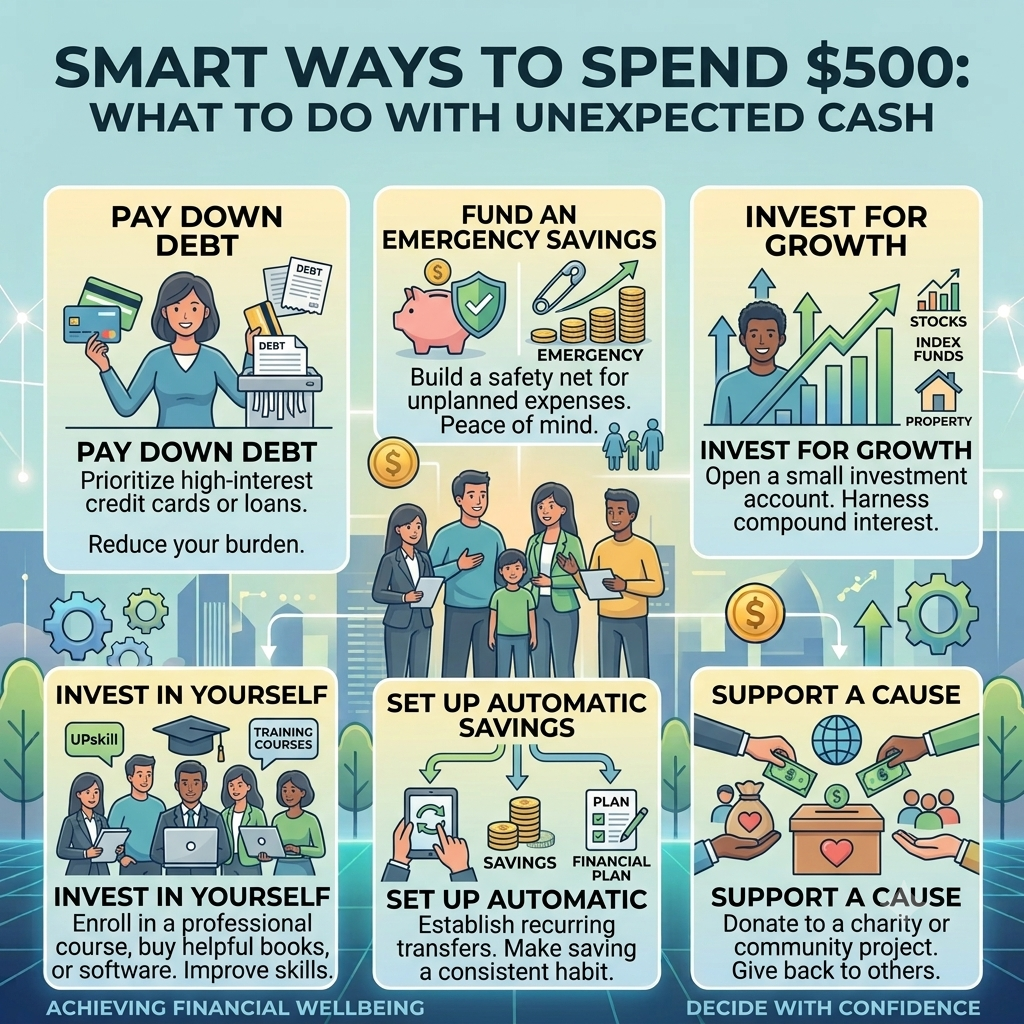
Smart Ways to Spend $500: What to Do with Unexpected Cash
Few things feel better than an unexpected cash windfall. Maybe it is an invoice you completely forgot about, a larger tax refund than you expected, a birthday gift, or a bonus at work.
Unexpected cash feels like “free money.” Because you didn’t budget for it, it can be tempting to spend it instantly on a weekend trip or a shopping spree. But blowing a lump sum without a plan is one of the most common money mistakes beginners make.
The Golden Rule of Personal Finance: Tell your money where to go before you spend it. Unexpected cash is a golden opportunity to make your assets work for you, build financial security, and upgrade your life.
If you just landed an extra $500 (or the equivalent in your local currency), here are the smartest, most impactful ways to put that money to work today.
1. Build or Boost Your Emergency Fund
If you do not have an emergency fund yet, stop right here: your extra $500 should become your very first installment.
An emergency fund is a safety net of cash held in a secure, liquid bank account that you touch only for unexpected life events—like urgent medical bills, car breakdowns, or sudden job loss.
Having a cash cushion means that the next time life throws a curveball, you won’t need to swipe a high-interest credit card or take out a stressful loan.
| Goal Phase | Target Amount | What It Covers |
| Starter Fund | $500 – $1,000 | Minor surprises (car repairs, urgent travel) |
| Full Emergency Fund | 3 to 6 months of living expenses | Major shocks (job loss, prolonged illness) |
2. Crush High-Interest Debt
If you carry credit card balances or high-interest loans, putting $500 directly toward your principal balance gives you an instant, guaranteed return on your investment.
While $500 might not erase a massive loan entirely, it can easily wipe out a smaller store card balance or significantly reduce the interest you pay every month.
Why Debt Repayment Beats Spending: Being debt-free is the ultimate foundation of financial freedom. Once you stop paying heavy interest charges to banks, every dollar you earn stays in your pocket to build real wealth.
3. Start Micro-Investing in the Stock Market
You do not need thousands of dollars to start investing. Modern digital platforms and low-cost funds allow absolute beginners to enter the stock market with as little as $50 or $500.
If you have never invested before, placing your money into an Exchange-Traded Fund (ETF) is one of the safest ways to start. An ETF is a bundle of hundreds of different company stocks sold as a single package.
Instead of betting your entire $500 on one risky company, an ETF spreads your money across major global businesses—such as those in the S&P 500 index—giving you instant diversification and low management fees.
4. Fund Your Future Retirement
Thinking about retirement in your 20s or 30s can feel premature, but starting early is the single greatest advantage you can give yourself. Thanks to compound interest—where your earnings generate their own earnings over time—a single $500 contribution today can grow into thousands by the time you stop working.
Depending on where you live, look into tax-advantaged account structures:
- United States: Fund a Roth IRA or contribute to an employer-sponsored 401(k) (especially if your employer matches your deposit).
- United Kingdom: Put the funds into a Personal Pension or a Stocks & Shares ISA.
- Canada: Deposit the money into a TFSA (Tax-Free Savings Account) or an RRSP.
- Australia: Make a voluntary contribution to your Superannuation fund.
5. Invest in Yourself and Upgrade Your Career
When managing money, you can focus on two things: spending less or earning more. Upgrading your skills is the fastest way to boost your income over a lifetime.
Using $500 to earn an industry-recognized professional certification, attend a high-value skill workshop, or take a specialized software course can give your resume an immediate upgrade.
If that $500 certificate helps you land a new position or leverage a 10% salary raise at your next performance review, that initial investment pays for itself many times over.
6. Seed an Education or College Savings Fund
If you have children (or plan to in the future), starting an education fund with an unexpected $500 gives your kids a massive head start. Student loan debt is a heavy burden for young adults entering the workforce. By starting early with a dedicated account—such as a 529 Plan in the US, an RESP in Canada, or a Junior ISA in the UK—you give that initial deposit years to grow tax-free.
Case Studies: Two Ways to Handle a $500 Windfall
Let’s look at how two different people handled receiving an unexpected $500 tax refund.
Scenario A: Maya’s High-Yield Plan
Maya received a $500 tax refund. Instead of leaving it in her daily checking account where it would slowly disappear on coffee and online shopping, she split the money intentionally.
- The Action: Maya put $300 into a high-yield emergency savings app and used the remaining $200 to purchase a professional project management certification course online.
- The Result: Six months later, Maya used her new certification to secure a promotion at work, increasing her monthly salary by $350 while keeping her $300 emergency safety net intact.
Scenario B: Sam’s Impulse Spend
Sam received the same $500 tax refund and spent it immediately on designer clothes and a weekend night out.
- The Action: Sam enjoyed the weekend, but two weeks later, his car’s alternator failed, resulting in an urgent $450 repair bill.
- The Result: Because Sam had no emergency savings, he had to charge the $450 repair to a high-interest credit card. He ended up paying high interest rates on that repair for over a year.
Pro-Tips for Managing Financial Windfalls
- Follow the 80/20 Rule: You do not have to be completely rigid. A great strategy for unexpected cash is to put 80% ($400) toward responsible goals (debt, savings, investing) and use 20% ($100) for a guilt-free reward. This protects your financial future while still letting you celebrate.
- Automate Your Decisions Immediately: The longer unexpected cash sits in your everyday spending account, the higher the chance you will spend it on small, forgettable daily purchases. Move the money to its intended destination the day you receive it.
- Prepay High-Impact Household Bills: If you already have savings and zero high-interest debt, consider prepaying one monthly mortgage, rent, or utility bill. Having your housing costs covered a month in advance provides incredible mental peace.
Common Pitfalls to Avoid
Chasing High-Risk “Get Rich Quick” Schemes
It can be tempting to throw your unexpected $500 into highly speculative assets like viral meme cryptocurrencies or volatile single stocks in hopes of doubling your money overnight. While small speculative investments can be fun, treat them as high-risk gambling. Never use money you actually need for your emergency fund or basic financial health on speculative hype.
Falling for the “Free Money” Mindset
Psychologically, people treat found money differently than money earned from a paycheck. This is known as “mental accounting.” Remember: a dollar of unexpected cash has the exact same purchasing power as a dollar you worked 40 hours to earn. Treat it with the same respect.
Frequently Asked Questions
How can I start investing with little to no money?
You can start investing with as little as $5 to $25 using micro-investing apps, fractional shares, or low-minimum mutual funds. Many digital platforms allow you to set up small, automated monthly contributions so your portfolio grows quietly in the background.
How can I make $500 fast in less than a week?
If you need to generate cash quickly, try decluttering your home to sell unused electronics or furniture on local marketplaces, taking on freelance gigs, working overtime shifts, or offering local services like yard care or dog walking.
Quick Action Checklist
Ready to make the most of your extra cash? Complete these four quick steps:
- [ ] Audit Your Safety Net: Check your current bank balances. If you have less than $1,000 in liquid savings, send your $500 straight to an emergency account.
- [ ] Check Your Debt Interest Rates: List your credit cards or loans. If any carry an interest rate above 8%, make a principal payment today.
- [ ] Open a Low-Cost Investment Account: If your savings are secure and high-interest debt is gone, set up an account with a low-cost ETF provider.
- [ ] Apply the 80/20 Split: Transfer $400 toward your financial goal and set aside $100 for a small, intentional treat.